
What is GLM-5
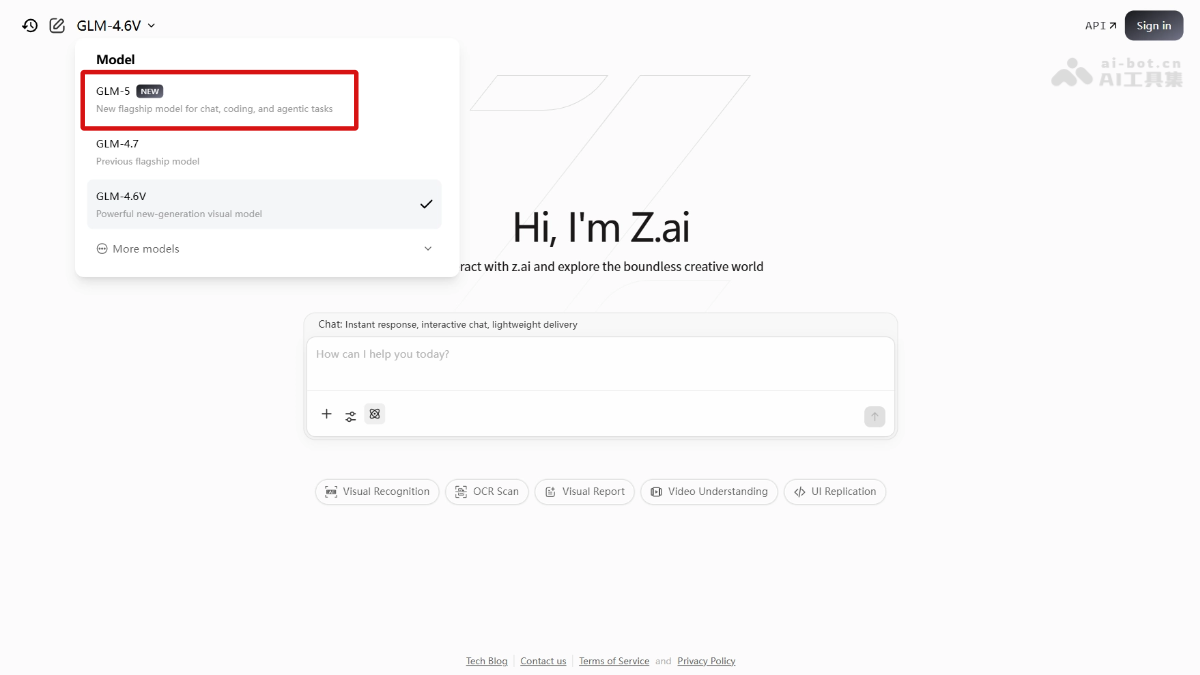
GLM-5 is Zhipu's new generation open-source flagship AI model, with parameter scale expanding fromGLM-4.5's 355B to 744B (40B activated), and pre-training data reaching 28.5T tokens. The model is the mysterious model "Pony Alpha" that previouslyOpenRoutertopped the popularity rankings. The model is designed for complex systems engineering and long-horizon Agent tasks, integrates DeepSeek Sparse Attention to reduce deployment costs, and features the self-developed slime asynchronous RL infrastructure to improve training efficiency. On the Artificial Analysis leaderboard, GLM-5 ranks fourth globally and first among open-source models. The model supports generating Office documents, is compatible withClaude Codeand other tools, and also supports deployment on domestic chips such as Huawei Ascend, Moore Threads, and Cambricon. The model is available for体验 on thez.aiofficial website,BigModel.cnplatform, and the API is now also open simultaneously.
Main features of GLM-5
-
Complex systems engineering: The model can handle multi-level technical tasks such as frontend development and backend architecture design, supporting full-process engineering delivery from requirements analysis to code implementation.
-
Long-horizon Agent tasks: It has long-term planning and resource management capabilities, and can make autonomous decisions and achieve goals in simulated business scenarios requiring continuous operation for one year, such as Vending Bench 2.
-
Intelligent document generation: It supports directly converting text or raw materials into .docx, .pdf, .xlsx and other formats, outputting professional documents ready for direct use such as PRDs, financial reports, and lesson plans.
-
Multi-tool collaboration: Compatible with Claude Code,OpenClawand other mainstream development toolchains, enabling cross-application automated operations and collaboration.
Technical principles of GLM-5
- Large-scale pre-training scaling: The model parameters expanded from 355B (32B activated) to 744B (40B activated), and pre-training data increased from 23T to 28.5T, using more compute to improve the general intelligence foundation.
- Asynchronous reinforcement learning infrastructure "Slime": The self-developed asynchronous RL training framework solves the efficiency bottleneck of reinforcement learning for large-scale language models. This infrastructure supports parallelized reward computation and policy updates, enabling finer-grained post-training iterations and effectively narrowing the gap between pre-training capabilities and actual performance.
- Sparse attention mechanism : It integrates DeepSeek Sparse Attention for the first time, greatly reducing token consumption and deployment costs in Agent scenarios while maintaining lossless long-text performance.
- Deep adaptation to domestic computing power: It has completed low-level operator optimization and hardware acceleration with domestic chips such as Huawei Ascend, Moore Threads, Cambricon, Kunlunxin, T-Head, and Metax, achieving high-throughput, low-latency inference.
Performance of GLM-5
- Reasoning ability
-
AIME 2026 I reaches 92.7%, on par withDeepSeek-V3.2, and HMMT Nov. 2025 leads most competitors at 96.9%.
-
GPQA-Diamond expert-level reasoning test scores 86.0%, and IMOAnswerBench reaches 82.5%.
- Programming ability
-
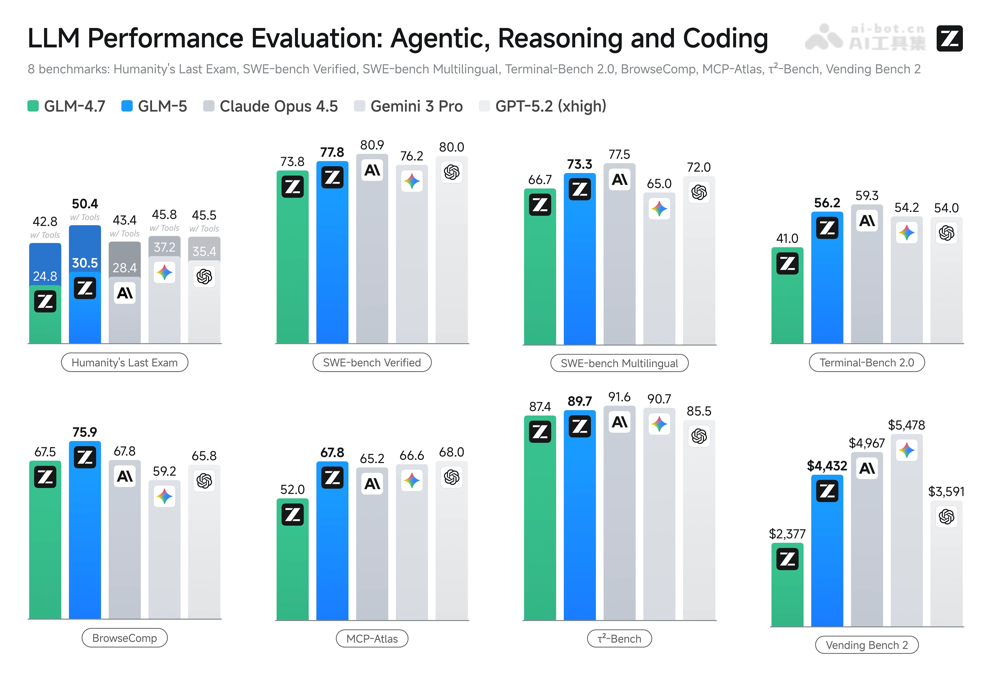
SWE-bench Verified real software engineering test scores 77.8%, and the multilingual version scores 73.3%, both improving by about 4 percentage points over GLM-4.7.
-
Terminal-Bench 2.0 terminal operation benchmark reaches 56.2%, and in the Claude Code environment it rises further to 61.1%, far exceeding GLM-4.7.
-
CyberGym cybersecurity test scores 43.2%, nearly double GLM-4.7's 23.5%, demonstrating attack and defense capabilities for complex systems.
-
- Agents and Tool Use
-
Vending Bench 2 one-year business simulation ranks first among open-source models with a $4,432 balance, approachingClaude Opus 4.5。
-
BrowseComp web browsing task 62.0%, which can be improved to 75.9% when combined with context management strategies, surpassing Kimi K2.5.
-
τ²-Bench multi-domain tool calling reaches 89.7%, MCP-Atlas public set 67.8%, Tool-Decathlon 38.0%.
-
- Overall Ranking: Artificial Analysis authoritative leaderboard: fourth globally, first among open-source.
How to Use GLM-5
- Online Experience: Visit thez.aiofficial website, manually select the GLM-5 model to try the Chat mode or Agent mode for free; the latter supports multi-tool collaboration and document generation. Access via theBigModel.cnplatform or Z.ai API service, compatible with the OpenAI format interface.
- Local Deployment
-
Download BF16/FP8 weights from HuggingFace and run them using vLLM, SGLang, or xLLM frameworks, supporting 8-GPU parallel inference.
-
In non-NVIDIA environments, deployment is possible via domestic chips such as Huawei Ascend and Moore Threads, with official targeted optimization solutions provided.
-
- Development Tool Integration
-
InClaude Code、OpenCode、Kilo Code、Roo Codeand other tools, configure the model name as "GLM-5" to call it.
-
Users who subscribe to the GLM Coding Plan can enable it directly, or useZ Codevisual environments to remotely control multi-Agent collaboration.
-
GLM-5 Project Addresses
- Project Official Website:https://z.ai/blog/glm-5
- GitHub Repository:https://github.com/zai-org/GLM-5
- HuggingFace Model Hub:https://huggingface.co/zai-org/GLM-5
GLM-5 Application Scenarios
-
Complex Systems Engineering: Supports end-to-end delivery of large projects, autonomously completing the entire process of requirement decomposition, architecture design, code implementation, and deployment.
-
Legacy System Refactoring: The model can deeply understand existing codebases and perform backend architecture optimization and modernization.
-
Deep Debugging and Repair: The model can analyze logs, locate root causes, and iteratively fix stubborn bugs until the system runs stably.
-
Agent Assistant: The model can automatically execute scheduled tasks such as searching, organizing, and publishing 24/7, becoming the user's digital intern.
-
Business Decision Optimization: Demonstrates long-term planning and resource management capabilities in simulated business scenarios, enabling intelligent strategy formulation.