
What is GLM-4.5
GLM-4.5 is Zhipu's new-generation flagship model, purpose-built for agent applications and the first open-source SOTA model to natively integrate reasoning, code, and agent capabilities. It adopts a Mixture of Experts (MoE) architecture and comes in two versions: GLM-4.5 (355 billion parameters, 32 billion activated) and GLM-4.5-Air (106 billion parameters, 12 billion activated). The model performs excellently across multiple evaluation benchmarks, with overall performance reaching the top level of open-source models, especially in code agent scenarios. It supports a hybrid reasoning mode, offering both thinking mode and non-thinking mode, balancing complex tasks and instant response needs.
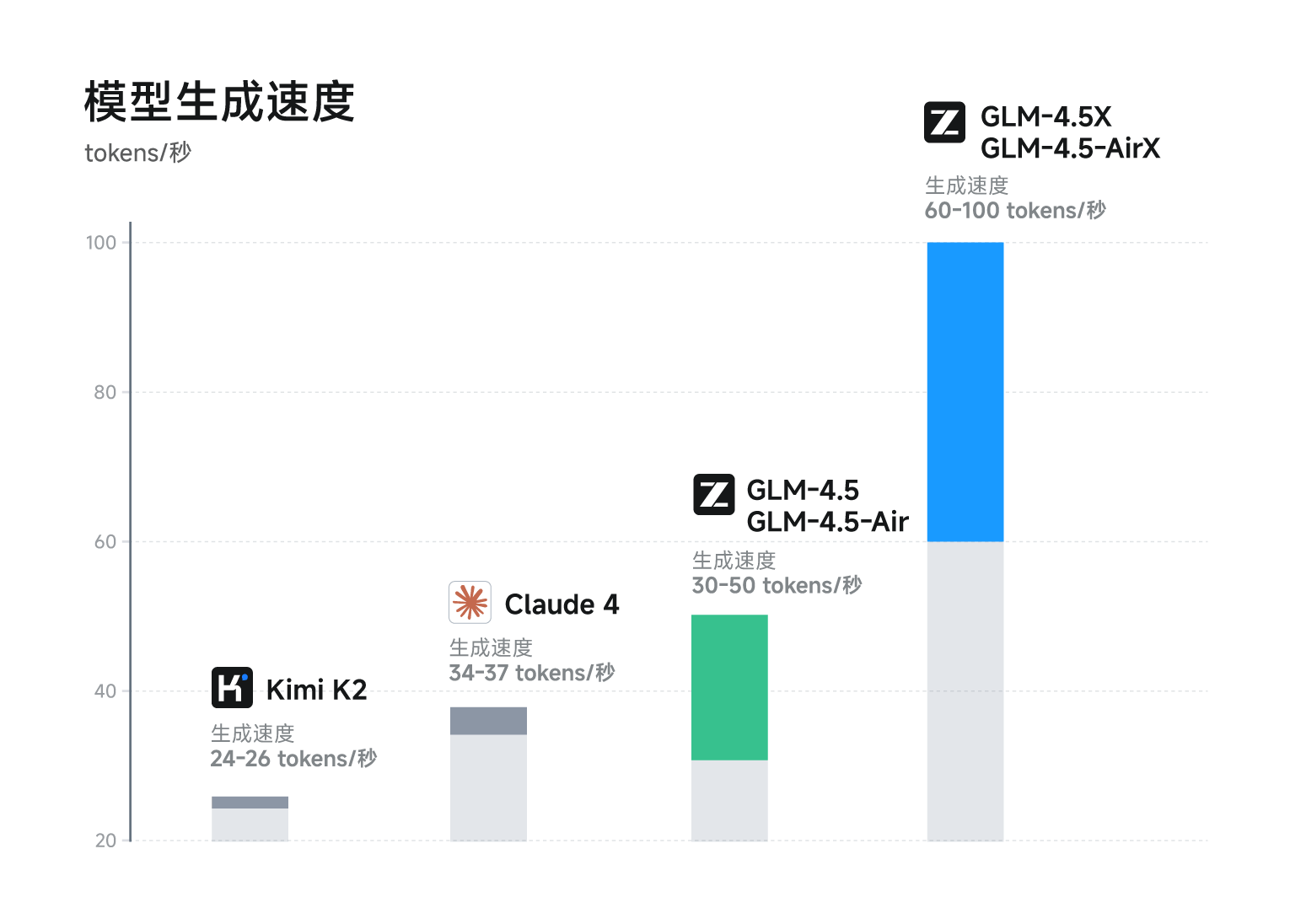
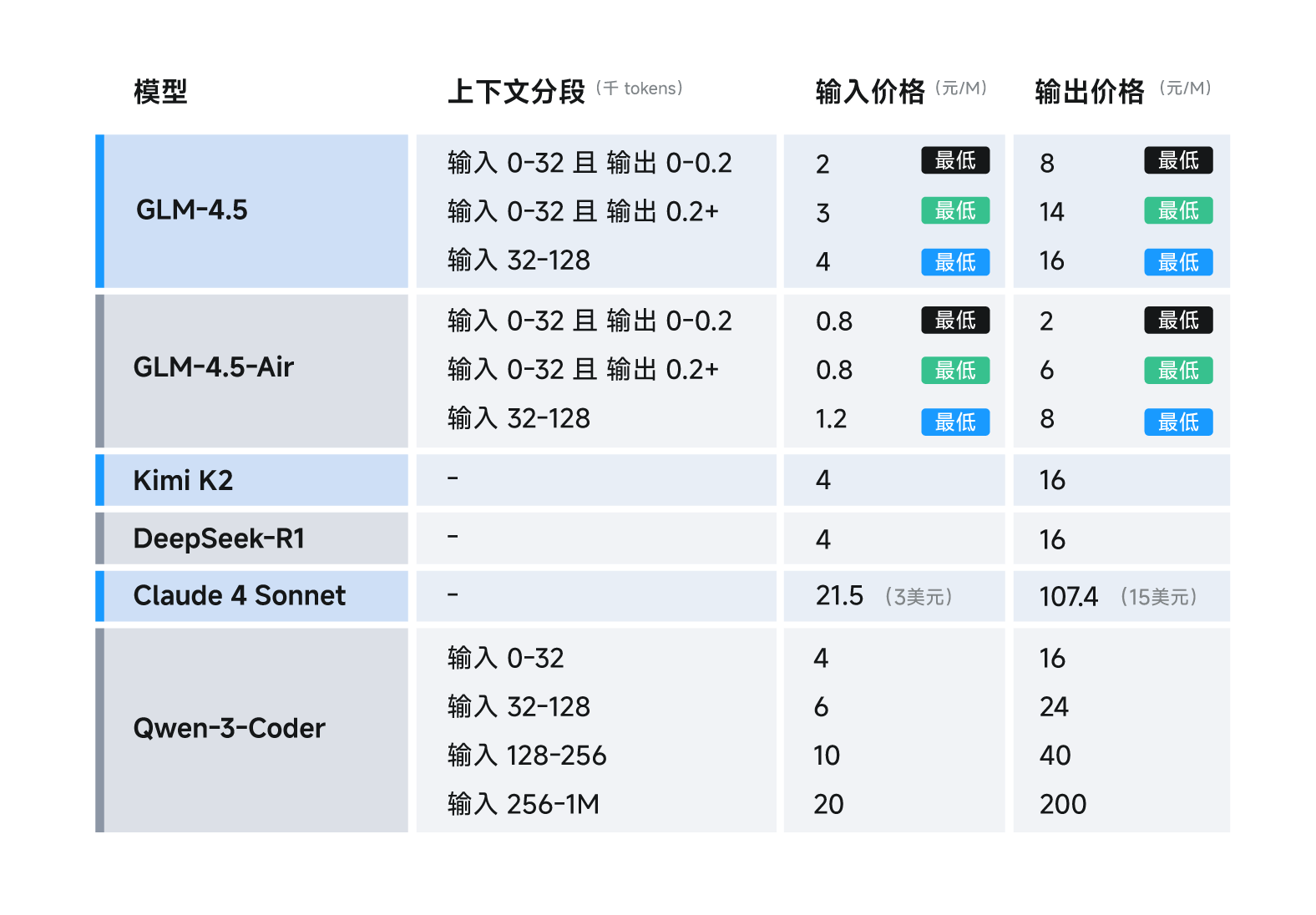
Parameter efficiency is doubled, the API price is only 1/10 of Claude, and the speed can reach up to 100 tokens/second. It is the first to achieve native integration of multiple capabilities in a single model and has made important technical breakthroughs—a single model simultaneously possesses powerful reasoning, code, agent, and other capabilities. It is now available for free experience on Zhipu Qingyan and Z.ai.
Main features of GLM-4.5
-
Multi-capability integration: For the first time, it achieves native integration of reasoning, code generation, and agent capabilities in a single model, meeting the needs of complex agent applications.
-
Reasoning capability: It performs excellently in multiple reasoning evaluation benchmarks and supports complex reasoning tasks, with reasoning performance reaching the top level of open-source models.
-
Code generation: It performs outstandingly in code generation and programming tasks, supports multiple programming languages, can generate high-quality code snippets, and is competent for full-stack development tasks.
-
Agent applications: It supports tool calling, web browsing, and other functions, can connect to code agent frameworks such as Claude Code and Roo Code, and is suitable for agent tasks.
-
Hybrid reasoning mode: It provides "thinking mode" for complex reasoning and tool use, as well as "non-thinking mode" for instant responses, balancing efficiency and performance.
Technical highlights of GLM-4.5
- Mixture of Experts (MoE) architecture: GLM-4.5 adopts a Mixture of Experts (MoE) architecture, which is an efficient model scaling method. The MoE architecture divides model parameters into multiple expert modules (Experts) and dynamically selects some experts to activate during each forward pass, achieving sparse activation of parameters. While maintaining the model's strong expressive ability, it significantly reduces computational cost and memory usage.
-
GLM-4.5: The total number of parameters is 355 billion, and the activated parameters are 32 billion。
-
GLM-4.5-Air: The total number of parameters is 106 billion, and the activated parameters are 12 billion。
-
- Multimodal capabilities: GLM-4.5 supports multimodal input and output, and can process multiple data types such as text and images. This enables the model to better understand and generate complex agent application content, for example, handling multimodal interaction scenarios such as web browsing and tool calling in agent tasks.
- Hybrid reasoning mode: GLM-4.5 provides two reasoning modes:
-
Thinking Mode: Suitable for complex reasoning and tool use scenarios; the model will conduct deeper thinking and reasoning to generate more accurate results.
-
Non-Thinking Mode: Suitable for real-time response scenarios, the model quickly generates results to meet low-latency requirements.
-
- Efficient training process: GLM-4.5's training process includes three stages:
-
General data pre-training: Pre-training on 15 trillion tokens of general data to learn the foundational representations of language and knowledge.
-
Targeted training: Targeted training on 8 trillion tokens of data in domains such as code, reasoning, and agents to enhance the model's performance on specific tasks.
-
Reinforcement learning optimization: Further optimizing the model's reasoning, code generation, and agent capabilities through reinforcement learning to improve the model's performance in real-world applications.
-
- Parameter efficiency optimization: GLM-4.5 has achieved a significant improvement in parameter efficiency. Although its parameter count is only 1/2 that of DeepSeek-R1 and 1/3 that of Kimi-K2, it performs better on multiple standard benchmarks. For example, in a model series with 100B total parameters and 10B activated parameters, GLM-4.5's reasoning performance on the Artificial Analysis benchmark rivals or even surpasses other top international models.
GLM-4.5 Project Address
- GitHub repository:https://github.com/zai-org/GLM-4.5
- HuggingFace repository: https://huggingface.co/collections/zai-org/glm-45-687c621d34bda8c9e4bf503b
- ModelScope repository:https://modelscope.cn/collections/GLM-45-b8693e2a08984f
- Experience address:
- HuggingFace: https://huggingface.co/spaces/zai-org/GLM-4.5-Space
- ModelScope:https://modelscope.cn/studios/ZhipuAI/GLM-4.5-Demo
GLM-4.5 Technical Indicators
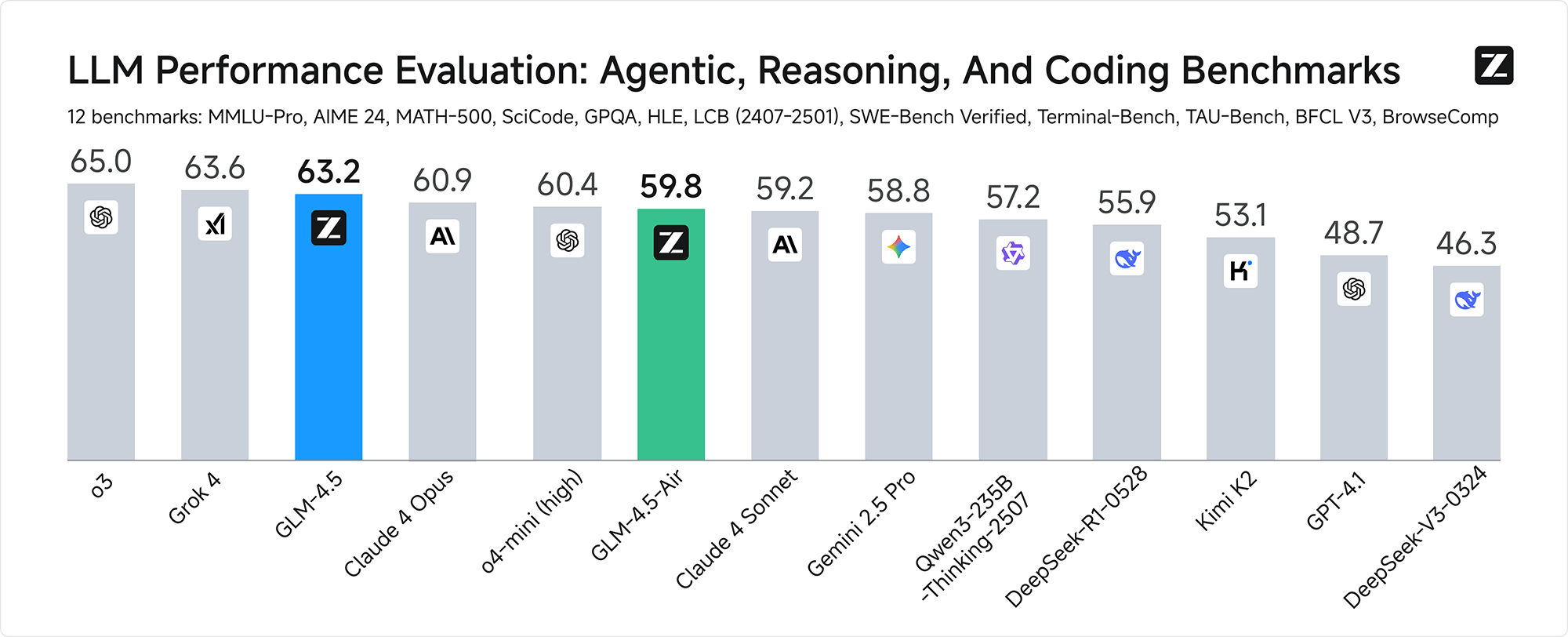
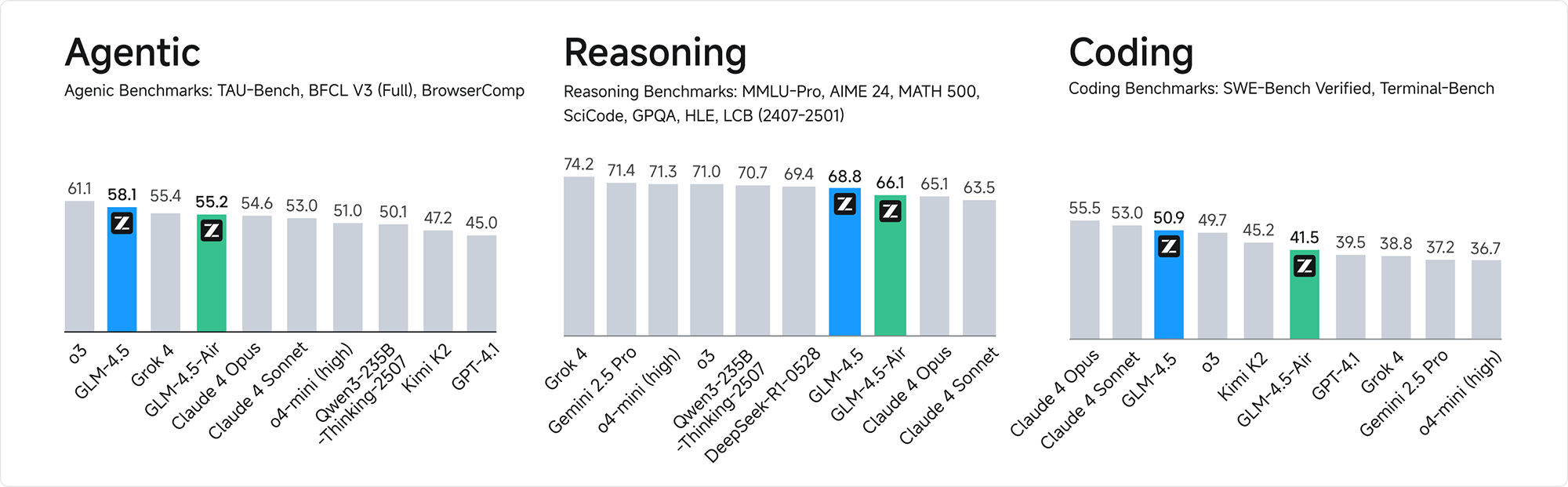
- ComprehensivePerformance SOTA:The 12 most representative evaluation benchmarks, including MMLU Pro, AIME 24, MATH 500, SciCode, GPQA, HLE, LiveCodeBench, SWE-Bench Verified, Terminal-Bench, TAU-Bench, BFCL v3, and BrowseComp.Comprehensiveaverage score, GLM-4.5 achievedglobal modelNo.three, domesticmodelNo.one, open-sourcemodelfirst.
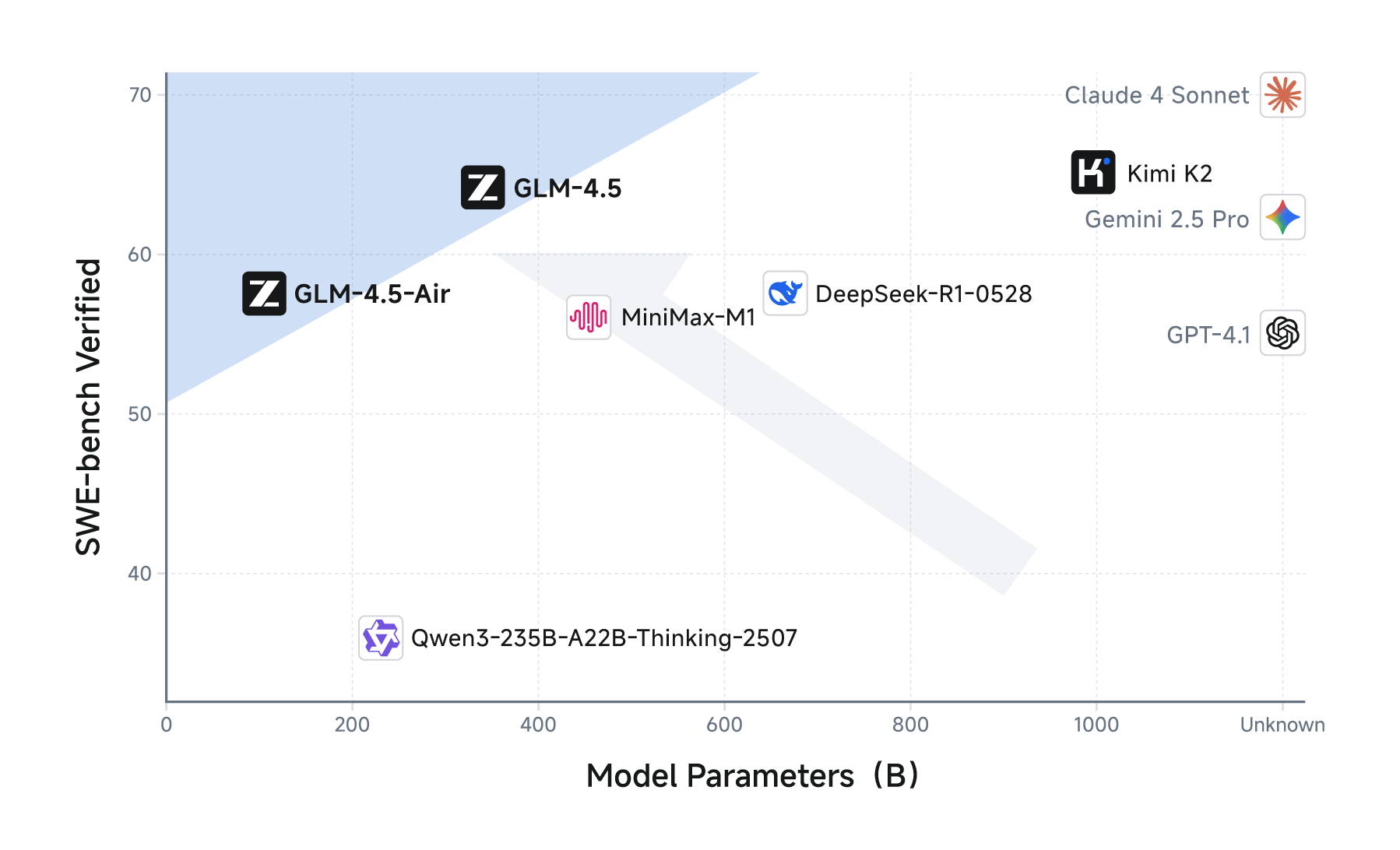
- Higher parameter efficiency: GLM-4.5 has 1/2 the parameters of DeepSeek-R1 and 1/3 of Kimi-K2, yet performs better on multiple standard benchmarks, which benefits from the higher parameter efficiency of the GLM model. On the SWE-bench Verified leaderboard, which measures a model's coding ability, the GLM-4.5 series is on the performance/parameter ratio Pareto frontier, indicating that at the same scale, the GLM-4.5 series achieves the best performance.
- Low cost, high speed: In addition to performance optimization, the GLM-4.5 series has also achieved breakthroughs in cost and efficiency, resulting in pricing far lower than mainstream models: API call prices are as low as 0.8 yuan per million tokens for input and 2 yuan per million tokens for output. At the same time, the high-speed version has a measured generation speed of up to 100 tokens/second, supporting low-latency, high-concurrency real-world deployment needs, balancing cost-effectiveness and interactive experience.
How to use GLM-4.5
- Experience platform
-
Zhipu Qingyan (chatglm.cn): You can directly visit theZhipu Qingyanplatform to experience the full version of GLM-4.5 for free. Users can perform various operations such as dialogue generation, code generation, and reasoning tasks, and experience the model's powerful capabilities.
-
Z.ai: Users can also experience GLM-4.5's features through the Z.ai platform.
-
- API call
-
BigModel.cn: Zhipu AI provides an API interface, through which users can use the BigModelplatform to make API calls. The API interface supports multiple functions, including text generation, code generation, reasoning tasks, and more.
-
Model Pricing of GLM-4.5
API call prices as low as: input 0.8 yuan/million tokens, output 2 yuan/million tokens, with a generation speed of up to 100 tokens/second, supporting low-latency and high-concurrency deployment.
Application Scenarios of GLM-4.5
- Full-stack development tasks: GLM-4.5 is capable of handling complex full-stack development tasks, supporting the writing of relatively complex applications, games, interactive web pages, and more.
-
Code generation: GLM-4.5 performs excellently in code generation, capable of generating high-quality code snippets and supporting multiple programming languages. It can help developers quickly generate code frameworks, fix code errors, optimize code structure, and more.
-
Programming assistance: The model can serve as a programming assistance tool, providing functions such as code completion, code generation suggestions, and code comments, improving development efficiency.
-
Content generation: The model can generate various types of content, such as articles, news reports, creative copy, and more, suitable for scenarios such as content creation and copywriting.
-
Academic research: GLM-4.5 can be used for academic research, helping researchers explore frontier issues in fields such as natural language processing and artificial intelligence.