
What Is DeepSeek-V3.2
DeepSeek-V3.2-Exp is an experimental artificial intelligence model launched by DeepSeek-AI. By introducing the DeepSeek Sparse Attention (DSA) mechanism, it significantly improves the efficiency of long-text processing. The model is based onDeepSeek-V3.1-Terminustrained continuously, introducing DSA only in the architecture, implementing a fine-grained sparse attention mechanism, and efficiently selecting key information with the help of a lightning indexer, greatly improving efficiency during long-text training and inference.
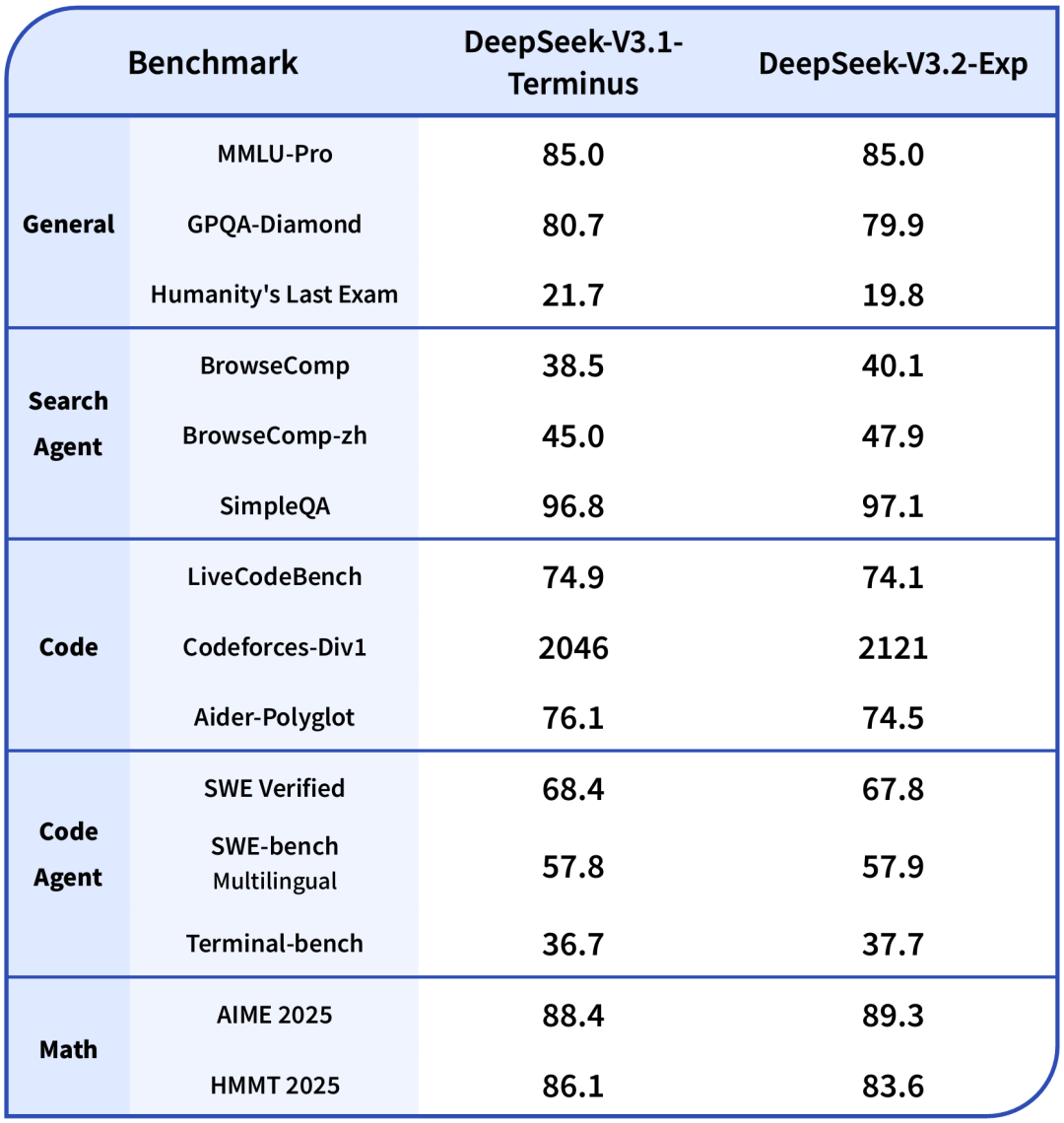
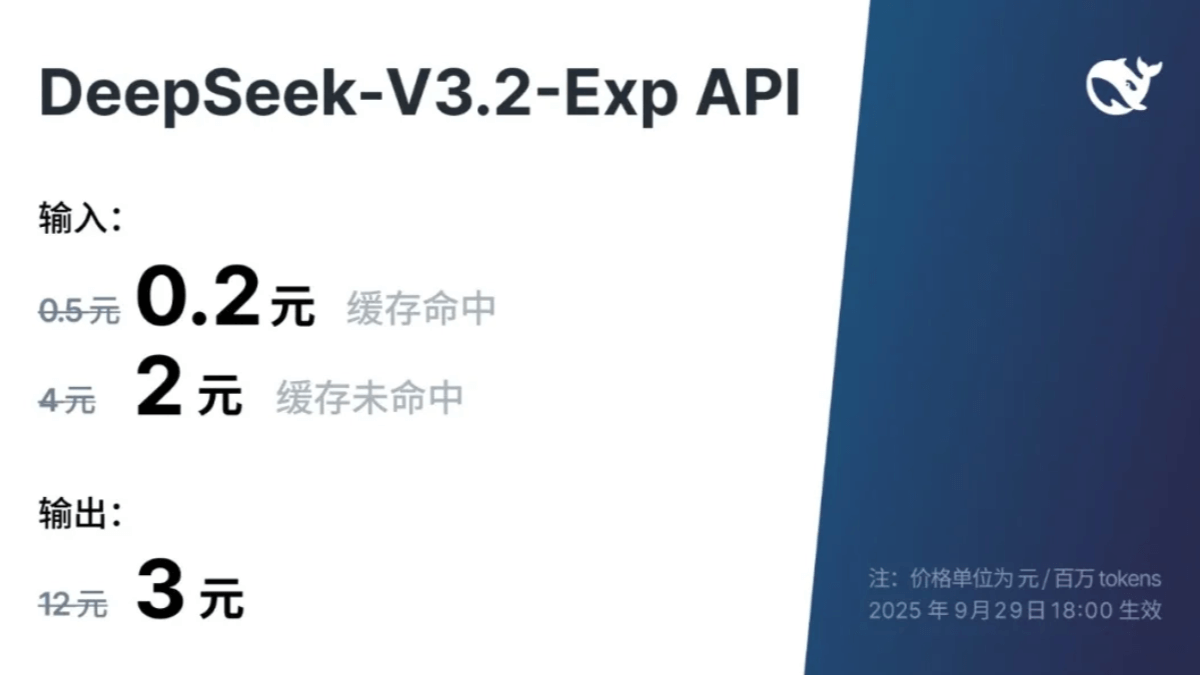
In terms of performance, DeepSeek-V3.2-Exp is basically on par with DeepSeek-V3.1-Terminus on multiple public evaluation sets, demonstrating its capabilities in different fields. The model is open-sourced on Hugging Face and ModelScope, making it convenient for researchers and developers to explore and apply. The API price of DeepSeek-V3.2-Exp has dropped significantly, reducing the cost of use for developers, further promoting its widespread deployment in practical applications.
The official version of DeepSeek-V3.2 has been released, with significant improvements in reasoning ability, Agent features, tool calling, and more. The version includes two sub-models:- DeepSeek-V3.2 (Standard Edition): Suitable for daily use, balancing reasoning speed and output quality.
- DeepSeek-V3.2-Speciale (Enhanced Edition): Optimized specifically for complex reasoning and long-thinking tasks, with stronger performance but higher computational cost.
Main Features of DeepSeek-V3.2
-
Architectural Innovation: DeepSeek-V3.2-Exp introduces the DeepSeek Sparse Attention (DSA) mechanism on the basis of DeepSeek-V3.1-Terminus. Through a lightning indexer and a fine-grained token selection mechanism, it achieves significant efficiency improvements, especially outstanding in long-text scenarios.
-
Performance Optimization: The model performs comparably to DeepSeek-V3.1-Terminus on multiple public evaluation sets, significantly reducing inference costs in long-text processing, from O(L2) optimized to O(Lk), greatly improving long-text inference efficiency.
-
Open-Source Sharing: DeepSeek-V3.2-Exp is open-sourced on Hugging Face and ModelScope, providing detailed implementation details and model weights, making it convenient for researchers and developers to conduct research and applications.
-
Cost Reduction: API prices have dropped significantly, reducing developers' usage costs, enabling more developers to access and use the model at lower cost, and promoting its widespread deployment in practical applications.
-
Application Expansion:Official App、Web version, and mini-programs have all been updated to DeepSeek-V3.2-Exp, supporting multiple application platforms and providing users with a more efficient and more economical AI service experience.
Technical Principles of DeepSeek-V3.2
- Significantly Improved Reasoning Ability
- Approaching GPT-5 Level: It performs excellently in multiple public reasoning evaluations (such as GSM8K, MATH, HumanEval, etc.), approaching GPT-5, and surpassing Gemini-3.0-Pro in some tasks.
- Enhanced Mathematical Ability: Integrating the theorem-proving capability of DeepSeek-Math-V2, it reaches the level of human gold medalists in top competitions such as the IMO (International Mathematical Olympiad) and ICPC (International Collegiate Programming Contest).
- More Efficient Long-Text Processing: Compared with the previous generation model (V3.1-Terminus), it reduces redundant content while maintaining high-quality output, improving response speed.
- Major Upgrade in Agent Capabilities
- The first model to support the fusion of "thinking + tool calling": It can dynamically call external tools (such as code execution, search engines, APIs, etc.) during the reasoning process. It supports multi-round thinking mode and performs more stably when solving complex tasks.
- Large-scale Agent training data: Trained on 1800+ different environments and 85,000+ complex instructions, greatly improving task planning and execution capabilities. It reaches the highest level in open-source Agent evaluations, narrowing the gap with closed-source models (such as GPT-5 and Claude 4).
- Smarter tool calling
- Supports Claude Code: Optimizes code execution capability and can combine tools such as Python and SQL for complex calculations.
- Thinking mode API: Allows users to pass back the Chain-of-Thought, enabling the model to maintain a more coherent reasoning process. It is suitable for tasks requiring multi-step reasoning, such as mathematical proofs, programming debugging, and data analysis.
-
Sparse attention mechanism: DeepSeek-V3.2-Exp introduces DeepSeek Sparse Attention (DSA), which uses a lightning indexer to calculate index scores between query tokens and preceding tokens, selects key-value entries, and achieves fine-grained sparse attention, significantly improving long-text processing efficiency.
-
Lightning indexer: The lightning indexer is the core component of DSA. It calculates index scores between query tokens and preceding tokens and, through a small number of index heads and efficient computation, quickly determines which tokens are most important to the query tokens.
-
Fine-grained token selection: Based on the index scores, the model selects the top k key-value entries for attention computation, reducing unnecessary computation and improving the model's inference speed and efficiency.
-
MLA-based implementation: DSA is implemented under the Multi-Layer Attention (MLA) architecture and adopts the Multi-Query Attention (MQA) pattern, allowing each key-value entry to be shared among multiple queries and improving computational efficiency.
-
Continuous training and optimization: Starting from the base checkpoint of DeepSeek-V3.1-Terminus, the lightning indexer and the entire model are optimized through two stages, dense warmup and sparse training, to adapt to the sparse attention pattern.
DeepSeek-V3.2 project address
- DeepSeek-V3.2:https://huggingface.co/deepseek-ai/DeepSeek-V3.2
- DeepSeek-V3.2-Speciale:https://huggingface.co/deepseek-ai/DeepSeek-V3.2-Speciale
- HuggingFace model repository:https://huggingface.co/deepseek-ai/DeepSeek-V3.2-Exp
- ModelScope community:https://modelscope.cn/models/deepseek-ai/DeepSeek-V3.2-Exp
- Technical paper:https://github.com/deepseek-ai/DeepSeek-V3.2-Exp/blob/main/DeepSeek_V3_2.pdf
How to use DeepSeek-V3.2
- Web version & APP: Visit DeepSeek official websiteor download the official APP.
-
Use via API: Developers can call the API interface of DeepSeek-V3.2-Exp to integrate the model's capabilities into their own applications. The significant drop in API prices reduces usage costs, making it easier for more developers to access.
-
Local running: Users can download the model weights of DeepSeek-V3.2-Exp from the Hugging Face platform, follow the provided local running guide to convert the weights into the format required for the inference demo, and launch the interactive chat interface for use.
-
Use the official application: DeepSeek'sofficial App、web versionand mini program have all been updated to the DeepSeek-V3.2-Exp version. Users can directly use the model through these platforms without additional configuration.
-
Model fine-tuning: For specific tasks or domains, users can fine-tune DeepSeek-V3.2-Exp to better adapt to specific application scenarios and improve the model's performance on specific tasks.
-
Secondary development: DeepSeek-V3.2-Exp is open-sourced on the Hugging Face and ModelScope platforms. Users can refer to the open-source code and implementation details to understand how the model specifically works and carry out secondary development as needed.
Application scenarios of DeepSeek-V3.2
-
Long text processing: Suitable for scenarios that require processing long texts, such as long document analysis and long text generation. Its sparse attention mechanism can significantly improve the efficiency of long text processing.
-
Search and information retrieval: It can be used in scenarios such as search agents to help users quickly and accurately retrieve information and improve search efficiency and relevance.
-
Code generation and programming assistance: It supports code generation and programming assistance tasks, such as code completion and code optimization, helping developers improve programming efficiency and code quality.
-
Mathematics and logical reasoning: It performs excellently in mathematical problem solving and logical reasoning tasks, and can handle complex mathematical problems and logical reasoning chains.
-
Multilingual processing: It supports multilingual tasks and can be applied to scenarios such as cross-language text generation and translation, meeting the needs of different language environments.
-
Intelligent agents and interaction: As the core model of intelligent agents, it can be used to build intelligent assistants, chatbots, etc., providing natural language interaction services.