

What is OpenCode
OpenCode is an open source AI programming tool , known as the Claude Code best alternative, it helps developers write code efficiently in the terminal, IDE, or desktop environment. OpenCode supports a variety of AI large models, including free built-in models (GLM-4.7, MiniMax-M2.1) and paid models from mainstream providers (such as OpenAI, Anthropic, GitHub Copilot, etc.). Users can also connect local models, making it convenient for developers to handle multiple tasks in parallel. OpenCode's privacy protection features ensure that code and data are not stored, making it suitable for privacy-sensitive scenarios, supporting a variety of development environments and workflows, and making it a developer's intelligent partner.
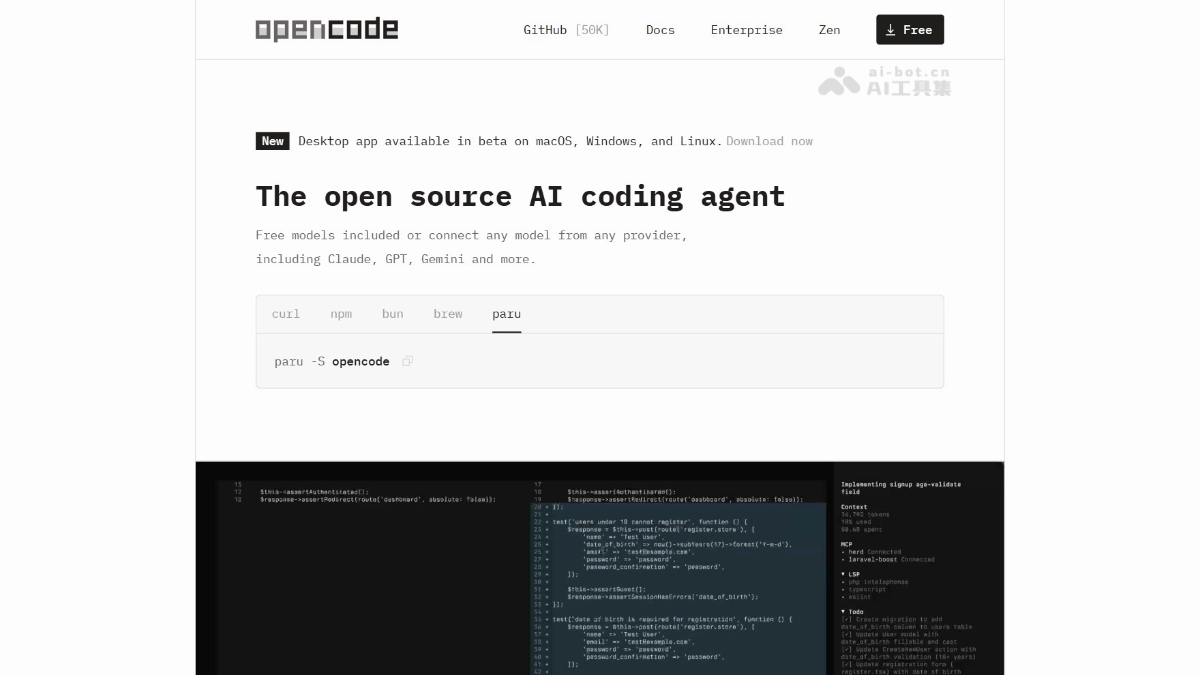
OpenCode's main features
- Multi-platform support
-
Terminal interface (TUI): Used directly through the command-line interface, suitable for developers accustomed to terminal operations.
-
Desktop application: Provides a standalone desktop application, supporting macOS, Windows, and Linux, suitable for users who need a graphical interface.
-
IDE extension: Supports extensions for mainstream development tools such as VS Code,Cursor , directly integrated into the development environment.
-
- Multi-model support
-
Built-in free models: Provides multiple free AI models (such as GPT-5 Nano, Big Pickle, etc.).
-
Mainstream model integration: Supports connecting to mainstream AI model providers such as OpenAI, Anthropic, GitHub Copilot, etc.
-
Local model support: Supports users in connecting to locally deployed models, meeting privacy and customization needs.
-
- Development mode switching
-
Build mode: Supports AI in performing actual code modifications, file edits, and Shell commands, suitable for executing specific tasks.
-
Plan mode: Analyzes and plans tasks in a read-only manner, generating detailed execution plans to avoid the risks brought by directly modifying code.
-
- Code management and optimization
-
Code analysis and suggestions: Helps developers understand complex codebases and provides code optimization suggestions.
-
Feature development assistance: Generates code implementations according to developers' needs, supporting the entire process from requirements analysis to code generation.
-
Version control integration: Supports Git commands, making it convenient for developers to manage code changes.
-
- Interaction and collaboration
-
Context reference: By entering
@to reference files or code snippets in the project, helping the AI understand the context more accurately. -
Command execution: Supports a variety of built-in commands (such as
/init、/review、/undo, etc.), improving development efficiency. -
Shared sessions: Generates session links, making it convenient for team members to share and collaborate.
-
- Privacy and security: By default, does not store user code or context data, supports fully localized model deployment, and avoids data leakage.
-
Theme and shortcut customization: Allows users to adjust interface themes and shortcuts according to personal preferences.
-
Advanced feature support: Provides advanced features such as LSP servers, MCP servers, and custom tools to meet complex development needs.
- Multi-language support: Supports multiple programming languages, adapts to the tech stacks of different projects, and helps developers work efficiently in different language environments.
- Multi-session management: Supports launching multiple sessions in parallel within the same project, making it convenient to handle multiple tasks at the same time.
OpenCode installation command
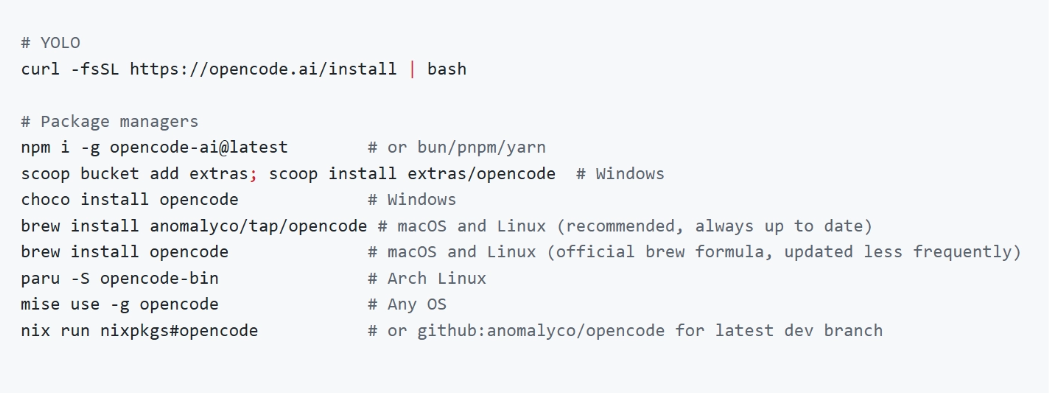
How to use OpenCode
- Terminal usage
- Install: Run curl -fsSL https://opencode.ai/install | bash to install OpenCode, or install it via tools such as npm and Homebrew.
- Start: Type opencode in the terminal to start the program.
- Configure model: On first launch, choose a built-in free model or connect an external model (such as OpenAI) via the /connect command.
- Initialize project: After entering the project directory, run opencode init to generate the project configuration file.
- Use: Enter requirements directly in the terminal (such as "add user authentication"), and press Tab to switch between Build mode and Plan mode.
- Advanced features: Type / to execute commands (such as /review, /undo), or type @ to reference files in the project.
- IDE usage
- Install plugin: Search for and install the OpenCode plugin in an IDE such as VS Code.
- Start: After opening the project, type opencode in the IDE terminal to start.
- Configure model: Type /connect and paste the API Key to connect an external model, or use the built-in model directly.
- Use: Enter requirements in the IDE terminal, such as "optimize code performance," and view the AI's suggestions.
- Advanced features: Type / to execute commands, or reference files via @, and manage code changes directly in the IDE.
- Desktop usage
- Install: Download and install the desktop app from the OpenCode official website.
- Start: Open the desktop app and select a project to load.
- Configure model: In the app interface, choose a built-in free model or connect an external model.
- Use: Enter requirements in the dialog box, such as "generate code for a new feature," and view the AI's output.
- Advanced features: Type / to execute commands, reference files via @, or upload images to assist development.
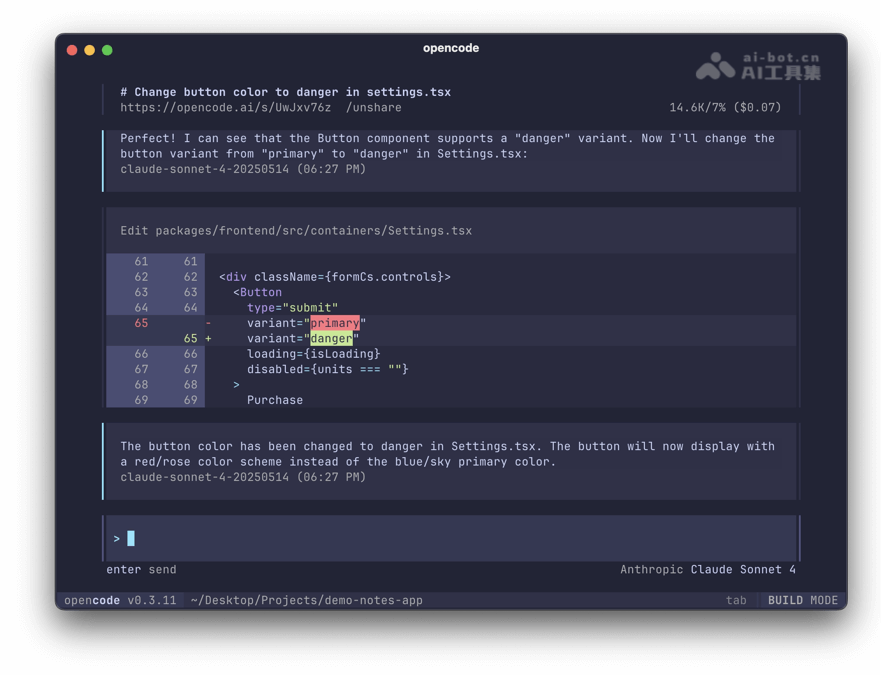
OpenCode official website address
- Official website address:https://opencode.ai/
- GitHub repository:https://github.com/anomalyco/opencode/
OpenCode product pricing
OpenCode uses a pay-as-you-go model, with fees calculated based on the number of tokens for model input, output, and cache read/write operations.
- Free models:Big Pickle、Grok Code Fast 1、MiniMax M2.1、GLM-4.7、GPT 5 Nano
- Paid models
- GLM-4.6V: Input $0.60/million tokens, output $2.20/million tokens, cache read $0.10/million tokens.
- Kimi K2: Input $0.40/million tokens, output $2.50/million tokens.
- Qwen3 Coder 480B: Input $0.45/million tokens, output $1.50/million tokens.
- Claude Sonnet 4.5(≤ 200K tokens): input $3.00/million tokens, output $15.00/million tokens, cache read $0.30/million tokens, cache write $3.75/million tokens.
- Gemini 3 Pro(≤ 200K tokens): input $2.00/million tokens, output $12.00/million tokens, cache read $0.20/million tokens.
- GPT 5.2: input $1.75/million tokens, output $14.00/million tokens.
- GPT 5.1 Codex: input $1.07/million tokens, output $8.50/million tokens.
- GPT 5.1 Codex Mini: input $0.25/million tokens, output $2.00/million tokens.
Differences Between OpenCode and Claude Code
-
Open Source: OpenCode is 100% open source, allowing users to freely view, modify, and distribute the code. This openness provides broad space for community participation and customization.
-
Provider Agnosticism: OpenCode does not depend on any specific model provider and can be flexibly used with Claude, OpenAI, Google, or local models, giving users more choices and flexibility for future development.
-
Out-of-the-Box LSP Support: OpenCode has built-in Language Server Protocol (LSP) support, so users can get features such as intelligent code completion and syntax checking without additional configuration, greatly improving development efficiency.
-
Focus on Terminal User Interface (TUI): OpenCode was created by terminal development enthusiasts and focuses on providing an ultimate terminal user interface experience, offering developers who like using the terminal an efficient and personalized development environment.
-
Client/Server Architecture: OpenCode adopts a client/server architecture, supports running locally, and can be controlled remotely through clients such as mobile apps, providing greater flexibility and convenience for use across multiple devices.
Application Scenarios of OpenCode
-
Personal Project Development: Independent developers can quickly generate code, optimize existing logic, or solve technical problems.
-
Team Collaborative Development: Team members can share sessions, collaboratively plan feature implementation, and ensure code quality and consistency.
-
Complex Project Analysis: OpenCode can quickly understand the structure of large codebases and generate feature implementation plans, avoiding the risk of directly modifying code.
-
Rapid Prototype Development: Quickly generate runnable code prototypes based on functional requirements, accelerating the product validation process.
-
Teaching and Learning Programming: Generate code examples and explanations for students or novice developers, assisting in learning programming knowledge.

