What is Codex
Codex is an AI programmingagent launched by OpenAI, powered by a GPT-5.5 programming-specialized model, benchmarked against Claude Code. Codex interacts with developers through a visual graphical interface and uses a two-layer architecture of "folder workspace + Thread conversation threads" to manage projects, avoiding context contamination. Codex supports code writing, complex refactoring, automated operations and maintenance, and scheduled task execution, enabling non-professional users to quickly enter the "Vibe Coding" flow state and achieve end-to-end delivery from requirements to code.
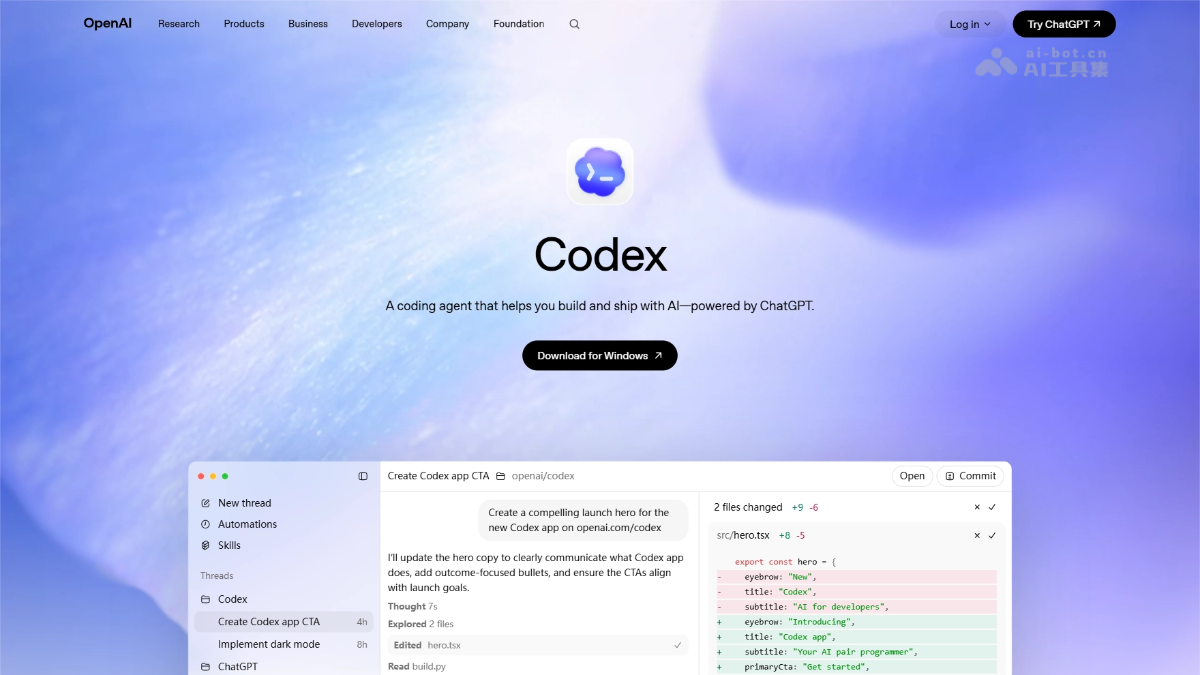
Codex's main features
-
Two-layer project management: Uses folders as workspaces to manage project directories, with Threads as independent conversation threads responsible for a single task, effectively avoiding context contamination.
-
GPT-5.3-codex model: A built-in programming-specialized large model, available only in the Codex app and not offered on the main ChatGPT site, optimized specifically for code generation and engineering tasks.
-
Scheduled tasks (Automations): Supports configuring periodic automated tasks, such as server inspections, data scraping, report generation, etc., enabling unattended operations and maintenance.
-
Skill extensions (Skills): Installable extension skill packs that enhance engineering capabilities in specific scenarios, such as frontend design, database migration, etc.
-
Local environment integration: Supports directly connecting to local project folders to execute code, run commands, and debug programs in an isolated environment.
-
Multi-level permission control: Provides permission options such as Local and Full access, flexibly managing the scope of AI access to system resources and code repositories.
- Digital pet: Enter
/petto awaken a pixel-style virtual companion that displays AI coding progress in real time and supports custom appearances. - Codex Chrome extension: Supports AI directly reading and operating the user's logged-in browser to complete tasks such as navigation, clicking, typing, and screenshots, with permissions controlled by the user throughout.
-
Agent Plugins: Preconfigures skill packs for 6 dedicated enterprise roles such as sales, data analysis, and creative production, enabling AI employees to directly call 62 apps and 110 skills to complete professional tasks without programming.
-
Annotations: Supports users selecting any content generated by Codex for precise point-and-edit modifications and explanations, enabling targeted edits.
-
Sites: Converts any content created by Codex into a secure, shareable interactive website or app prototype with one click, facilitating team review and business dashboard display.
- Codex Cloud: Tasks are uploaded to the cloud Workspace for execution, so the Agent can keep running after the computer is turned off, and progress can be checked anytime on a phone.
- Multi-Agent parallelism (/agents): A single task can be split among multiple Agents developing in parallel in their own independent Git Worktrees, then merged uniformly at the end.
- Code Review: Codex can view code diffs and automatically review GitHub PRs / GitLab MRs, completing a round of checks in the cloud first.
- Security Cloud: Scans GitHub repositories on demand or periodically, and upon discovering security risks automatically verifies them and generates remediation plans.
- Ultrafast tier: Paid acceleration, with token generation speeds up to 300 tokens/s, about 8 times the original.
- Agents API open: Codex's multi-agent, tool calling, context compression and other capabilities are exposed as APIs, allowing developers to directly call the OpenAI-hosted Codex Harness.
How to use Codex
- Download the Codex app: Visit the Codex official website https://openai.com/codex/ , download the installation package, and after installation, log in with a ChatGPT account.
- Connect a code repository: On first entry, you can choose "Connect to GitHub" to directly link a remote repository, or "Add local project" to import a project folder from your computer as a workspace; Codex will automatically index the code structure.
- Create a task thread: In the Threads column on the left, click "New thread" to create a new conversation thread. Each thread corresponds to an independent development task. It is recommended to follow the principle of "one thread does only one thing" to avoid cross-contamination of context.
- Initiate an engineering task: In the input box, describe the requirement in natural language, for example "fix the routing navigation bug on the login page" or "add unit tests for the order module." Codex will automatically analyze the code, plan the steps, execute the modifications, and display the change diff.
- Review and merge: After the task is completed, Codex will summarize all file changes (such as +180 -21 lines). Click "Review changes" to review the code item by item, and after confirming it is correct, directly commit to the current branch or open a Pull Request.
- Configure skill extensions: Go to the "Skills" panel on the left and install team-custom skills or official preset skills (such as front-end design specifications or document generation templates), so that Codex's output directly aligns with team standards and engineering specifications.
- Set up automated tasks: In the "Automations" panel, configure scheduled rules, for example "check server logs every day at midnight and generate an inspection report" or "automatically categorize newly submitted Issues," enabling unattended background operation.
- Multi-environment collaboration: In addition to the desktop app, you can install the Codex plugin in editors such as VS Code, or use Codex CLI in the terminal, to achieve cross-environment task synchronization and unified permission management through the same ChatGPT account.
Key information and usage requirements for Codex
- Project architecture: It must use a two-layer management approach of "folder workspace + Thread conversation thread," and the same thread should advance only a single specific task.
- Permission management: It provides multiple permission levels such as Local and Full access, and the scope of AI access to system resources should be reasonably configured according to task risk.
- Environment isolation: It has a built-in cloud sandbox execution environment to ensure code execution safety and isolation from the local system.
- Scheduled tasks: The Automations feature supports configuring periodic background tasks to achieve unattended automated operations and maintenance.
- Skill extensions: The Skills feature supports installing custom skill packages, so that output directly aligns with team engineering specifications and code standards.
Codex's core advantages
- End-to-end engineering support: From routine Pull Requests to core architecture challenges, it covers the full process of tasks such as feature development, complex refactoring, and code migration.
- Multi-agent parallelism: Relying on built-in worktrees and a cloud environment, it supports multiple agents collaborating in parallel across projects, compressing traditional development cycles of several weeks into a few days.
- Team standard adaptation: Directly participate in code understanding, prototype building, and documentation writing through the Skills feature, ensuring output stays consistent with team engineering standards.
- Backend Automation: Automatically run without human prompts, handling key daily operations and maintenance work such as Issue triage, monitoring alerts, and CI/CD.
- Quality Assurance: Elevate engineering standards through rigorous design, comprehensive testing, and high-quality code review, resolving risks at the source to ensure robust delivery.
- Unified Multi-Environment: Supports multiple entry points including desktop app, editor plugin, and terminal CLI, enabling unified cross-environment connection through the same ChatGPT account.
- Visual Experience: Provides a graphical interface as the command center for agentic coding, greatly lowering the barrier for non-professional developers compared to pure command-line tools.
Comparison of Codex's Similar Competitors
| Comparison Dimension | OpenAI Codex | Claude Code (Anthropic) | Cursor (Anysphere) |
|---|---|---|---|
| Product Positioning | AI coding agent, end-to-end engineering delivery | Command-line AI coding Agent | AI-native integrated development environment |
| Interaction Interface | Visual desktop app + CLI + IDE plugin | Pure terminal TUI interface | Full graphical IDE interface |
| Core Model | GPT-5.3-codex (coding-specialized) | Claude Opus 4.6 / Sonnet | GPT-4o / Claude / in-house models |
| Execution Mode | Multi-agent parallelism, supports backend automated running | Single-session step-by-step command execution | Real-time code completion + Agent mode |
| Project Management | Folder workspace + Thread two-layer isolation | Directory-based session management | Workspace-based file tree management |
| Automation Capabilities | Built-in Automations scheduled task panel | No built-in scheduling; requires external script triggering | No built-in scheduling; requires coordination with external tools |
| Platform Support | Mac app is live; Windows app coming soon | Cross-platform CLI (Mac/Win/Linux) | Mac / Windows / Linux all platforms |
| Usage Cost | Plus / Pro quotas doubled; basic features available in the free version | Opus 4.6 Fast mode $150/MTok, extremely high cost | Subscription-based at $20/month, tiered payment by feature |
| Context Management | Thread-level isolation, effectively preventing cross-task contamination | Shared context within a session; long texts easily trigger compression | File-level context control, dependencies can be added manually |
| Target audience | From non-professional developers to enterprise engineering teams | Professional backend developers accustomed to the command line | Full-stack developers and heavy IDE users |
Codex application scenarios
- Automated code writing and debugging: Codex can generate complete functional code based on natural language descriptions, fix bugs, automatically run tests and commit code, significantly improving development efficiency. For example, developers can automatically generate CRUD operations, API interfaces, or user authentication systems through instructions.
- Intelligent analysis and refactoring of codebases: Helps developers quickly understand the structure of complex codebases, identify potential issues, and provide refactoring suggestions (such as optimizing performance, migrating code, or improving design patterns). Supports customizing analysis rules through configuration files (such as
AGENTS.md). - Test coverage improvement and quality assurance: Automatically generates test cases, executes tests, and fixes failed cases to ensure code quality. OpenAI internal usage data shows that Codex can significantly improve test coverage and debugging efficiency.
- Exploratory design and technology selection: In the solution design phase, Codex can provide multiple implementation approaches (such as event-driven vs. request/response patterns), analyze the pros and cons of different solutions, and assist technical decision-making.
- Education and learning assistance: As a programming teaching tool, it provides learners with real-time code examples and feedback, lowering the barrier to entry for programming. Non-technical users can also complete simple automation tasks through natural language instructions.