
What is GPT-5.5
GPT-5.5 is OpenAI's latest flagship large model, positioned as its most intelligent and intuitive AI system to date. The model achieves significant leaps in four major areas: agentic coding, computer use, knowledge work, and scientific research, reaching 82.7% on Terminal-Bench 2.0 and 58.6% on SWE-Bench Pro. GPT-5.5 and NVIDIA GB200/GB300 NVL72 systems are jointly designed from training to deployment, maintaining compatibility with GPT-5.4 while completing equivalent tasks with fewer tokens at comparable latency. The model is now available to ChatGPT Plus/Pro and Codex users.
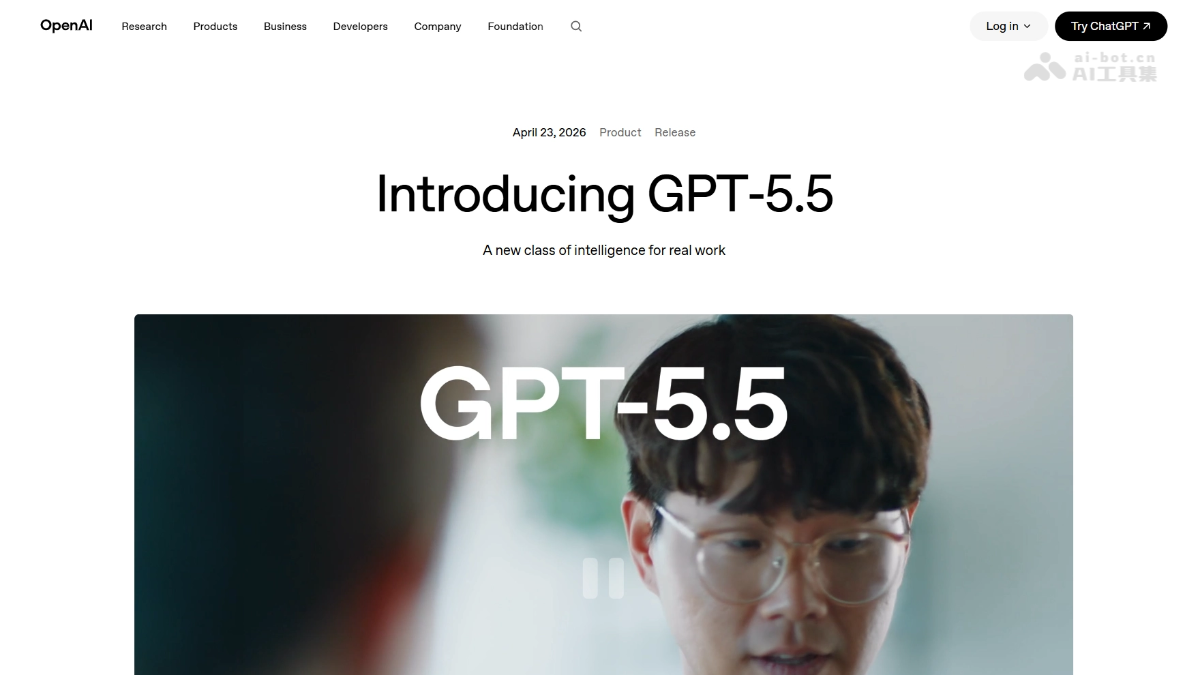
GPT-5.5's main features
-
Agentic coding: Supports end-to-end code implementation, refactoring, debugging, and testing, and can autonomously plan and execute complex development tasks.
-
Computer use: Possesses visual perception and GUI operation capabilities, and can automatically click, type, and navigate across tools to complete workflows.
-
Knowledge work: Generates documents, spreadsheets, and PPTs, conducts operations research and data modeling, and transforms messy business inputs into executable plans.
-
Scientific research: Assists with multi-stage scientific data analysis, gene expression research, and mathematical proof exploration, acting as a "collaborative scientist."
-
Tool calling: Autonomously uses plugins, browses the web, and analyzes data, checking outputs and self-correcting in multi-step tasks.
GPT-5.5's technical principles
-
Agentic reasoning architecture: Adopts an end-to-end task planning and execution framework. The model can autonomously break down multi-part tasks, call tools, verify outputs, and continuously iterate in ambiguous situations without step-by-step human intervention.
-
Software-hardware co-design: Jointly designed with NVIDIA GB200/GB300 NVL72 systems across the full stack from training to inference, achieving bidirectional optimization of model architecture and hardware infrastructure.
-
Dynamic inference optimization: Treats inference as an integrated system rather than isolated optimization, replacing fixed static partitioning with dynamic load balancing and partition heuristics, increasing GPU utilization by more than 20%.
-
Context-awareness mechanism: Supports ultra-long context windows from 400K (Codex) to 1M (API), and uses efficient attention mechanisms to maintain long-term memory and cross-file reasoning across large-scale codebases and documents.
-
Multimodal perception and operation: Integrates visual understanding capabilities, can parse screen content and perform precise GUI operations, enabling autonomous computer use across applications.
GPT-5.5's performance
-
Agentic terminal operation: Terminal-Bench 2.0 reaches 82.7%, significantly ahead of GPT-5.4's 75.1% and Claude Opus 4.7's 69.4%, greatly improving the completion rate of complex command-line workflows.
-
Real-world code repair: SWE-Bench Pro reaches 58.6%, surpassing the previous generation in end-to-end GitHub issue resolution, completing more tasks in a single pass.
-
Knowledge work evaluation: GDPval reaches 84.9%, outperforming Claude Opus 4.7's 80.3% and Gemini 3.1 Pro's 67.3% on knowledge work tasks covering 44 occupations.
-
Autonomous computer operation: OSWorld-Verified reaches 78.7%, industry-leading in autonomously completing complex operations in real computer environments.
-
Customer service workflow: Tau2-bench Telecom reaches 98.0%, handling complex customer service workflows without prompt tuning.
-
Financial Modeling: FinanceAgent reaches 60.0%, internal investment banking modeling tasks reach 88.5%, with outstanding professional financial analysis capabilities.
-
Mathematical Reasoning: FrontierMath reaches 51.7%, high-difficulty math problems (Tier 3 & 4) reach 35.4%, far exceeding Claude Opus 4.7's 22.9%.
-
Cybersecurity: CyberGym reaches 81.8%, outperforming competitors in advanced cybersecurity capability evaluations.
-
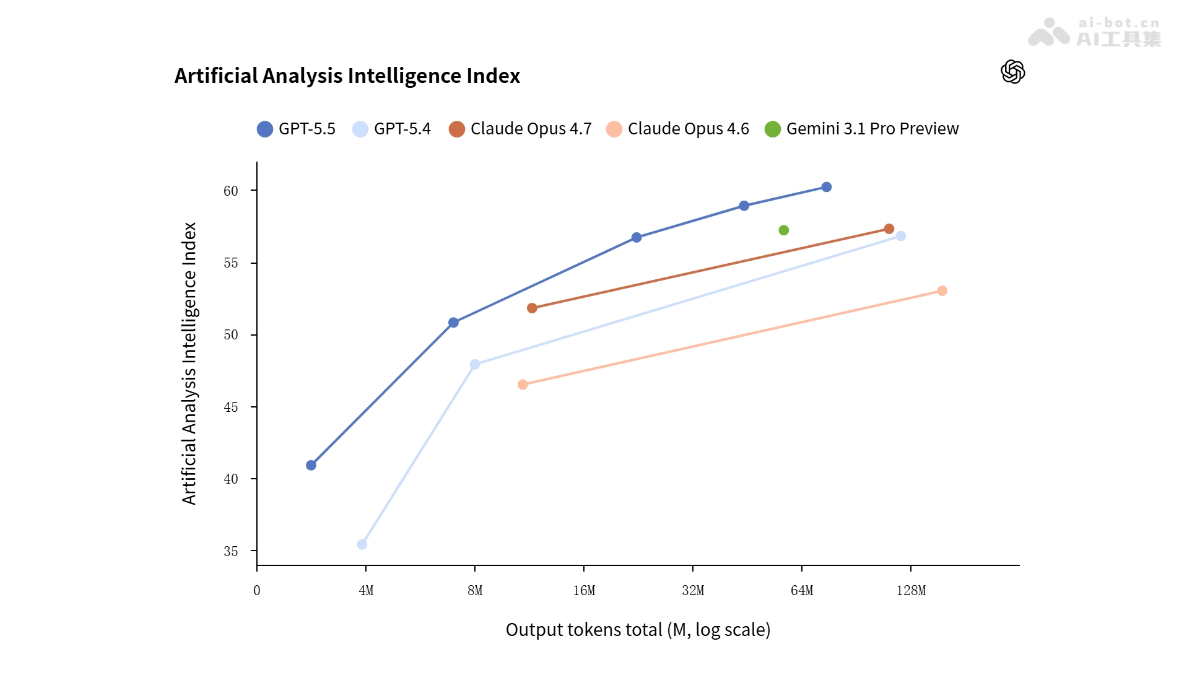
Reasoning Efficiency: On the Artificial Analysis Intelligence Index, it achieves a higher score at the same token consumption, or requires fewer tokens for the same score, achieving both intelligence and efficiency.
-
Latency Control: In real production environments, per-token latency is on par with GPT-5.4, breaking the scaling law that "stronger must be slower".
How to Use GPT-5.5
-
ChatGPT Users: VisitChatGPTthe official website,Plus/Pro/Business/Enterprise users can already switch to GPT-5.5 Thinking in the model selector; Pro users additionally have access to GPT-5.5 Pro.
-
Codex Users: VisitCodexthe official website,Plus/Pro/Business/Enterprise/Edu/Go plan users can select GPT-5.5 in Codex, supporting a 400K context and Fast mode.
-
API Developers: The model will soon be available on the Responses and Chat Completions APIs.
-
Secure Access: Trusted organizations engaged in cyber defense can apply for Trusted Access for Cyber to reduce usage restrictions for defensive work via chatgpt.com/cyber.
Key Information and Usage Requirements for GPT-5.5
-
Release Status: Officially released on April 24, 2026, already rolled out to subscribers, with the API coming soon.
-
Subscription Requirements: ChatGPT requires Plus or above; Codex covers all tiers from Plus to Go; GPT-5.5 Pro is limited to Pro/enterprise users.
-
Context Window: Codex supports 400K; the standard API supports 1M tokens.
-
Safety Mechanisms: Deploys the strongest safeguards to date, including cybersecurity classifiers, biological/chemical capability evaluations, and external red-team testing.
-
Hardware Dependencies: Inference is based on NVIDIA GB200/GB300 NVL72 systems; Fast mode requires an additional fee (2.5x cost, 1.5x speed).
Core Advantages of GPT-5.5
-
Performance Leap: Terminal-Bench 2.0 reaches 82.7%, SWE-Bench Pro reaches 58.6%, GDPval reaches 84.9%, all leading previous generations and competitors.
-
Efficiency Breakthrough: Latency is comparable to GPT-5.4, while completing the same Codex tasks consumes significantly fewer tokens, offering better cost efficiency.
-
Deep Reasoning: Possesses "conceptual clarity", able to understand system architecture, anticipate failure causes, and predict testing needs without decomposing tasks step by step.
-
Hardware Synergy: Co-designed with NVIDIA GB200/GB300 NVL72, achieving deep software-hardware optimization from training to inference.
-
Persistent Autonomy: Maintains focus during long-horizon complex tasks, reduces mid-task stoppages, and supports a 400K context window.
GPT-5.5 Project Address
- Project Official Website:https://openai.com/index/introducing-gpt-5-5/
Comparison of GPT-5.5 with Similar Competitors
| Comparison Dimensions | GPT-5.5 | Claude Opus 4.7 | Gemini 3.1 Pro |
|---|---|---|---|
| Terminal-Bench 2.0 | 82.7% | 69.4% | 68.5% |
| SWE-Bench Pro | 58.6% | — | — |
| GDPval | 84.9% | 80.3% | 67.3% |
| OSWorld-Verified | 78.7% | 78.0% | — |
| FrontierMath (Tier3&4) | 35.4% | 22.9% | 16.7% |
| Context Window | 1M (API) / 400K (Codex) | 200K | 1M |
| Programming Autonomy | High, supports end-to-end tasks | Medium-High | Medium |
| Latency Performance | On par with GPT-5.4 | Slower | Moderate |
| API Output Pricing | $30/million tokens | $75/million tokens | — |
| Hardware Collaboration | Co-designed with NVIDIA GB200/GB300 | None | Google TPU |
Application Scenarios of GPT-5.5
-
Software Development: Directly generate runnable applications from natural language requirements, handle large-scale codebase refactoring and cross-branch merging.
-
Enterprise Operations: Automatically analyze six months of business data, build scoring frameworks, audit tax forms, and accelerate financial and communication processes.
-
Scientific Research: Analyze genetic datasets with tens of thousands of samples, assist with combinatorial mathematics proofs, and build bioinformatics visualization tools.
-
Cybersecurity: Provide advanced security capabilities for trusted defenders, supporting code auditing, vulnerability patching, and infrastructure protection.
-
Daily Office Work: Handle complex research, information synthesis, and document analysis through ChatGPT, improving knowledge worker efficiency.