
What is ChatGPT
ChatGPT stands for Chat Generative Pre-trained Transformer and is anAI chatbotlaunched by OpenAI. Based on the GPT series of large language models, through massive amounts of textpre-trainingand RLHF alignment optimization, it can conduct natural and fluent multi-turn conversations, answer questions, write articles, write code, and perform various language tasks. In May 2026, the default model has been upgraded to GPT-5.5 Instant, available free to all users, greatly reducing the hallucination rate while maintaining extremely fast responses, with a newly added transparent memory source management feature, suitable for diverse scenarios such as intelligent customer service, content creation, educational assistance, and programming debugging.
OpenAI is a research and deployment company dedicated to ensuring thatartificial general intelligence (AGI)can benefit all of humanity. ChatGPT is an important achievement it has made in this field, and also a direct application and important milestone of the GPT (Generative Pre-trained Transformer) series models in the field of dialogue systems.
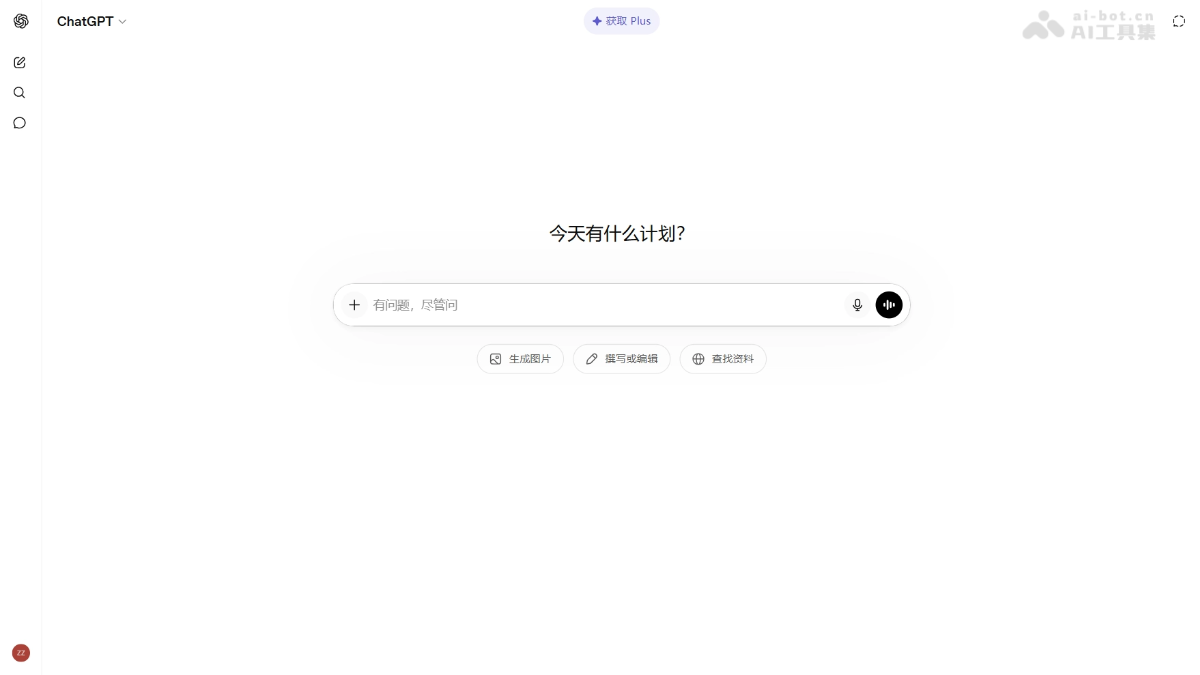
Analysis of the meaning of the name: Chat and GPT
“Chat", meaning "chat" or "conversation," which directly points out the product's main form of interaction and application scenario, as a chatbot capable of natural language conversation with users. It emphasizes the model's ability to understand and generate dialogue, providing a smooth, coherent, and logical communication experience that makes users feel as if they are talking with an intelligent partner.
-
Generative: Indicates that the model has the ability to generate text. It not only simply retrieves or matches existing information, but can create entirely new text content that conforms to grammar and logic based on learned language patterns and contextual information. This enables ChatGPT to complete various creative tasks such as writing articles, writing code, and composing poetry.
-
Pre-trained: Means that the model has been pre-trained on large amounts of unlabeled text data. Through this process, the model can automatically learn language structure, grammar, semantics, and world knowledge, acquiring rich language understanding and generation capabilities. This enables the model to perform well on downstream specific tasks even with only a small amount of labeled data or no labeled data at all.
-
Transformer (Transformer): Is a deep learning model architecture proposed by Google in 2017, which has achieved great success in the field of natural language processing. The core of the Transformer architecture is theSelf-Attention Mechanism, which can effectively capture long-distance dependencies in text sequences, process input data in parallel, and greatly improve the efficiency and effectiveness of the model in handling long texts and complex language structures.
Main functions of ChatGPT
-
Natural language conversation: Supports multi-turn continuous communication, understands contextual semantics, and provides a smooth, logically clear dialogue experience.
-
Text generation and creation: Generates articles, stories, poems, and advertising copy based on prompts, and supports imitating specific writing styles.
-
Translation and language learning: Achieves multilingual translation, provides grammar explanations and vocabulary assistance, and helps users learn new languages.
-
Knowledge Q&A: Covers fields such as history, science, and technology, answers various knowledge-based questions, and summarizes complex information.
-
Code programming and debugging: Write, explain, and debug multilingual code, helping developers understand complex code logic.
-
Multimodal Content Analysis: Supports uploading photos, charts, handwritten formulas, and documents for joint visual-language reasoning and information extraction.
-
Memory and Personalization: Automatically records user preferences and historical information, provides precise recommendations based on past conversations, and supports viewing and managing memory sources item by item.
-
Real-Time Web Search: Calls search tools to obtain the latest web information, breaking through knowledge cutoff date limitations.
ChatGPT's Technical Principles
-
Transformer Self-Attention Architecture: Based on the GPT series generative pretrained Transformer architecture, it captures long-distance dependencies in text sequences through the self-attention mechanism, processes input data in parallel, and achieves efficient understanding and generation of complex semantics.
-
Large-Scale Pretraining and RLHF Alignment: Performs unsupervised pretraining on massive unlabeled text to learn language structure and world knowledge; optimizes output style and safety through reinforcement learning from human feedback (RLHF), making responses more aligned with human preferences and values.
-
In-Context Learning and Memory Retrieval: Jointly encodes the current input with multi-turn conversation history, using in-context learning to maintain conversational coherence; GPT-5.5 Instant introduces memory source technology, where the model retrieves relevant historical conversations, uploaded files, and Gmail-linked content during generation, with explicit attribution in the interface.
-
Autoregressive Text Generation: Uses autoregressive decoding to predict output tokens one by one, combines nucleus sampling and temperature sampling to introduce reasonable randomness, and through factual alignment and hallucination suppression technology reduces false statements by 52.5% in high-risk domains.
-
Multimodal Joint Reasoning: Integrates visual-language understanding capabilities to jointly encode and reason over images, scientific charts, handwritten formulas, and complex documents, achieving significant accuracy improvements on multimodal benchmarks such as CharXiv and MMMU-Pro.
ChatGPT's Core Advantages
-
Significantly Reduced Hallucination Rate: In high-risk domains such as healthcare, law, and finance, false statements are reduced by 52.5%, making daily interactions more credible and reliable.
-
Leap in Reasoning and Academic Capabilities: Achieves 81.2% on the AIME 2025 mathematics test and 85.6% on GPQA doctoral-level scientific reasoning, greatly enhancing STEM problem-solving.
-
Natural and Concise Expression: Through style post-training, it reduces redundant formatting and meaningless emojis, cutting word count by about 30% while retaining a warm tone.
-
Controllable and Transparent Memory: Users can view, correct, or delete personal memory entries that affect responses, avoiding interference from outdated information, with privacy autonomously controllable.
-
Multimodal and Tool Augmentation: Supports parsing of photos, charts, and documents as well as intelligent search invocation, enabling a leap from plain text to joint visual-language reasoning.
-
Improved Ecosystem and API: The platform has a vast ecosystem of custom GPTs, and the API supports quick integration via chat-latest, offering high developer friendliness.
Comparison of ChatGPT with Similar Competing Products
| Comparison Dimension | ChatGPT | Kimi Intelligent Assistant | Claude |
|---|---|---|---|
| Core Positioning | AI conversation and content generation, with emphasis on deep reasoning and programming | Long-text processing and intelligent search, with a focus on information integration | A secure and controllable AI assistant, with a focus on deep analysis and long-text understanding |
| Conversational ability | Coherent multi-turn context, supporting complex reasoning and code debugging | Supports an ultra-long context of 2 million characters, suitable for literature and report analysis | Skilled at deep reasoning and nuanced conversation, with precise long-text understanding, suitable for academic and professional analysis |
| Knowledge timeliness | Built-in search tool, able to proactively obtain real-time web information | Strong web search capability, real-time information integration and source tracing | Knowledge cutoff is the training date; real-time information needs to be supplemented through search plugins |
| Multimodal capability | Supports image, chart, handwritten formula, and PDF parsing and reasoning | Supports parsing of multiple formats such as images, PDFs, web pages, and PPTs | Supports image, PDF, and document parsing and visual analysis, with robust multimodal reasoning |
| Memory and personalization | Adds a 'Memory Sources' panel, allowing item-by-item viewing, correction, or deletion | Supports long-term memory, maintaining user preferences across sessions | Supports cross-session Projects and long-term memory, and allows document uploads to build a dedicated knowledge base |
| Ecosystem integration | A vast custom GPTs ecosystem, with rich APIs and third-party tools | Supports all platforms: WeChat Mini Programs, browser extensions, and web | A well-developed API ecosystem, with high integration with office tools such as Slack and Notion |
| Usage threshold | Domestic access requires a network environment and registration of an OpenAI account | Direct domestic access, supports registration-free trial, and one-click login with a mobile phone number | Domestic access requires a network environment, registration of an Anthropic account, and is restricted in some regions |
| Featured functions | Code generation, deep research, custom GPTs, multilingual translation | One-click generation of PPTs, mind maps, meeting minutes, and web page summaries | Real-time Artifacts preview, in-depth document analysis, and outstanding security and controllability |
ChatGPT product pricing
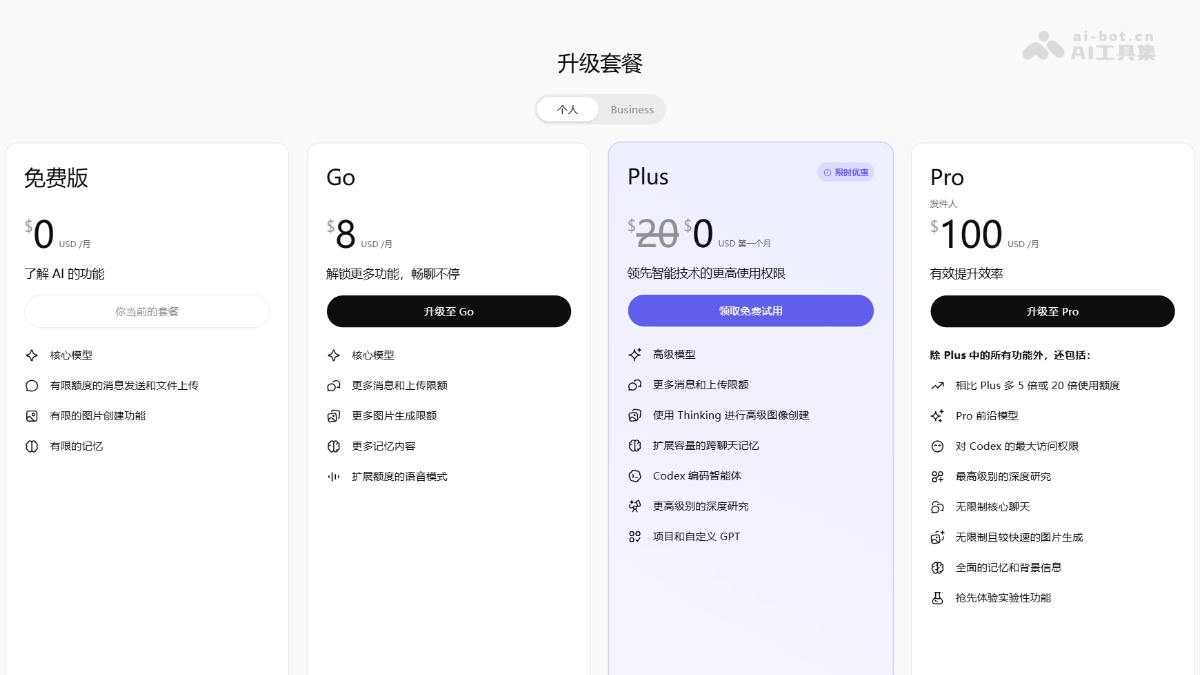
- Free version (Free): $0/month, provides access to the core model, but message sending, file uploads, image generation, and memory functions all have strict quota limits, suitable for basic users trying AI for the first time.
- Go: $8/month, increases the quotas for messages, uploads, image generation, memory, and voice mode on top of the free version, but still uses the core model and does not include advanced features, suitable for light users with limited budgets who need higher-frequency use.
- Plus: $20/month (limited-time $0 offer for the first month, returning to the original price starting June 9, 2026), unlocks advanced models, expanded message and upload limits, Thinking advanced image creation, cross-chat memory, the Codex coding agent, deep research, and custom GPTs, making it the main choice for most professional users.
- Pro: $100/month, includes all Plus features and provides 5x or 20x usage quotas, the Pro frontier model, maximum Codex access, the highest level of deep research, unlimited core chat and image generation, comprehensive memory, and early access to experimental features, suitable for high-frequency heavy users and professionals.
ChatGPT application scenarios
-
Intelligent customer service and daily consultation: Handles user issues 24/7, understands intent and provides personalized answers, suitable for customer service scenarios such as e-commerce, finance, and government affairs.
-
Marketing and Content Creation: Assists in writing advertising copy, social media posts, blog articles, and email marketing content, helping brands efficiently reach target audiences.
-
Education and Research Assistance: Provides students with personalized tutoring, problem-solving approaches, and knowledge explanations; summarizes papers, analyzes data charts, and assists academic writing for researchers.
-
Programming Development and Debugging: Generates code snippets, explains complex logic, and troubleshoots bugs, supporting multiple languages such as Python, JavaScript, and C++.
-
High-Risk Professional Consultation: In scenarios with extremely high accuracy requirements, such as medical symptom interpretation, legal clause analysis, and financial data verification, it provides trustworthy references by leveraging the advantage of a 52.5% reduction in hallucination rate.
-
Personalized Lifestyle Recommendations: Proactively recommends restaurants, recipes, and travel plans based on historical memory, without requiring users to repeatedly state dietary restrictions and preferences.
ChatGPT's Strengths and Limitations
Strengths Analysis
-
Significantly Reduced Hallucination Rate: In high-risk fields such as healthcare, law, and finance, false statements are reduced by 52.5%, making daily interactions more trustworthy and reliable.
-
Leap in Reasoning and Academic Capabilities: Achieves 81.2% on the AIME 2025 mathematics test and 85.6% on GPQA doctoral-level scientific reasoning, greatly enhancing STEM problem-solving.
-
Natural and Concise Expression: Through style post-training, reduces redundant formatting and meaningless emojis, cutting word count by about 30% while retaining a warm tone.
-
Controllable and Transparent Memory: Users can view, correct, or delete personal memory entries that affect responses, avoiding interference from outdated information and keeping privacy autonomous and controllable.
-
Multimodal and Tool Enhancement: Supports parsing of photos, charts, and documents as well as intelligent search invocation, enabling a leap from plain text to joint visual-language reasoning.
-
Well-Developed Ecosystem and API: The platform has a vast ecosystem of custom GPTs, and the API supports quick integration via chat-latest, offering high developer friendliness.
Limitations and Challenges
-
Knowledge Cutoff and Insufficient Real-Time Capability: ChatGPT is pretrained on massive historical text, and its knowledge base reflects the state of the world at the cutoff of the training data. For new events, discoveries, policies, or dynamically changing information that occur afterward, it cannot provide accurate answers and may even give erroneous answers based on outdated information.
-
May Generate Misinformation and Bias: The model generates text based on statistical patterns in training data and does not truly "understand" the actual meaning of the content, nor can it conduct fact-checking like humans. Therefore, it may generate content that sounds plausible but is actually inaccurate, factually incorrect, or even entirely fabricated (i.e., "hallucinations"), while biases present in the training data may be inherited and amplified by the model.
-
Lacks True Human Emotional Understanding and Empathy: ChatGPT cannot truly experience joy, anger, sorrow, or happiness, and cannot deeply understand the complexity and subtleties of human emotions. The "emotional" responses it generates are more based on language patterns and common emotional expressions learned from training data, rather than genuine feelings from the heart, and therefore cannot replace professional psychological counseling or emotional support.