
What is DeepSeek
DeepSeek is the open-source large model andAI intelligent assistantindependently developed by DeepSeek, an artificial intelligence company under High-Flyer Quant. It focuses on the research and development of underlying models and technologies for artificial general intelligence (AGI), exploring paths to realize AGI. DeepSeek has launched multiple open-source large language models, such as DeepSeek-V3 and DeepSeek-R1, targeting GPT-4o and OpenAI's o1 model, respectively. The models perform excellently in reasoning, mathematics, and programming capabilities, with training costs far below the industry average. They are widely applicable, covering multiple fields such as intelligent dialogue, text generation, semantic understanding, and code generation, and support functions such as web search and deep thinking.
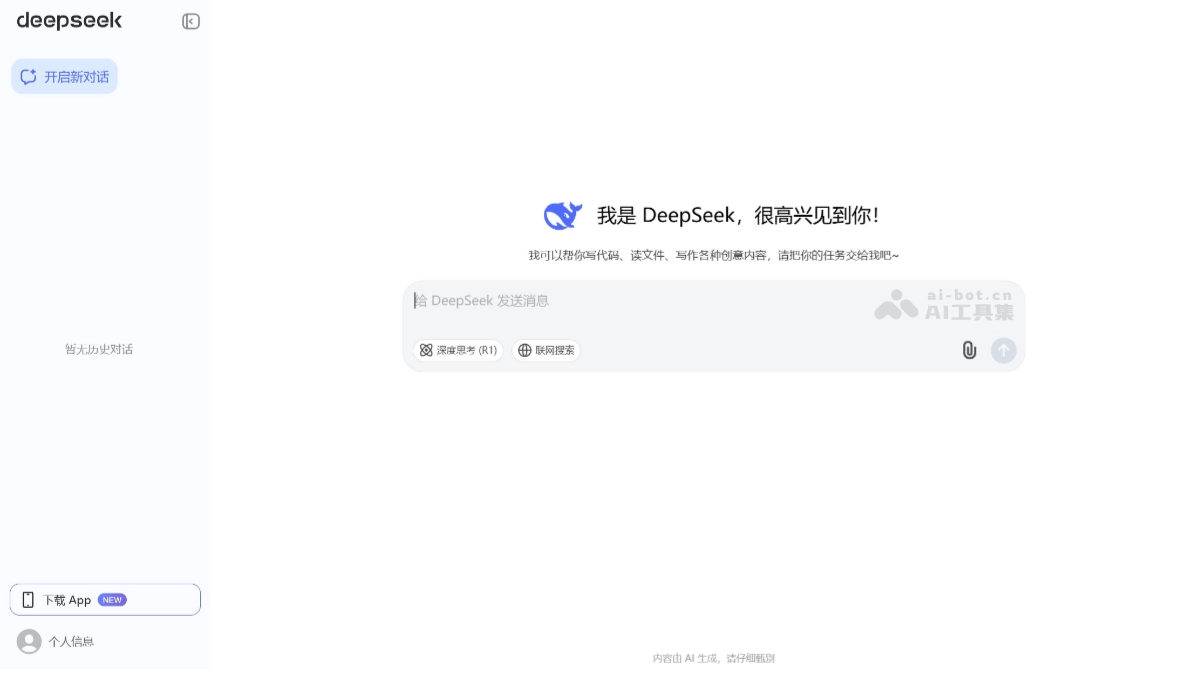
DeepSeek's main features
-
Intelligent question answering and dialogue: DeepSeek can quickly answer various questions, covering scientific knowledge, history and culture, everyday common sense, and technical questions, etc., supports multi-turn dialogue interaction, understands context, and gives coherent answers.
-
Text creation: It can generate many types of text content, such as articles, stories, poems, reports, and emails.
-
Language translation: It supports translation between multiple languages.
-
Data processing: It can process and clean data and perform statistical analysis.
-
Visualization chart generation: It transforms data into intuitive visualization charts such as bar charts, line charts, and pie charts.
-
Code generation: It generates code based on natural language descriptions and supports multiple programming languages.
-
Code debugging and optimization: It helps developers quickly locate and solve problems.
-
Mathematical calculation and reasoning: DeepSeek performs excellently in mathematical calculation and logical reasoning and can handle complex mathematical problems.
-
Web search and real-time information acquisition: Through the web search function, DeepSeek can capture the latest information on the internet in real time, helping users obtain the latest data and developments.
-
Deep thinking and complex problem solving: Deep thinking mode (R1) can handle complex logical reasoning and multi-step analysis problems.
-
Intelligent customer service and automated service: DeepSeek can be integrated into various systems to provide intelligent customer service support and improve service efficiency.
-
Large model development and management: DeepSeek provides a large model development platform that supports functions such as model training, management, and dataset control.
- Image recognition mode: Users can upload images for the AI to perform deep visual understanding and interaction.
DeepSeek's open-source models
- General large language model
-
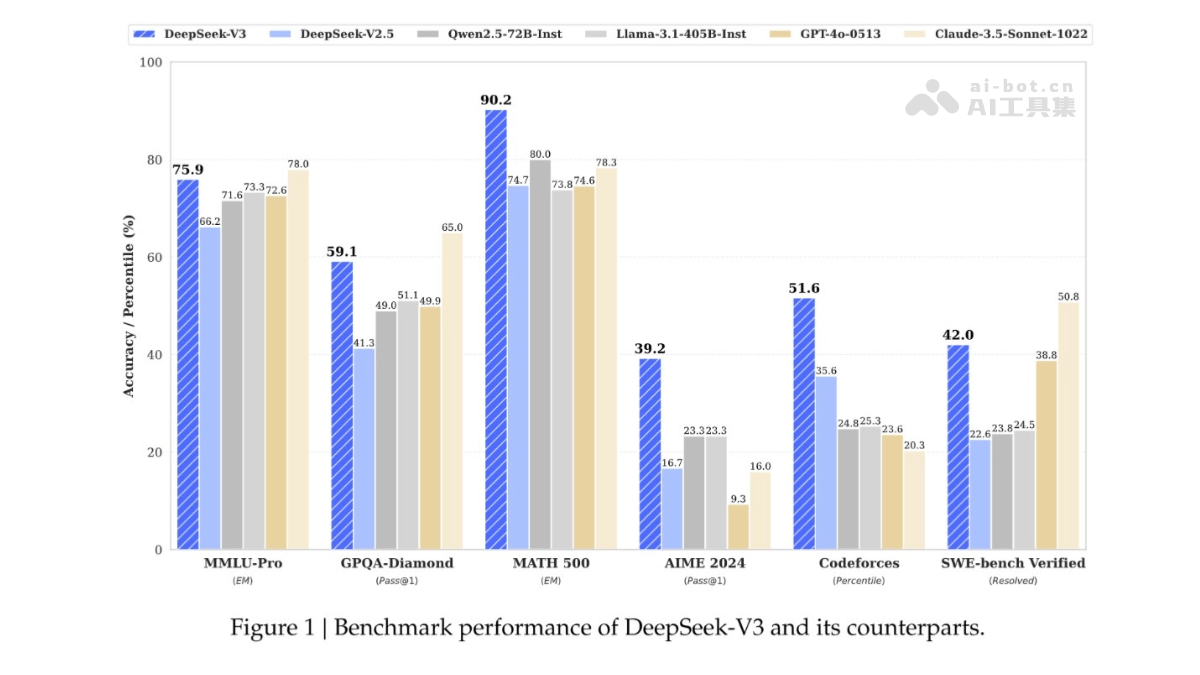
DeepSeek-V3: It adopts a mixture-of-experts (MoE) architecture, with a total parameter scale of 671B and 37B activated parameters. The model performs excellently on tasks such as mathematics and code, supports a 128K long context, and achieves a generation speed of 60 TPS.
-
DeepSeek-V3-Base: It has the same architecture as DeepSeek-V3, provides native FP8 weights, and supports multiple inference frameworks.
- DeepSeek-V3.2: The official version of V3.2 open-sourced by DeepSeek, the model is based onDeepSeek-V3.1-Terminuscontinuous training, and only introduces DSA in the architecture, realizing a fine-grained sparse attention mechanism. With the help of a lightning indexer to efficiently select key information, it greatly improves efficiency during long-text training and inference.
-
- Reasoning-optimized model
-
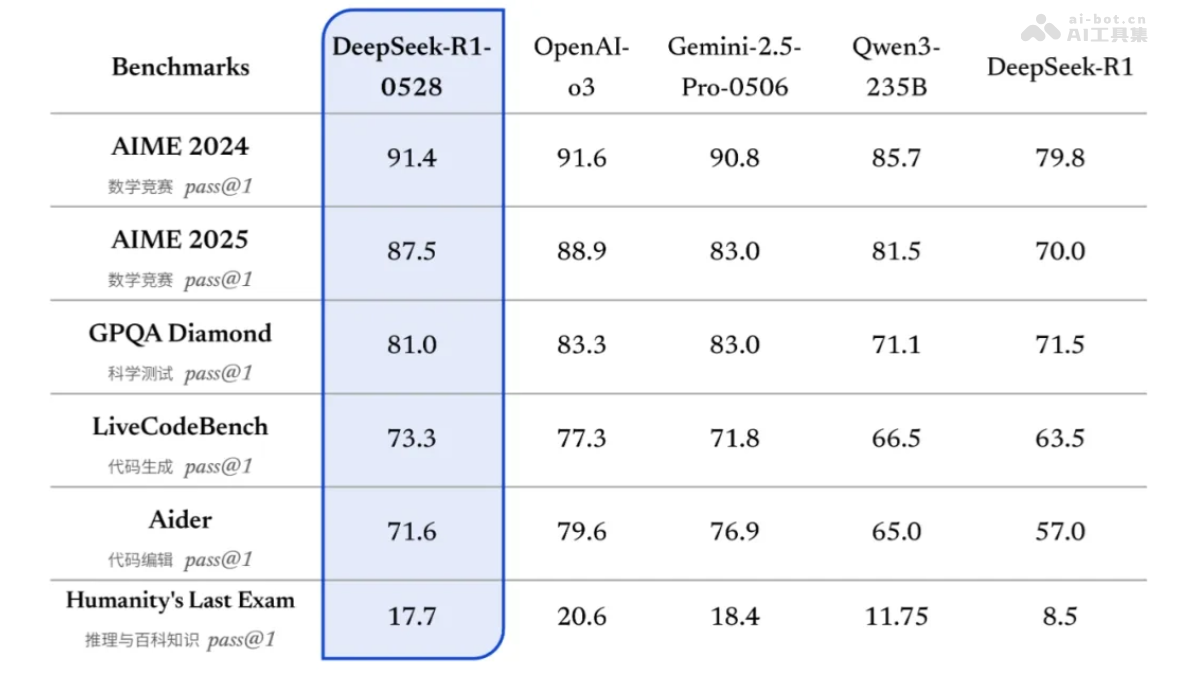
DeepSeek-R1: Trained based on DeepSeek-V3-Base, with reasoning capabilities optimized through reinforcement learning, it performs outstandingly in mathematics, programming, and natural language reasoning tasks.
-
DeepSeek-R1-Zero: A reinforcement learning model that does not use supervised fine-tuning, with powerful reasoning capabilities, but it faces challenges in readability and other aspects.
-
DeepSeek-R1-Distill: Small models are distilled and optimized based on reasoning data generated by DeepSeek-R1, covering different scales such as 1.5B, 7B, 8B, 14B, 32B, and 70B.
- DeepSeek-R1-0528 : It is the latest AI model released by DeepSeek. The model is trained based on DeepSeek-V3-0324 and has 660B parameters. Its core highlights include deep reasoning capabilities, optimized text generation, a unique reasoning style, and the ability to handle a single task for as long as 30-60 minutes.
-
- Multimodal model
-
DeepSeek-VL2: A multimodal model for vision and language understanding, including Tiny, Small, and standard versions, with 1.0B, 2.8B, and 4.5B activated parameters respectively.
-
Janus: A series of multimodal models focused on the combination of vision and language.
-
- Vertical domain models
-
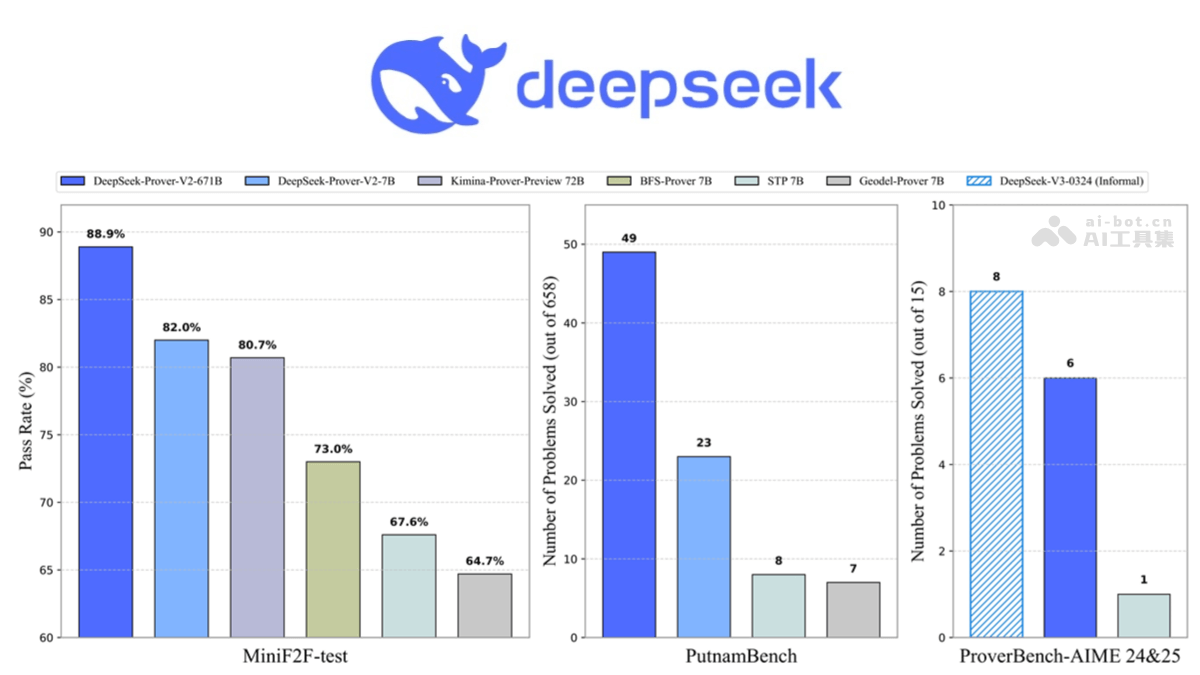
DeepSeek-Prover-V2: Designed specifically for mathematical theorem proving, implementing formal reasoning verification based on the Lean 4 programming language.
-
DeepSeek's technical advantages
-
Mixture of Experts (MoE) architecture: DeepSeek-V3 adopts an MoE architecture, with a total parameter scale of 671B, while in actual operation only 37B parameters are activated per token. Through Multi-head Latent Attention (MLA) technology, the architecture compresses the Key-Value cache to 1/4 of that of a traditional Transformer, greatly reducing inference latency.
-
Multi-token prediction mechanism: DeepSeek-V3 adopts Multi-Token Prediction (MTP) technology to predict multiple tokens at once, improving training efficiency and inference speed.
-
Reinforcement learning optimization: DeepSeek-R1 is trained through a reinforcement learning flywheel and has built a decision-making sandbox containing 14,000 virtual scenarios, adding indicators for thought coherence and interpretability, enabling the model to perform excellently in learning efficiency and decision quality.
-
Trillion-token training system: DeepSeek-V3 has built a 14.8 trillion token corpus covering rich content such as code, mathematical proofs, and multilingual literature, and adopts a dynamic quality filtering mechanism to ensure high data quality.
-
Progressive training: Gradually expanded from a 4K context to 128K, with memory usage increasing by only 18%, and it can adapt to more complex tasks.
-
Model distillation technology: DeepSeek can compress a tens-of-billions-parameter model to the billion level without significantly losing performance, and can run complex AI tasks on edge devices such as low-end phones and industrial sensors.
-
Multilingual support: DeepSeek-V3 supports as many as 83 languages and scores an average of 89.4 on the XTREME-UR evaluation, making it suitable for cross-national communication and multilingual document processing.
-
Fast inference response: DeepSeek's inference response speed is fast, with latency in the inference decoding stage as low as 163 microseconds, 5 times faster than a human blink.
-
Lower computing power costs: By optimizing resource utilization, DeepSeek allows developers to train larger models with fewer GPUs, reducing computing power costs by 60%.
-
Advantages of on-device deployment: DeepSeek's lightweight versions can adapt to a variety of hardware from low-end to high-end chips, promoting the construction of the on-device AI ecosystem.
-
Multimodal fusion: DeepSeek can fuse multi-source data such as satellite remote sensing, drone inspections, and vehicle-mounted sensors to build complex "digital twin" models.
-
Adaptability in low-resource scenarios: Through transfer learning and few-shot learning capabilities, DeepSeek can achieve accurate recognition in scenarios with few disease samples.
-
Open-source features: DeepSeek's open-source features and low-cost, high-performance advantages lower the barrier for enterprises to enter the AI field and promote the普及 of AI technology.
-
Communication optimization: DeepSeek's open-source communication library DeepEP can greatly improve data transmission efficiency, speed up training by 40%, and significantly reduce cross-server transmission latency.
How to use DeepSeek
- Usage methods
-
Web version: Visit the DeepSeek official website; no download is required, and you can use it by opening a browser.
-
App version: Download “DeepSeek APP” from major app stores and install it.
-
Browser extension: Search for “DeepSeek AI” in the Chrome Web Store and install it.
-
- Function modes
-
Smart conversation mode: Used for daily Q&A, copywriting, content optimization, etc.
-
AI search mode: Combined with web search functionality, it provides answers after real-time queries of online information.
-
File reading mode: After uploading a document, DeepSeek can extract key information and summarize the content.
-
Deep thinking mode: When enabled, the model displays its thinking process and is suitable for solving complex problems.
-
- Usage tips
-
Clarify the question: Describe the question clearly and avoid vague expressions.
-
Ask in steps: Break complex questions into multiple smaller questions and go deeper step by step.
-
Use keywords: Help the model better understand the requirements.
-
Multi-turn dialogue: Gradually explore a topic in greater depth.
-
Role-playing: Simulate different roles for dialogue.
-
Knowledge base construction: Build a personal knowledge base with RAGFlow.
- More tips:DeepSeek from beginner to expert
-
- Local deployment: For users with data security and privacy protection needs, DeepSeek supports local deployment: (click to getDeepSeek local deployment nanny-level tutorial)
- Download the model files from the official website.
- Install the required dependency libraries and environment.
- Configure the server and deploy the model.
- Test and optimize model performance.
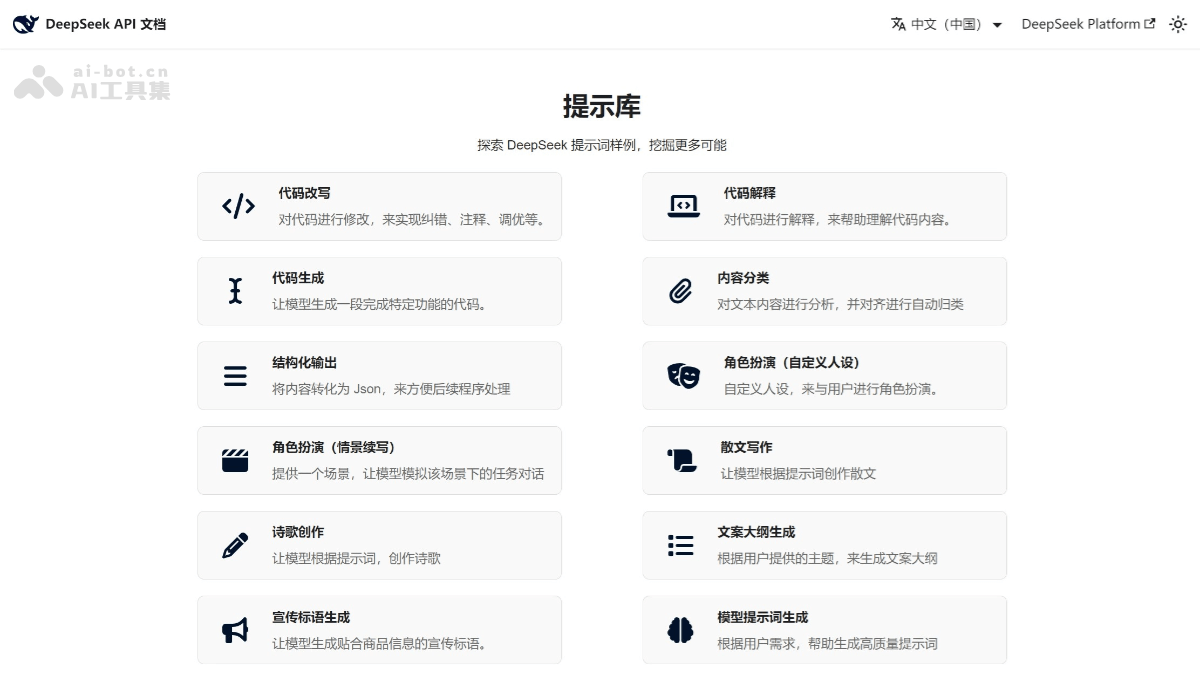
- DeepSeek official prompt library:is an efficient AI interaction tool provided for users, covering multiple application scenarios such as code processing, text generation, content classification, and translation. It provides prompts for 13 core application scenarios, including code rewriting, code explanation, code generation, content classification, structured output, role-playing, prose writing, poetry creation, copy outline generation, promotional slogan generation, model prompt generation, and Chinese-English translation.
DeepSeek's open-source week project
- FlashMLA: A multi-head linear attention decoding kernel optimized for NVIDIA Hopper GPUs, supporting variable-length sequence processing.
-
Breakthrough: Achieves 580 TFLOPS compute performance and 3000 GB/s memory bandwidth on H800 GPUs, improving inference efficiency by 2-3x.
-
Significance: Breaks the monopoly of big tech on efficient inference tools, lowers the barrier for developers, and promotes deployment on edge devices.
-
- DeepEP : A communication library designed specifically for Mixture of Experts (MoE) models, optimizing inter-node data distribution and merging.
-
Breakthrough: Through low-latency kernels and communication-computation overlap techniques, achieves 3x faster training and 5x lower latency, and supports FP8 low-precision communication.
-
Significance: Challenges NVIDIA's NCCL ecosystem and breaks the technical barrier of hardware-software coupling.
-
- DeepGEMM: An FP8-based efficient matrix multiplication library, optimized specifically for MoE models.
-
Breakthrough: With only 300 lines of code, through just-in-time compilation (JIT) and CUDA-core two-level accumulation techniques, achieves 1.1-2.7x speedup, with peak performance reaching 1350 TFLOPS.
-
Significance: Promotes the adoption of low-precision computing and reduces the deployment cost of hundred-billion-parameter models.
-
- DualPipe & EPLB: Innovative bidirectional pipeline parallelism algorithm (DualPipe) and dynamic load balancing tool (EPLB).
-
Breakthrough: Through task interleaving and dynamic replication of expert models, reduces GPU idle time and optimizes resource utilization.
-
Significance: Restructures the AI training process and improves industrial-grade efficiency.
-
- 3FS: A high-performance distributed file system supporting RDMA networks and SSD storage.
-
Breakthrough: Achieves 6.6 TB/s read speed, accelerating vector search during massive data training and inference stages.
-
Significance: Completes the last piece of the AI infrastructure puzzle and solves the storage bottleneck problem.
-
- Smallpond: A data processing framework based on 3FS, supporting lightweight, high-performance data processing and scalable to PB-level datasets.
-
Significance: Based on 3FS's high-performance storage and DuckDB's efficient query capabilities, provides a simple and easy-to-use data processing interface.
-
DeepSeek's Application Scenarios
-
Clinical Auxiliary Diagnosis: DeepSeek can integrate patients' symptoms, medical history, and examination results to provide diagnostic suggestions, helping doctors reduce misdiagnosis and missed diagnosis.
- Education: Helps teachers quickly generate teaching plans and lesson plans. Provides students with customized learning paths and tutoring. Answers students' math and science questions in real time.
-
Intelligent Data Quality Monitoring: Automatically identifies abnormal data patterns and deviations, and provides real-time alerts for quality issues.
-
Natural Language Data Query: Converts natural language questions into SQL queries, lowering the technical barrier to data analysis.
- Content Creation and Office Automation: Quickly generates marketing copy, meeting minutes, etc. Supports code generation and debugging in multiple programming languages. Quickly creates presentation slides and spreadsheets. Provides real-time voice or text translation to facilitate cross-language communication.