
What is MiniMax M2.1
MiniMax M2.1 is a multilingual coding AI model launched by MiniMax. The model systematically improves multilingual capabilities such as Rust, Java, Golang, and more, covering development from the low level to the application layer. In Web and App development, the model significantly enhances design understanding and aesthetic expression, optimizes the execution of compound instructions, and makes office scenarios more practical. Compared with the previous generationMiniMax M2, M2.1 replies more concisely and efficiently, and performs stably and excellently in various programming tools and frameworks. The model has high-quality dialogue and writing capabilities, and can help enterprises and individuals achieve a more AI-native way of working and living.
Main features of MiniMax M2.1
-
Multilingual programming support: MiniMax M2.1 improves its capabilities in multiple languages such as Rust, Java, Golang, and more, covering development from low-level systems to the application layer, and performs excellently in Web and mobile development.
-
Complex task handling: By introducing Interleaved Thinking, M2.1 can efficiently integrate compound instructions, support building complete applications from scratch, and optimize code generation and performance.
-
Office scenario automation: M2.1 can control the mouse and keyboard through natural language instructions to complete complex office tasks such as data processing and document generation, achieving end-to-end automation.
-
Efficient interaction and optimization: The model replies concisely and efficiently, responds faster, reduces Token consumption, and supports automatic caching, optimizing the user experience.
-
Generalization ability across tools and frameworks: It performs stably in a variety of programming tools and Agent frameworks, supports multiple context management mechanisms, and provides APIs in different speed versions to meet diverse needs.
-
High-quality dialogue and writing: In daily conversations and technical writing, M2.1 provides more detailed and structured answers, and is not limited to code generation.
Performance of MiniMax M2.1
-
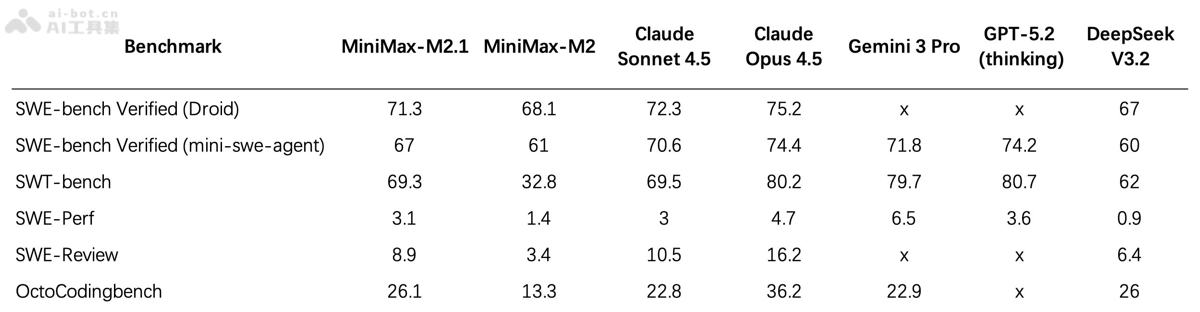
Performance on core software engineering leaderboards: MiniMax M2.1 shows significant improvement over M2 on core leaderboards related to software engineering scenarios, especially in multilingual scenarios, and has surpassed Claude Sonnet 4.5 and Gemini 3 Pro, approaching the level of Claude Opus 4.5 .
-
Framework generalization and stability: In the SWE-bench Verified test, MiniMax M2.1 demonstrates good framework generalization and stable performance, and is suitable for a variety of Coding Agent frameworks.
-
Performance in segmented scenarios: In segmented scenarios such as test case generation, code performance optimization, code review (SWE-Review), and instruction following (OctoCodingBench), MiniMax M2.1 improves comprehensively compared with M2, matching or surpassing Claude Sonnet 4.5.
-
Performance on the VIBE benchmark: In the VIBE benchmark covering Web, simulation, Android, iOS, and backend, MiniMax M2.1 scores an average of 88.6 points, approaching Claude Opus 4.5, and significantly outperforms Claude Sonnet 4.5 on almost all subsets.
-
Office scenarios and comprehensive capabilities: MiniMax M2.1 improves steadily in office scenarios, long-horizon tool calling, and comprehensive intelligence indices, reflecting the model's ability to solve more complex real-world tasks.
MiniMax M2.1 project address
- Project official website:MiniMax
- GitHub repository:https://github.com/MiniMax-AI/MiniMax-M2.1
- HuggingFace model library:https://huggingface.co/MiniMaxAI/MiniMax-M2.1
How to use MiniMax M2.1
- API call: Users can use the MiniMax M2.1 API open platformhttps://platform.minimaxi.com/docs/guides/text-generation直接调用模型,
- MiniMax Agent Use: Get started quickly with the general-purpose Agent product (MiniMax Agent).
-
Local deployment: The open-source version supports local deployment (Hugging Face model repositoryhttps://huggingface.co/MiniMaxAI/MiniMax-M2.1),将在几天后全面开源权重。
To meet different needs, MiniMax provides two API versions, M2.1 and M2.1-lightning. The latter is faster and suitable for high-TPS scenarios, and MiniMax M2.1 fully supports automatic caching to optimize the user experience.
MiniMax M2.1 product pricing
-
MiniMax – M2.1:
-
Input price: 2.1 yuan/million tokens
-
Output price: 8.4 yuan/million tokens
-
Cache read: 0.21 yuan/million tokens
-
Cache write: 2.625 yuan/million tokens
-
-
MiniMax – M2.1 – lightning(Faster version):
-
Input price: 2.1 yuan/million tokens
-
Output price: 16.8 yuan/million tokens
-
Cache read: 0.21 yuan/million tokens
-
Cache write: 2.625 yuan/million tokens
-
MiniMax M2.1 application scenarios
-
Multilingual programming and development: The model supports multilingual programming such as Rust, Java, and Golang, and is suitable for Web, mobile applications (Android/iOS), and backend development, improving development efficiency.
-
Office automation: The model can automatically process data, generate documents, and schedule tasks, and control the mouse and keyboard through natural language instructions to optimize office workflows.
-
Complex task processing: Efficiently integrates multi-step instructions and handles complex logical tasks, ensuring task coherence and accuracy.
-
Code generation and optimization: The model can generate high-quality code, optimize the performance of existing code, and assist development and testing.
-
Full-stack application development: Supports building Web, mobile, and backend applications from scratch, covering the full-stack development process.