
What is GLM-4.6V
GLM-4.6V is a multimodal large model launched by Zhipu, including the base version GLM-4.6V (106B-A12B) for cloud and high-performance cluster scenarios and the lightweight version GLM-4.6V-Flash (9B) for local deployment and low-latency applications. The model supports long context (128k tokens), achieves top-tier visual understanding accuracy at the same parameter scale, and for the first time natively integrates tool-calling capabilities into a vision model, enabling a closed loop from visual perception to executable actions. The model is widely used in scenarios such as intelligent image-text creation, image-based shopping, front-end replication, and long document / video understanding, with performance significantly better than the previous generationGLM-4.5V, and cost reduced by 50%.
Main Features of GLM-4.6V
- Multimodal understanding and generation: The model can process multiple input forms such as images, videos, and text, and generate high-quality mixed image-text content, suitable for scenarios such as content creation and social media publishing.
- Vision-driven tool calling: Supports directly using images, screenshots, etc. as tool parameters without text descriptions, reducing information loss, and can also process multimodal results returned by tools, such as statistical charts, webpage screenshots, etc.
- Long context processing: The context window is increased to 128k tokens, capable of processing complex documents up to 150 pages or 1 hour of video content, supporting cross-document comparative analysis and key event localization in long videos.
- Intelligent shopping assistance and price comparison: In e-commerce scenarios, it can enable a complete pipeline from image recognition to product search, price comparison, and shopping list generation.
- Front-end replication and interactive debugging: Supports pixel-level front-end replication, can quickly transform design mockups into runnable webpage code, and supports multi-turn visual interactive modifications based on screenshots.
- Multimodal interaction and reasoning: In complex tasks, it can combine visual input and textual information for reasoning and generate structured output results, applicable to various business scenarios.
- High cost-effectiveness and flexible deployment: Compared with the previous generation model, cost is reduced by 50%, and it supports deployment in the cloud, locally, and on various hardware environments, meeting the needs of different scenarios.
Performance of GLM-4.6V
In validation across more than 30 multimodal evaluation benchmarks such as MMBench, MathVista, and OCRBench, GLM-4.6V shows significant improvements over the previous generation model, especially reaching top-tier levels in key capabilities such as multimodal interaction, logical reasoning, and long context processing.
- The 9B version GLM-4.6V-Flash: Overall performance exceeds Qwen3-VL-8B (8B parameters), demonstrating higher efficiency and performance in multimodal tasks.
- GLM-4.6V with 106B parameters and 12B activated: Performance is on par with Qwen3-VL-235B, which has 2 times the parameter count, proving its significant advantage in parameter efficiency and its ability to achieve similar or even better performance with fewer computational resources.
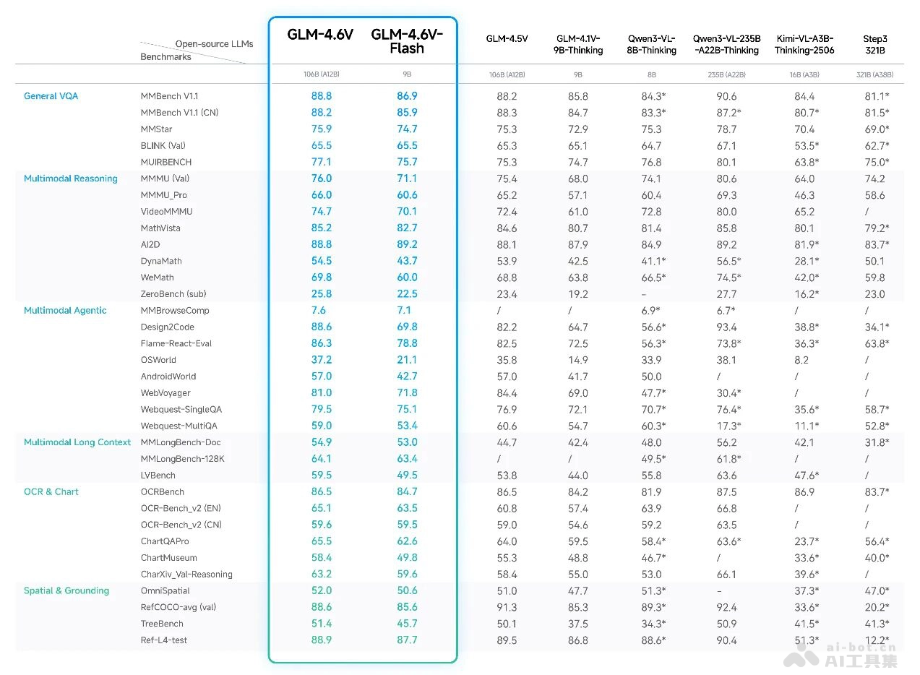
Model Highlights of GLM-4.6V
- Autonomous tool calling: The model natively supports tool calling based on visual input and can handle more complex visual tasks such as mixed image-text, image-based shopping and shopping assistance, and Agent scenarios.
- 128k context window: Theoretically can understand 150 pages of complex documents, 200 pages of PPT, or one hour of video, and can process multiple long documents or long videos in a single inference.
- Improved coding capabilities: Front-end replication and multi-turn visual interaction modification capability optimization, helping developers shorten the path from 'design draft to runnable page'.
- Same-level SOTA: At the same parameter scale, the model achieves SOTA performance in key capabilities such as multimodal interaction, logical reasoning, and long context.
How to use GLM-4.6V
-
Local deployment: Download the code and model weights from GitHub or other open-source platforms, and run them on a local computer or server.
-
Cloud invocation: VisitZhipu Open Platform, register an account, obtain an API key, and invoke the cloud model via network requests.
-
Online experience: Directly visit z.ai orZhipu Qingyan APP / web version, select the GLM-4.6V model, upload an image or enter text, and click 'Inference' to view the results.
-
Integrate into applications: Integrate the model into your own software or system via API or local deployment to implement specific functions.
-
Use inference frameworks: Load the model in supported frameworks (such as SGLang, transformers, etc.) and run it with hardware (such as a GPU).
GLM-4.6V project address
- GitHub repository:https://github.com/zai-org/GLM-V
- HuggingFace model library:https://huggingface.co/collections/zai-org/glm-46v
- Technical paper:https://z.ai/blog/glm-4.6v
GLM-4.6V usage examples
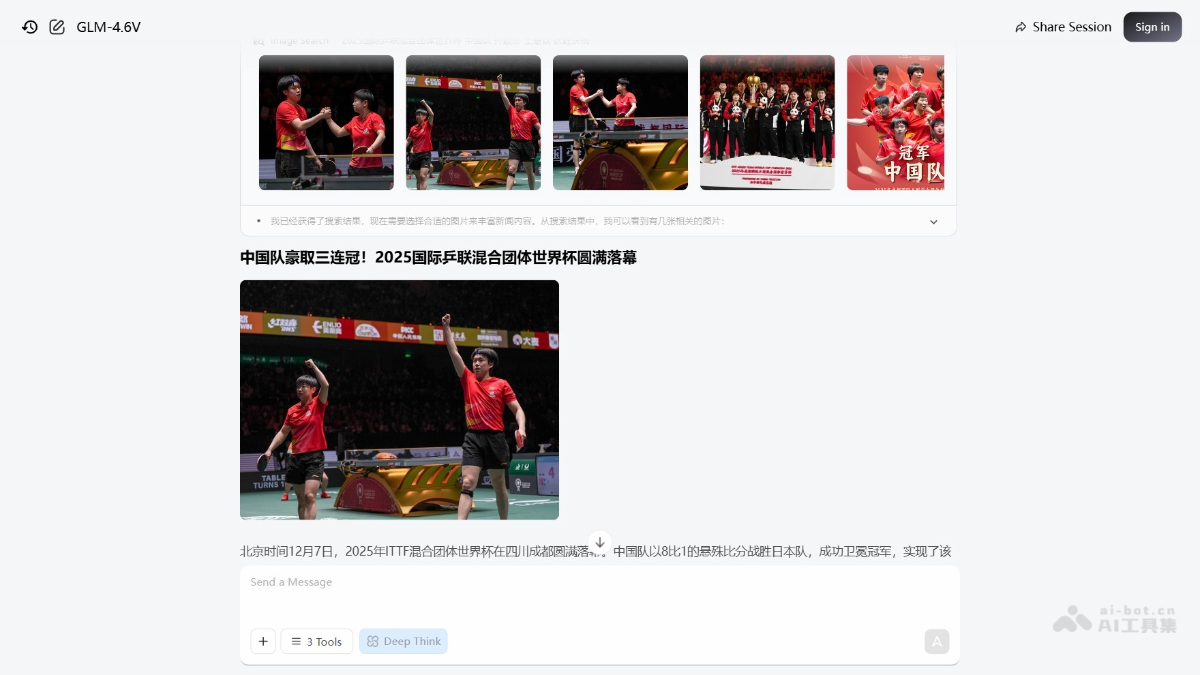
Case: Generate illustrated news from only a topic input
Search for Team China's results in the 2025 ITTF Mixed Team World Cup, and generate an illustrated news introduction
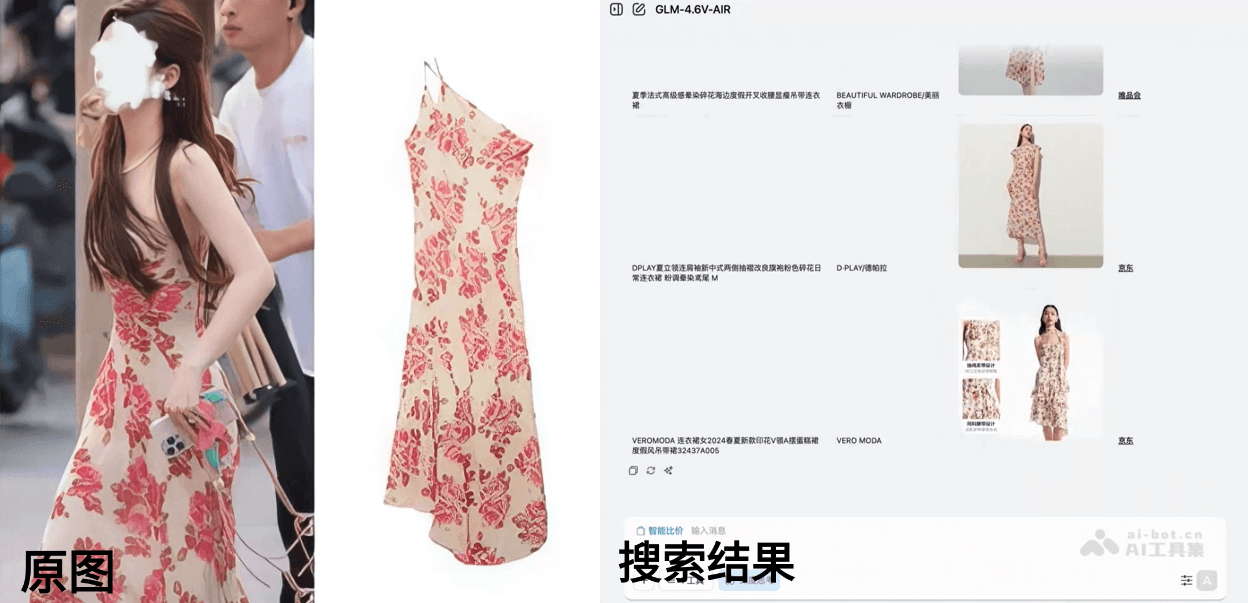
Case: Search for the same item, compare prices, and generate a shopping guide list
GLM-4.6V application scenarios
-
Intelligent illustrated content creation: Input a topic or mixed text-and-image materials, and the model automatically generates clearly structured, illustrated content, suitable for platforms such as social media and WeChat official accounts.
-
Vision-driven shopping: Upload an image and issue an instruction, and the model identifies the shopping intent, searches for the same product, and generates a shopping guide list, improving the e-commerce shopping experience.
-
Front-end development assistance: Upload a webpage screenshot or design draft, and the model accurately replicates it to generate code, supports multi-turn interactive modifications, and accelerates the front-end development process.
-
Long document and video understanding: Process long documents or long videos, support cross-document comparative analysis and key event localization, and assist complex content understanding and research.
-
Multimodal intelligent customer service: Combine visual and textual information to provide accurate answers and suggestions, support multi-turn dialogue, and improve customer service efficiency.