
What is GLM-5.3
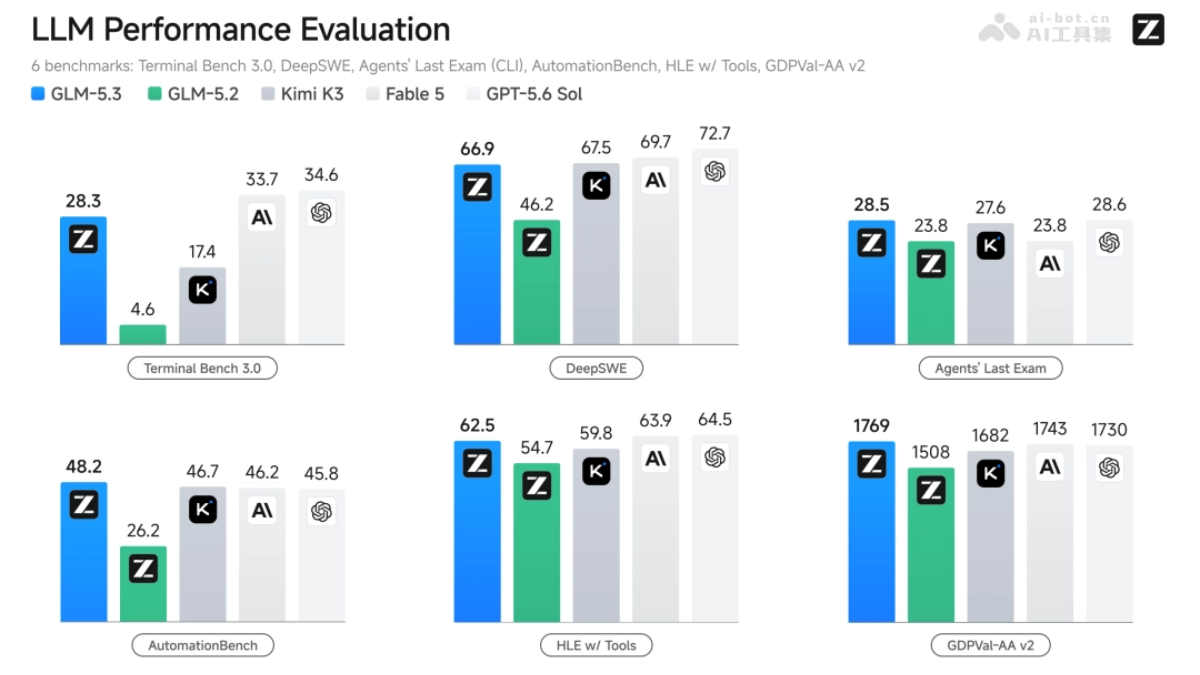
GLM-5.3 is Zhipu's latest open-source foundation model, sharing the same base as GLM-5.2 , and greatly raising the intelligence ceiling through extreme post-training scaling. GLM-5.3 is currently the open-source model with the strongest coding capability, ranking first in multiple benchmarks such as Terminal Bench and DeepSWE; at the same time, it has emerged with powerful cybersecurity capabilities, matching Mythos 5 in white-box code review and vulnerability discovery. Zhipu will open-source the model weights within two weeks and launch the "Shield of Open Source" plan to make security defense capabilities a public good for developers worldwide.
GLM-5.3's main features
- Coding development: GLM-5.3 currently has the strongest coding capability among open-source models, and can handle complex software engineering, terminal operations, long-horizon code modification, and end-to-end development task execution. In real development environments, it can complete the full process from requirements analysis to code implementation and test verification like an engineer.
- Agent tasks: Supports cross-tool collaboration and long-horizon task planning and execution, covering high-value knowledge work in 44 occupational scenarios, with outstanding performance in benchmarks such as Agents' Last Exam.
- Cybersecurity defense: Possesses capabilities such as white-box code review, vulnerability discovery and verification, and exploit analysis, reaching top-tier levels in security benchmarks such as CyberGym and ExploitBench, and can be used for security auditing and CTF problem-solving.
- Code auditing: Has been integrated into Zhipu's official coding tool ZCode, and can automatically perform security checks in daily R&D processes, helping developers discover potential risks at the coding stage.
- Multi-platform access: Supports TraeWork、Coze、WorkBuddy、Qoder、CatPaw and other mainstream coding platforms, so developers can invoke GLM-5.3's capabilities in a variety of development environments.
GLM-5.3's technical principles
- Post-training scaling: GLM-5.3 and GLM-5.2 share exactly the same foundation model, and the performance leap comes entirely from extreme post-training scaling. By expanding the training environment scale by dozens of times, introducing richer and more diverse task types, and investing ultra-long post-training time, based on IndexShare, SAO, and the new-generation Slime reinforcement learning framework, it efficiently advances the model's capability boundary without changing the base.
- Emergent capability mechanism: The model training environment has expanded from the traditional "complete a coding problem" to a complete workflow close to real expert work. The task workload can reach the scale of an engineer working continuously for several days. The model needs to execute end-to-end in real computing clusters, storage systems, code repositories, and experimental results, learning the closed-loop ability from discovering problems, analyzing and reasoning, implementing and verifying, to independently completing work.
- Layered risk review system: GLM-5.3 adopts the principle of defense in depth to build a three-layer review architecture spanning from the API to the model's interior. The outer lightweight classifier intercepts large-scale abusive requests, the reasoning monitor reviews task intent in real time while the model is running, and deep safety alignment enables the model to fundamentally identify and refuse offensive requests on its own, forming a robust protection system with multiple redundant and mutually independent layers.
- Intelligent review methods: The review system distinguishes attack from defense tasks based on "intent" rather than "keywords," and through differential data synthesis and adversarial training it addresses jailbreak variants and disguise techniques. At the same time, it classifies cybersecurity tasks by risk level (such as security knowledge Q&A, blue-team defense, CTF, vulnerability discovery, penetration testing, real intrusion, etc.), constructing tiered risk instances for each, ensuring precise interception of high-risk requests without mistakenly blocking legitimate low-risk routine tasks.
- Security Evaluation System: Zhipu, together with top domestic security teams, conducts continuous red-team testing and automated attack jailbreak evaluation, using newly generated jailbreak samples to continuously iterate and harden the review system. Before open-sourcing, it invites professional teams such as DARKNAVY to independently evaluate the model's capability on risky tasks, ensuring a good balance between protection and capability release.
How to Use GLM-5.3
- ZCode(Coding Tool): An AI coding tool officially launched by Zhipu, already integrated with GLM-5.3, supporting code generation, review, and end-to-end development tasks.
- AutoClaw(Productivity Tool): An official Zhipu productivity tool, already connected to GLM-5.3, usable for daily office work and automation tasks.
- GLM Coding Plan: Zhipu's official coding subscription plan, now open to all users.
Core Advantages of GLM-5.3
- Coding Ability: GLM-5.3 has the strongest coding ability among current open-source models, ranking first in multiple benchmarks such as Terminal Bench and DeepSWE, and its token utilization efficiency is significantly better than comparable closed-source models.
- Cybersecurity Defense: Through post-training, it has developed strong white-box code review and vulnerability discovery capabilities, matching Mythos 5 on security benchmarks such as CyberGym, and has already helped discover thousands of high-risk vulnerabilities in real environments.
- Post-training Scaling: Sharing the same base as GLM-5.2, it achieves a leap in capability solely by expanding the training environment by dozens of times, enriching task types, and greatly extending post-training time, proving that the intelligence upper bound of the base is far from being fully developed.
- Token Efficiency: In real coding scenarios, GLM-5.3 achieves 31.4% accuracy with about 50,000 tokens, surpassing the 29.5% achieved by Claude Opus 4.8 with 120,000 tokens, with a shorter execution path and lower cost.
- Democratizing Open-Source Security: It persists in open-sourcing model weights and launches the "Open-Source Shield" initiative, transforming cutting-edge security defense capabilities from the privilege of a few closed-source organizations into a public good equally accessible to global developers and the open-source community.
- Layered Risk Review: It adopts a three-layer defense-in-depth architecture consisting of an outer classifier, a reasoning monitor, and deep safety alignment, precisely intercepting high-risk attack requests based on intent rather than keywords, while ensuring that legitimate security tasks such as blue-team defense and CTF education are not affected.
Comparison of GLM-5.3 with Similar Competitors
| Comparison Dimension | GLM-5.3 | Kimi K3 |
|---|---|---|
| Developer | Zhipu (Z.ai) | Moonshot AI |
| Open-Source Nature | Full weights open-sourced in two weeks | Open source |
| Coding Ability (Terminal Bench 3.0) | 28.3 | 17.4 |
| Coding Ability (DeepSWE) | 66.9 | 67.5(Slightly higher) |
| Coding Ability (Agents' Last Exam) | 28.5 | 27.6 |
| Cybersecurity (CyberGym) | 84.5% | 80.0% |
| Cybersecurity (ExploitBench) | 54.4% | 32.2% |
| Cybersecurity (Number of ExploitGym 6-hour tasks) | 130 | 70 |
Application Scenarios of GLM-5.3
- AI-Assisted Programming and Complex Software Development: Developers invoke GLM-5.3 through ZCode or third-party coding platforms to complete end-to-end software engineering tasks ranging from requirements analysis, code generation, and long-horizon modifications to test verification, making it particularly suitable for large-scale project iteration and terminal environment operations.
- Enterprise Code Security Auditing and Vulnerability Defense: Security teams use GLM-5.3's white-box code review capabilities to perform automated vulnerability scanning and risk assessment on their own codebases and open-source dependency components, identifying and remediating hidden risks before attackers can exploit them.
- Continuous Security Maintenance for Open-Source Projects: Through the open-source "Shield" program, open-source project maintainers can apply for free model quotas to conduct continuous security audits on key open-source projects, helping the community discover and fix long-unnoticed underlying risks for free.
- Security Research and Talent Development: Universities and training institutions use GLM-5.3 for CTF teaching, blue-team defense exercises, and security knowledge Q&A. While blocking real attack tasks, the model supports low-risk experimental and educational security tasks.
- Critical Infrastructure and Protocol Security: Security laboratories leverage GLM-5.3 to analyze underlying infrastructure such as operating system kernels, browser engines, the DNS protocol, and communication software, uncovering protocol-level or architectural-level vulnerabilities that have lain dormant for decades and preventing large-scale systemic risks.