
What is GLM-5.2
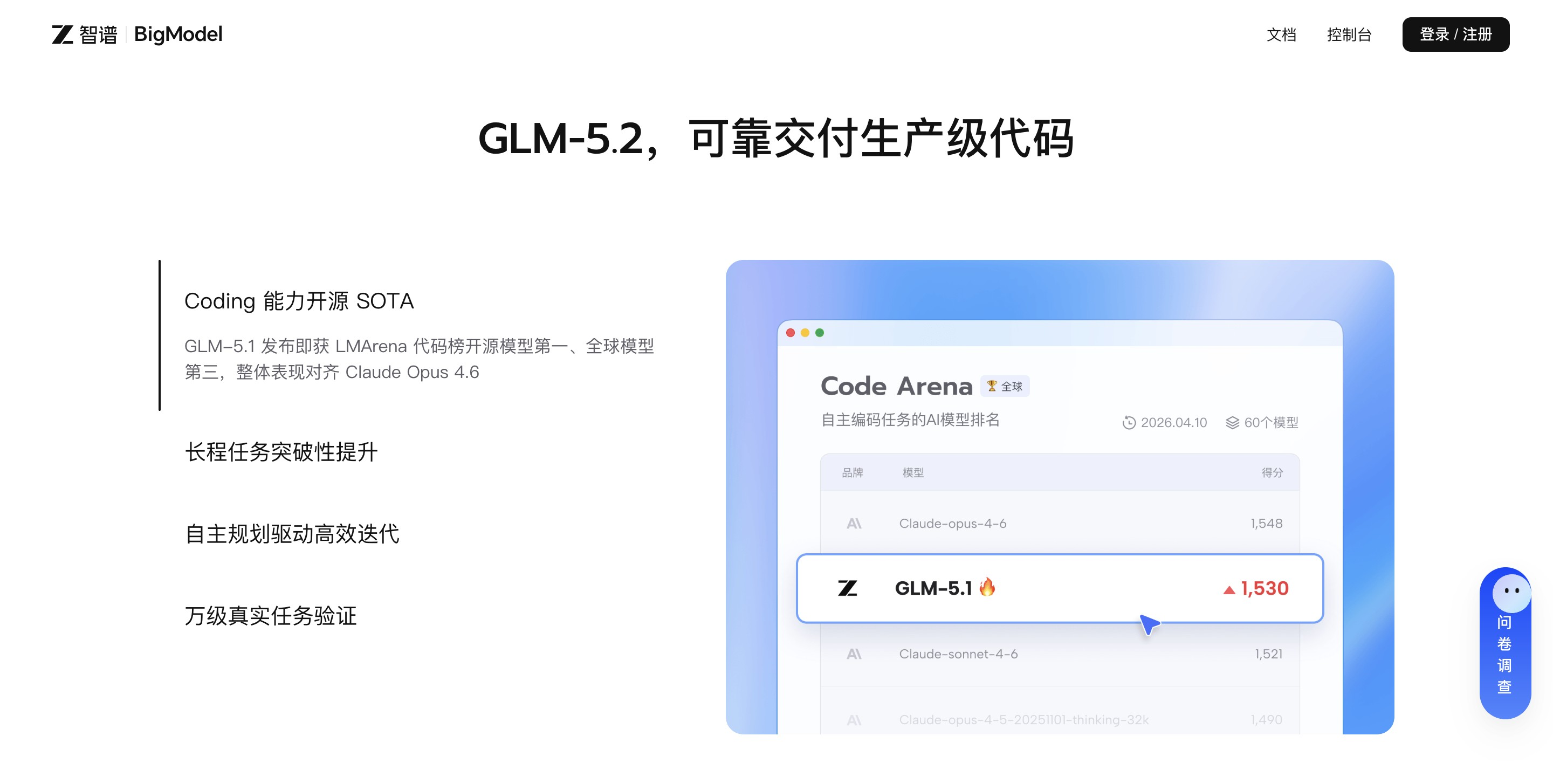
GLM-5.2 is Zhipu's new generation open-source large model with a 1M context, released under the MIT license, focusing on Agentic Coding and ultra-long context capabilities. The GLM-5.2 model supports a 1M tokens context window, can handle large-scale codebases and complex long-horizon tasks, and supports dual-mode reasoning: Thinking/Standard. It is trained on Huawei Ascend chips and the MindSpore framework, with no NVIDIA dependency. Its performance in code generation and software engineering tasks is on par with Claude Opus 4.8, making it a benchmark for domestic Coding models.
Main features of GLM-5.2
-
Ultra-long context processing: Supports 1M tokens context window, can handle large-scale codebases, long documents, and complex multi-turn tasks, maintaining leading performance in long-horizon tasks.
-
Agentic Coding: Focuses on complex software engineering tasks, supports multi-step tool calling, long-chain execution, and autonomous planning, and can independently complete programming tasks lasting up to 8 hours.
-
Dual-mode reasoning: Supports switching between Thinking mode and Standard mode , allowing users to flexibly choose the reasoning depth according to task complexity.
-
Code generation and debugging: Generates high-quality, clearly structured code, and supports full-process programming assistance including code review, bug fixing, and code refactoring.
-
Multi-file/multi-module collaboration: Supports cross-file analysis and project-level code understanding, enabling global optimization and architecture adjustments in large engineering projects.
-
API and tool calling: Supports function calling and external tool integration, and can connect to external resources such as databases, search engines, and code repositories.
-
Private deployment: Model weights will be open-sourced next week, supporting private deployment and secondary fine-tuning based on frameworks such as SGLang, vLLM, and xLLM.

Follow WeChat and reply "open source" to join theAI Open Source Project Communication Group
How to use GLM-5.2
- Online experience: Directly visit Z.ai orZhipu Qingyan web page/App, no configuration required, ready to use out of the box.
- API access: Via the BigModel open platform or Z.ai to obtain an API Key, then call the glm-5.2 model.
- Local deployment: From the Hugging Face model repository https://huggingface.co/zai-org/GLM-5.2下载权重,用 vLLM, SGLang, or transformers to directly load for inference.
- Agent products: Programming scenarios ZCode and office scenarios AutoClaw。
Core advantages of GLM-5.2
-
1M ultra-long context: Supports 1 million tokens of truly usable context window, can process an entire codebase, long documents, and complex multi-turn tasks at once, maintaining leading performance in long-horizon tasks.
-
Fully open source under MIT: Open-sources model weights under the MIT license; developers can freely download, privately deploy, fine-tune, and use commercially without licensing restrictions.
-
Self-reliant domestic computing power: Based on Huawei Ascend chips + MindSpore framework Training, with no NVIDIA dependency throughout, enabling self-controllable compute power and immunity to external export controls.
-
Agentic Coding Benchmark: Focused on complex software engineering tasks, it supports multi-step tool calls and long-chain autonomous execution, and can independently complete programming workflows lasting up to 8 hours.
-
Flexible Dual-Mode Reasoning: Supports switching between Thinking Mode and Standard Mode , enabling deep reasoning for complex tasks and fast responses for simple tasks.
-
Performance on Par with International Top Tier: Code generation and software engineering capabilities are essentially on par with Claude Opus 4.8, ranking among the top open-source models in authoritative benchmarks such as SWE-Bench.
-
Open Ecosystem Philosophy: Adheres to the open path that "frontier intelligence belongs to everyone," with the full chain of APIs, models, and tools open, ensuring developers can use and build at any time.
GLM-5.2 Project Address
- Project Official Website:https://z.ai/blog/glm-5.2
- GitHub Repository:https://github.com/zai-org/GLM-5
- HuggingFace Model Hub:https://huggingface.co/zai-org/GLM-5.2
Comparison of GLM-5.2 with Similar Competitors
| Comparison Dimension | GLM-5.2 | Claude Opus 4.8 | Kimi K2.7 Code |
|---|---|---|---|
| Developing Company | Zhipu AI (China) | Anthropic (USA) | Moonshot AI (China) |
| Release Date | June 13, 2026 | May 28, 2026 | June 12, 2026 |
| Model Positioning | Flagship open-source coding model | Flagship closed-source coding model | Coding-specific model |
| Context Window | 1M tokens | 1M tokens(default) | 256K tokens |
| Open-Source License | MIT(weights open-sourced next week) | Not open-source, API Only | Open-source (already available on HuggingFace) |
| Reasoning Mode | Thinking Mode + Standard Mode (dual-mode switching) | Adaptive thinking + user-controllable effort | Thinking Mode only(mandatory, error if disabled) |
| Coding Benchmark | To be announced (predecessor 5.1 reached SWE-Bench Pro 58.4%) | SWE-Bench Verified 88.6%(all-time high) | Relative to K2.6 improvement: Kimi Code Bench v2 +21.8%、MLS Bench Lite +31.5% |
| Agent Capability | Supports 8-hour independent workflows | Claude Code Workflows (hundreds of parallel sub-agents) | Improvement of about in Kimi Claw 24/7 Bench, etc. 10% |
| API Price | To be announced (launching next week) | $5 / $25 per 1M tokens (Fast mode $10/$50) | 6.5 yuan / 27 yuan per 1M tokens (cache hit 1.3 yuan) |
| High-Speed Version | To be announced | Fast mode (2.5× speed) | High-speed version (5-6× speed, 2× price, launching June 15) |
GLM-5.2 Application Scenarios
-
Large-Scale Codebase Understanding and Refactoring: Using 1M tokens ultra-long context, import an entire project codebase at once (such as a monorepo with hundreds of thousands of lines of code), and perform cross-file dependency analysis, architecture review, technical debt identification, and global refactoring.
-
Complex Software Engineering and Full-Stack Development: Through Agentic Coding capabilities, autonomously complete full-stack project development from requirements analysis, technology selection, front-end and back-end development, database design, to deployment configuration, supporting independent workflows of up to 8 hours.
-
Legacy System Migration and Modernization: Analyze old code (such as Java to Go, jQuery to React), automatically generate migration plans, rewrite code, and ensure functional consistency, reducing the cost of technology stack upgrades.
-
Multi-File Bug Localization and Fixing: In large-scale projects, track cross-module Bug propagation paths based on ultra-long context, automatically generate fix plans, and execute multi-file coordinated modifications.
-
Code Review and Quality Assurance: As an automated Code Review assistant, check code standards, security vulnerabilities, and performance bottlenecks, and output detailed review reports and optimization suggestions.
-
Technical Documentation and Knowledge Base Processing: Process ultra-long technical documents, API specifications, and log files (such as millions of lines of system logs), extract key information, generate summaries, or convert them into executable code.