
What is Kimi K2.7 Code
Kimi K2.7 Code is the open-source next-generation coding-specialized model from Moonshot AI. Compared to K2.6, it significantly improves instruction-following capabilities in long-context coding scenarios and long-horizon task performance, ameliorates the tendency to overthink, and reduces average token consumption by 30%. On benchmarks such as Kimi Code Bench v2, Program-Bench, and MLS Bench Lite, performance improves by 21.8%, 11%, and 31.5% respectively, and Agent autonomous execution capability also improves by about 10%.
Kimi K2.7 Code's Main Features
-
Leap in Long-Context Coding Capability: Significantly improves instruction-following capability in long-context coding scenarios, with substantial enhancement in long-horizon coding task performance.
-
Token Efficiency Optimization: Ameliorates the tendency to overthink in long-horizon tasks, reduces average token consumption by 30%, achieving higher performance with fewer tokens.
-
Comprehensive Breakthroughs on Code Benchmarks: Significant performance improvements on internal and external benchmarks such as Kimi Code Bench v2, Program-Bench, and MLS Bench Lite (improvements of 21.8%, 11%, and 31.5% respectively).
-
Evolution of Agent Autonomous Execution Capability: Performance improves by about 10%。
-
Thinking Mode: Thinking mode must be enabled to achieve optimal performance; both API and Kimi Code have it enabled by default.
-
6x Speed High-Speed Version Support: Output speed in regular coding scenarios is about 180 Token/s, reaching up to 260 Token/sin short-context scenarios; available on API on June 15.
-
Open Source and Local Deployment: The model has been open-sourced and listed on Hugging Face, supporting local deployment by developers.
-
Multi-Platform Access: Supports access and use via the Kimi API open platform, Kimi Code tool, Kimi membership, and enterprise edition.
-
Cache Hit Optimization: Supports a caching mechanism, with the cache-hit input price reduced to 1.3 yuan/1M tokens, effectively reducing invocation costs.
How to Use Kimi K2.7 Code
-
Use via the Kimi Code Tool: Visit kimi code; the default model has been automatically upgraded to Kimi K2.7 Code, and you can start coding assistance directly.
-
Call via the Kimi API Open Platform: Visit the Kimi open platform https://platform.kimi.com/,接入 API to create an application, and refer to the quick start documentation for integration.
-
Experience via Membership/Enterprise Edition: Subscribe to Kimi Code Plan or the enterprise edition Kimi membership plan (which includes Kimi Code Plan benefits) to use the new model.
-
Deploy the Model Locally: Go to Hugging Face (
moonshotai) to download the model weights and deploy and run it in your own local environment. -
Enable Thinking Mode: When using K2.7 Code, thinking mode must be turned on to achieve optimal performance; both API and Kimi Code have it enabled by default. If manually disabled, the API will report an error, and Kimi Code will fall back to the K2.6 model.
-
Use the High-Speed Version (from June 15): Call the high-speed version model via the Kimi API open platform to enjoy about 5-6xoutput speed (in regular scenarios 180 Token/s, short context can reach 260 Token/s)。

Follow WeChat and reply "Open Source" to join theAI Open Source Project Community Group
Core Advantages of Kimi K2.7 Code
-
Comprehensive performance leap: Kimi Code Bench v2 improved by 21.8%, Program-Bench improved by 11%, MLS Bench Lite improved by 31.5%, coding capabilities significantly surpass the previous generation.
-
Token efficiency revolution: overthinking tendency in long-horizon tasks greatly improved, average token consumption reduced by 30%, achieving higher output quality at lower cost.
-
Evolution of autonomous Agent execution: performance on Agent benchmarks such as Kimi Claw 24/7 Bench and MCP Atlas improved by about 10%, with stronger autonomous task execution capabilities.
-
6x ultra-fast experience: the high-speed version reaches an output speed of 180 Token/sin regular programming scenarios, with short-context peaks reaching 260 Token/s, at only 2x the price.
-
Extreme cost-effectiveness: 1M token standard input 6.5 yuan, output 27 yuan, consistent with K2.6; cache-hit input only 1.3 yuan, with limited-time top-up rewards returning up to 30%。
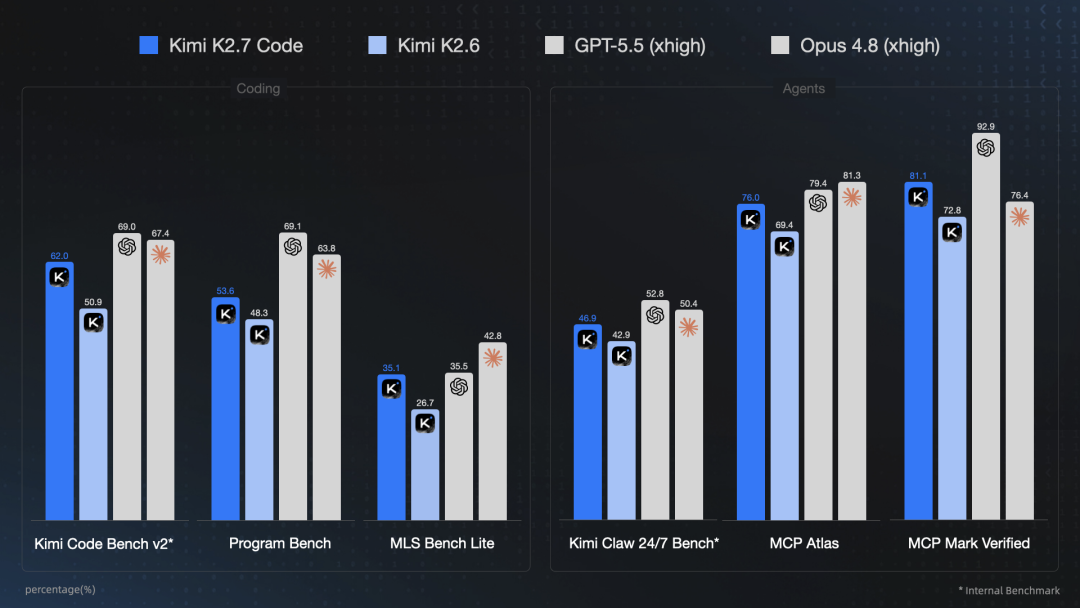
Comparison of Kimi K2.7 Code with Similar Competitors
| Comparison Dimension | Kimi K2.7 Code | Kimi K2.6 | GPT-5.5 (xhigh) | Opus 4.8 (xhigh) |
|---|---|---|---|---|
| Kimi Code Bench v2 | 62.0 | 50.9 | 69.0 | 67.4 |
| Program Bench | 53.6 | 48.3 | 69.1 | 63.8 |
| MLS Bench Lite | 35.1 | 26.7 | 35.5 | 42.8 |
| Kimi Claw 24/7 Bench | 46.9 | 42.9 | 52.8 | 50.4 |
| MCP Atlas | 76.0 | 69.4 | 79.4 | 81.3 |
| MCP Mark Verified | 81.1 | 72.8 | 92.9 | 76.4 |
| Standard input price (yuan/1M tokens) | 6.5 | 6.5 | — | — |
| Standard output price (yuan/1M tokens) | 27 | 27 | — | — |
| Cache-hit input (yuan/1M tokens) | 1.3 | — | — | — |
| Relative token consumption | Reduced by 30% | compared with K2.6 | — | — |
| High-speed version output speed | 180~260 Token/s | — | — | — |
Application Scenarios of Kimi K2.7 Code
-
Large-scale codebase understanding and development: use long-context capabilities to handle complex projects with tens of thousands of lines of code, performing cross-file analysis, architecture organization, and feature development.
-
Long-horizon software engineering tasks (SWE): complete requirement analysis, code writing, test case generation, and debugging fixes end to end, supporting complex engineering benchmarks such as Program-Bench.
-
Agent automated workflows: connect external tools and services through the MCP protocol to achieve autonomous code deployment, document generation, CI/CD process orchestration, and other 24/7 uninterrupted tasks.
-
Real-time interactive programming assistance: leverage the high-speed version (180~260 Token/s) for rapid prototyping, instant code completion, real-time error diagnosis, and fix suggestions.
-
Code review and refactoring optimization: conduct in-depth review of legacy code, identify potential vulnerabilities and performance bottlenecks, and perform large-scale refactoring to reduce technical debt.
-
Multimodal programming scenarios: combine the multimodal capabilities of the Kimi series to handle programming tasks involving visual information such as UI screenshots, design mockups, and video demonstrations (such as front-end reproduction and interface implementation).