
What is Step 3.7 Flash
Step 3.7 Flash is a new-generation open-source Flash model launched by StepFun for the Agent productionization stage. It adopts a sparse MoE architecture and achieves a maximum generation speed of 400 Tokens/s. The model is systematically optimized around Agent, Coding, Search, and multimodal workflows, striking a balance between speed, cost, reliable execution, and complex task completion capability, providing developers with a highly efficient base model for building production-grade Agents.
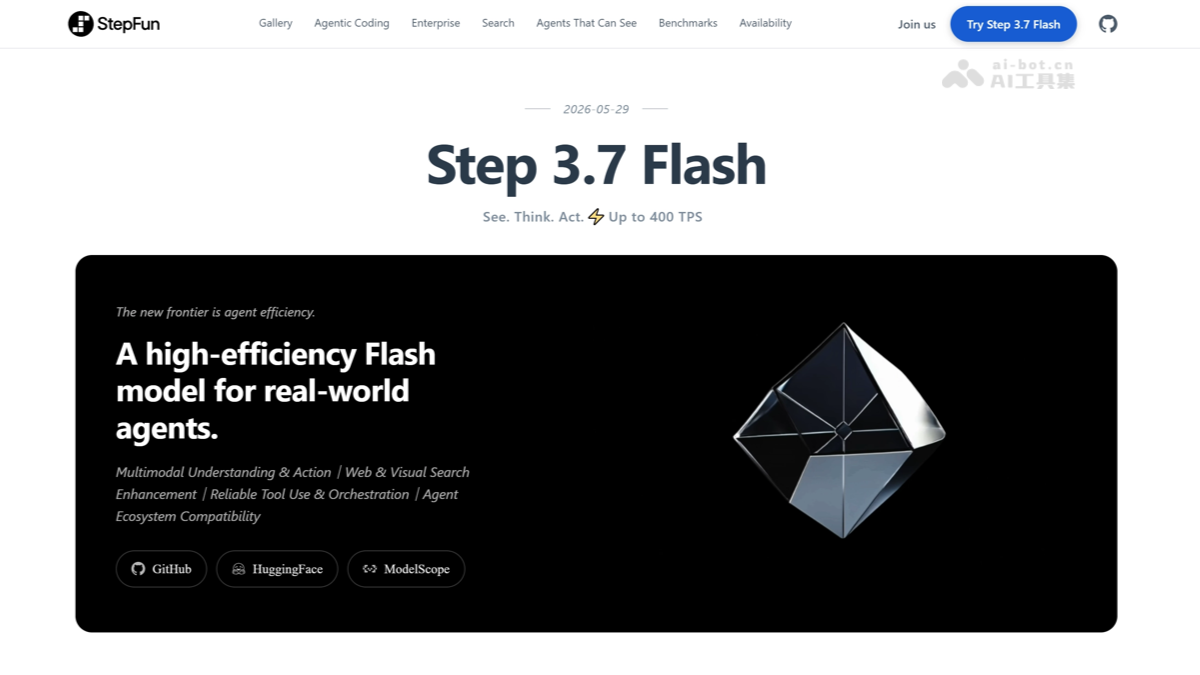
Main features of Step 3.7 Flash
-
Native multimodal understanding and execution: Natively understands UI, charts, documents, images, and application interfaces, transforming complex visual information into structured results, code generation, and executable tasks, and supports autonomous cropping, zooming in, and re-reading images.
-
Enhanced web and visual search: Strengthens web retrieval and image search, actively acquiring and cross-checking multi-source evidence across text and images in open information environments.
-
Highly reliable tool calling and orchestration: Stably calls APIs, browsers, terminals, Office tools, and external systems in long-horizon multi-turn Agent workflows, maintaining task trajectory consistency.
-
Agent ecosystem compatibility optimization: Compatible and adapted for Claude Code、KiloCode、RooCode、OpenCode、Hermes Agent、OpenClaw and other mainstream Agent frameworks as well as MCP/Skills protocols.
-
Dual local and cloud deployment: Supports cloud API calls while being optimized for local deployment on personal workstations, providing GGUF multi-precision on-device versions.
Technical principles of Step 3.7 Flash
-
Sparse MoE architecture: Total parameters 196B + 1.8B (ViT), with only 11B activated parameters, achieving a better balance between model capability and inference cost.
-
Visual perception-search-reasoning fusion: Deeply integrates visual perception, search, and reasoning processes, proactively initiating searches for cross-validation when facing complex visual problems.
-
Long-horizon task trajectory preservation: Maintains task trajectory consistency in multi-turn Agent workflows through optimization, reducing drift and execution failure rates.
-
Multi-precision on-device optimization: Provides GGUF format support, adapting to local deployment needs with different hardware resources.
How to use Step 3.7 Flash
- Cloud access
- Domestic open platform API: Visit https://platform.stepfun.com注册账号,获取 After obtaining an API Key, you can call the model's capabilities through standard interfaces.
- Overseas open platform API: Visit https://platform.stepfun.ai for overseas node access, suitable for international business scenarios.
- Studio online experience: Enter https://studio.stepfun.com/ to experience model conversation and multimodal capabilities directly on the web without configuration.
- Open-source deployment
- GitHub repository: Go to https://github.com/stepfun-ai/Step-3.7-Flash下载完整代码与权重,按文档完成本地或服务器部署。
- Huggingface model: Load and infer directly in https://huggingface.co/stepfun-ai/Step-3.7-Flash获取模型文件,支持 Transformers and other mainstream frameworks.
- Modelscope model: Viahttps://modelscope.cn/models/stepfun-ai/Step-3.7-Flash下载,适合国内开发者快速拉取。
- On-device GGUF version: Visit https://huggingface.co/stepfun-ai/Step-3.7-Flash-GGUF to obtain multi-precision quantized versions, which can run smoothly on personal workstations and even low-configuration devices.
- Application end and ecosystem
- StepFun AI App: DownloadStep AI Mobilemobile application, experience Step 3.7 Flash's question-answering and Agent capabilities directly on your phone.
- Agent Framework Integration: Configure Step 3.7 Flash's API endpoint in verified Agent tools such as Kilo Code and Nous Research (Hermes Agent), where it can serve as the underlying model to drive coding and automated workflows.
Core Advantages of Step 3.7 Flash
-
Ultra-Fast Inference: Up to 400 TPS per request, suitable for high-frequency, multi-turn, low-latency Agent applications.
-
Extremely Low Activated Parameters: Only 11B activated parameters, greatly reducing inference cost and offering extremely high cost-effectiveness.
-
Production-Grade Reliability: Stable performance on real-world environment benchmarks such as Toolathlon (49.5%), ClawEval-1.1 (67.1%), and GDPval (45.8%).
-
Deep Multimodal Understanding: Comparable to larger flagship models on complex visual tasks such as SimpleVQA (79.2%) and V* (95.3%).
-
Plug-and-Play Ecosystem: Pre-optimized for mainstream Agent frameworks and the MCP/Skills protocols, reducing integration costs.
Step 3.7 Flash Project Address
- Project Official Website:https://static.stepfun.com/blog/step-3.7-flash/
- GitHub Repository:https://github.com/stepfun-ai/Step-3.7-Flash
- HuggingFace Model Repository:https://huggingface.co/stepfun-ai/Step-3.7-Flash
Comparison of Step 3.7 Flash with Similar Competitors
| Comparison Dimension | Step 3.7 Flash | Step 3.5 Flash | Gemini 2.5 Flash |
|---|---|---|---|
| Architecture | Sparse MoE, 196B/11B activated | Previous-generation Flash architecture | Unknown |
| Maximum Speed | 400 TPS | Lower | Higher |
| SWE-Bench Pro | 56.3 | 51.3 | 55.6 |
| Terminal-Bench 2.1 | 59.5 | 53.4 | 62.0 |
| SimpleVQA (Tool) | 79.2 | 78.2 | 78.2 |
| V (Python)* | 95.3 | 89.0 | 96.9 |
| ClawEval-1.1 | 67.1 | 43.6 | 57.8 |
| Toolathlon | 49.5 | 33.3 | 52.8 |
| HLE (Tool) | 47.2 | 35.7 | 45.1 |
| Open Source | ✅ Fully open source | ✅ Open source | ❌ Closed source |
Application Scenarios of Step 3.7 Flash
-
Coding Agent: Outstanding performance on SWE-Bench Pro and Terminal-Bench, capable of reliably executing development tasks such as code generation, debugging, and terminal operations.
-
Multimodal Knowledge Work: Automatically understands UI interfaces, charts, and documents, generating structured analysis or operation guides, suitable for product analysis, design review, and software tutorial generation.
-
Enterprise Process Automation: Through stable invocation of APIs, Office tools, and external systems, it embeds into enterprise workflows to perform data entry, report generation, and cross-system operations.
-
Visual Search and Verification: Proactively initiates image search and cross-verification when information is uncertain, suitable for e-commerce price comparison, content moderation, and fact-checking.