

What is Hermes Agent
Hermes Agent is an open-source autonomous AI Agent framework launched by Nous Research. It is not a simple chatbot or programming assistant, but an intelligent agent with a built-in "self-improving learning loop" that can automatically create and optimize reusable Skills after completing tasks, and achieve persistent memory across sessions through FTS5 and Honcho, understanding users better the more it is used. It supports unified access to 15+ messaging platforms, 47 built-in tools, MCP ecosystem extensions, and Cron scheduled automation, and can be deployed on 6 terminal backends including local, Docker, and Modal.
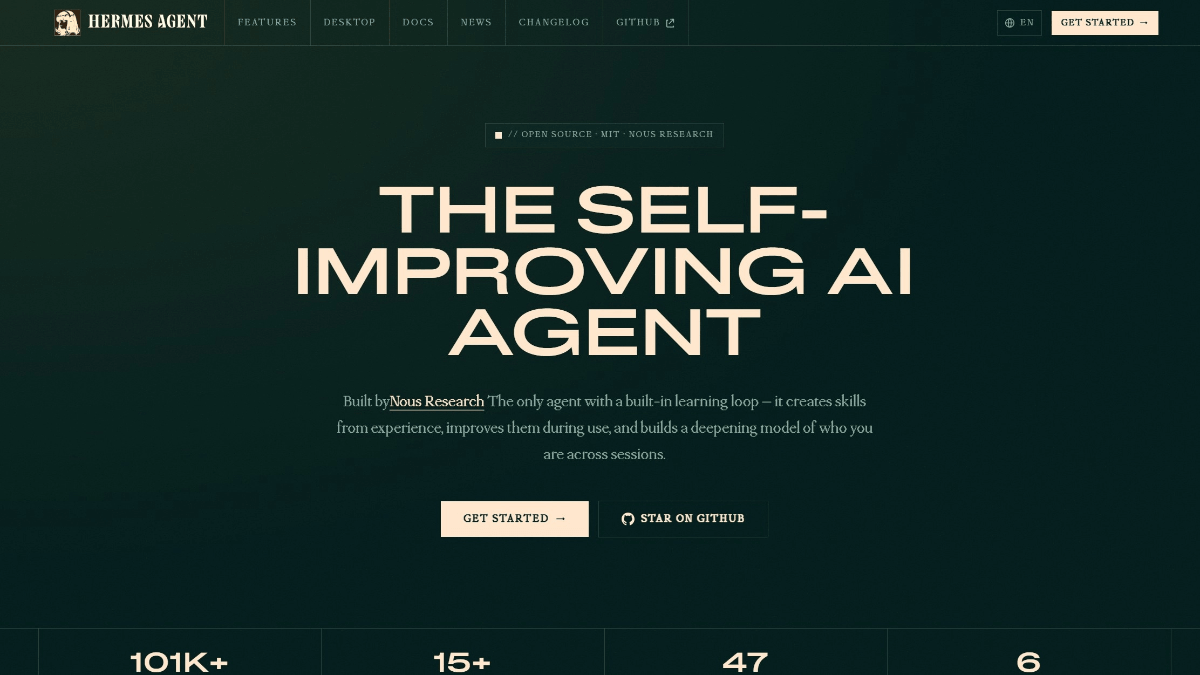
Main features of Hermes Agent
-
Self-improving learning loop: After completing a task, it automatically evaluates and generates a reusable Skill stored locally, continuously optimizes it during use, and directly calls it the next time a similar task is encountered. The official claim is that it can reduce API call costs by about 90%.
-
Persistent three-tier memory system: Based on SQLite FTS5, it achieves millisecond-level cross-session retrieval, and works with Honcho for user preference modeling. The memory capacity is theoretically unlimited, and it understands users better the more it is used.
-
Portable skill system: Skills are stored as documents in
~/.hermes/skills/, compatible with the agentskills.io standard, and support community sharing and cross-Agent reuse. -
15+ messaging platform gateway: A single gateway connects to Telegram, Discord, Slack, WhatsApp, Signal, DingTalk, Feishu, WeCom, Email, SMS, Home Assistant, and more.
-
MCP ecosystem integration: Supports Model Context Protocol server extensions, and can securely connect to 40+ built-in tools and external MCP services.
-
Scheduled automation: Built-in Cron system, supports creating scheduled tasks with natural language descriptions, and results can be pushed to any connected messaging platform.
-
Multi-terminal backends: Supports 6 deployment methods including Local, Docker, SSH, Daytona, Singularity, and Modal. Modal supports serverless hibernation and on-demand wake-up.
-
200+ LLM compatibility: Through OpenRouter or direct connection to Anthropic, OpenAI, Ollama, etc., supports automatic failover, and requires a model context of no less than 64K tokens.
-
Multi-Agent collaboration: Supports Subagent parallel isolation and delegation, and can split complex tasks into subtasks and coordinate multiple Agents to complete them together.
- Profile Builder: A web-based visual configuration tool that, through a 5-step wizard, integrates the originally scattered command-line configuration into a one-stop intelligent agent role creation process.
How to use Hermes Agent
-
Installation and deployment: Execute a one-line command on Linux, macOS, or Windows WSL2
curl -fsSL https://raw.githubusercontent.com/NousResearch/hermes-agent/main/scripts/install.sh | bashto complete installation, requiring only a minimum of 4GB of memory. -
Configure the model: Run
hermes setupto select an LLM provider. It supports accessing 200+ models through OpenRouter, or directly connecting to Anthropic, OpenAI, local Ollama models, etc. The model context window is required to be no less than 64K tokens. -
Start a conversation: Execute
hermesto start the Agent and begin natural language interaction. The Agent will automatically record the conversation and build a user model. -
Connect to messaging platforms: Configure the gateway to connect Hermes to 15+ platforms such as Telegram, Discord, Slack, DingTalk, Feishu, WeCom, Email, etc., achieving unified responses across channels.
-
Create scheduled tasks: Use the built-in Cron system to set scheduled tasks through natural language descriptions (such as "push a tech briefing to Telegram every morning at 9 AM"), and Hermes will execute autonomously and push the results.
-
Extend tool capabilities: Connect to external servers through the MCP protocol to extend the toolset, or directly use 47 built-in tools to perform web search, browser automation, code execution, and other operations.
-
Reuse with Skills: After executing complex tasks, the Agent automatically creates a Skill and saves it to
~/.hermes/skills/, and directly invokes it when encountering similar tasks later; Skills can also be imported from the community or contributed to agentskills.io. -
Choose a runtime backend: Choose Local, Docker, SSH, Daytona, Singularity, or Modal backend deployment according to the scenario. Modal supports serverless automatic sleep and on-demand wake-up, making it suitable for low-cost long-term operation.
-
Offline local operation: Combined with Ollama to load local large models, it enables fully offline, zero-API-cost private deployment, requiring 8–16GB+ VRAM.
Hermes Agent's official website address
- Official website address:https://hermes-agent.nousresearch.com/
- Github repository:https://github.com/NousResearch/hermes-agent
Hermes Agent's core advantages
-
Built-in self-improving learning loop: After completing tasks, it automatically creates, evaluates, and optimizes reusable Skills, and directly invokes them next time instead of reasoning from scratch. The official claim is that it can reduce API call costs by about 90%, achieving "the more you use it, the smarter it gets".
-
Persistent three-tier memory system: Based on SQLite FTS5 millisecond-level cross-session retrieval, combined with Honcho dialectical user modeling, the memory capacity is theoretically unlimited, and it can deeply remember user preferences and project background.
-
Minimal installation barrier: One line
curlcommand completes installation within 60 seconds, and it can be up and running in 5–15 minutes, greatly reducing the onboarding cost compared with the 30+ minutes of debugging time for similar tools. -
High operational reliability: The architecture is more stable, with a task failure rate of only about 5%, far lower than the 30% failure rate of some competitors, and there have been zero Agent-specific CVE security vulnerabilities to date.
-
Not tied to a single model: Through OpenRouter, it is compatible with 200+ LLMs, supports Anthropic, OpenAI, Ollama, etc., and has a built-in automatic failover chain to avoid vendor lock-in.
-
Unified messaging gateway: A single gateway covers 15+ platforms including Telegram, Discord, Slack, DingTalk, Feishu, WeCom, Email, etc., eliminating the need to separately develop integrations for each channel.
-
Permanently open source and free: Open sourced under the MIT license, with 101K+ GitHub Stars. The community has contributed 310+ Skills, the ecosystem is active, and no paid subscription is required.
-
Deploy and run anywhere: Supports 6 backends including Local, Docker, SSH, Daytona, Singularity, and Modal. Modal supports serverless automatic sleep, making long-term operating costs extremely low.
-
MCP ecosystem compatibility: Native support for Model Context Protocol, allowing secure connection to any MCP server, with flexible and standardized tool extension.
Comparison of Hermes Agent with similar competitors
| Comparison dimension | Hermes Agent | OpenClaw |
|---|---|---|
| Developer | Nous Research | Peter Steinberger / Open Foundation |
| Product positioning | Turnkey autonomous AI Agent (Turnkey Agent) | Personal AI Agent operating system / channel operations layer |
| Core philosophy | Cognitive depth — gets smarter the more you use it, self-improving | Breadth of connectivity — local-first, connects to every platform |
| Memory system | Three-layer persistent memory (SQLite FTS5 + Honcho), cross-session recall | Basic file-based memory (Markdown), limited cross-session |
| Self-learning | Built-in E-A-A-S loop, automatically generates and improves Skills | No autonomous learning, Skills must be developed manually |
| Multi-Agent collaboration | Supports Subagent parallel isolation and delegation | Mainly monolithic, can collaborate indirectly via messages |
| Messaging platforms | Native plugins for 15+ platforms (Telegram, Discord, Slack, DingTalk, Feishu, etc.) | 20+ channels, broader coverage |
| Installation barrier | One-line curl command, 60-second install, 5–15 minutes to get started | npm install, 30 minutes+, often requires debugging |
| Reliability | About 5% task failure rate, zero Agent-specific CVEs | About 30% failure rate, 9 CVEs disclosed in 2026.3 (including CVSS 9.9) |
| Best-fit scenarios | 24/7 autonomous operation, messaging channel bots, personal research assistants | Privacy-sensitive local automation, multi-platform operations, cross-border e-commerce |
Hermes Agent application scenarios
-
Personal knowledge management and research assistant: Automatically monitors RSS feeds and academic papers, summarizes key information on a daily schedule and pushes briefings to Telegram or Slack, accumulating over the long term to form a personal knowledge base.
-
Smart meeting preparation Agent: Before meetings, automatically retrieves historical meeting notes, to-dos and related project documents, generating structured meeting agendas and background materials to reduce manual preparation time.
-
DevOps operations monitoring: Periodically checks server health, SSL certificate validity and service uptime via Cron, and immediately alerts to Discord, DingTalk or WeCom when anomalies are found.
-
Automated code review: Connects to the GitHub MCP server, periodically scans newly submitted PRs, automatically performs code review, style checks and flagging of potential issues, and directly submits Review comments.
-
Cross-platform customer service and community operations: Simultaneously connects to channels such as Telegram, Discord, WhatsApp, DingTalk and Feishu through a unified gateway, automatically replies to common questions, and uses persistent memory to record user preferences and provide personalized service.
-
Scheduled data pipelines: Automatically pulls third-party API data on a Cron schedule, and after completing cleaning, transformation and aggregate analysis, periodically pushes data reports to Email or Slack channels.


