
What is Step 3.5 Flash
Step 3.5 Flash is StepFun's latest open-source foundation model, purpose-built for Agent scenarios. The model uses a sparse MoE architecture with 196 billion total parameters, activating only 11 billion parameters per token, balancing performance and efficiency. Step 3.5 Flash delivers inference speeds of up to 350 TPS and supports a 256K long context, rivaling top closed-source models in mathematical reasoning, code generation (SWE-bench 74.4%), and Agent tasks. Step 3.5 Flash is open-sourced and supports frameworks such as vLLM, SGLang, and llama.cpp, and can be deployed locally on consumer-grade hardware such as Mac Studio M4 Max and NVIDIA DGX Spark, achieving both data privacy and high performance.
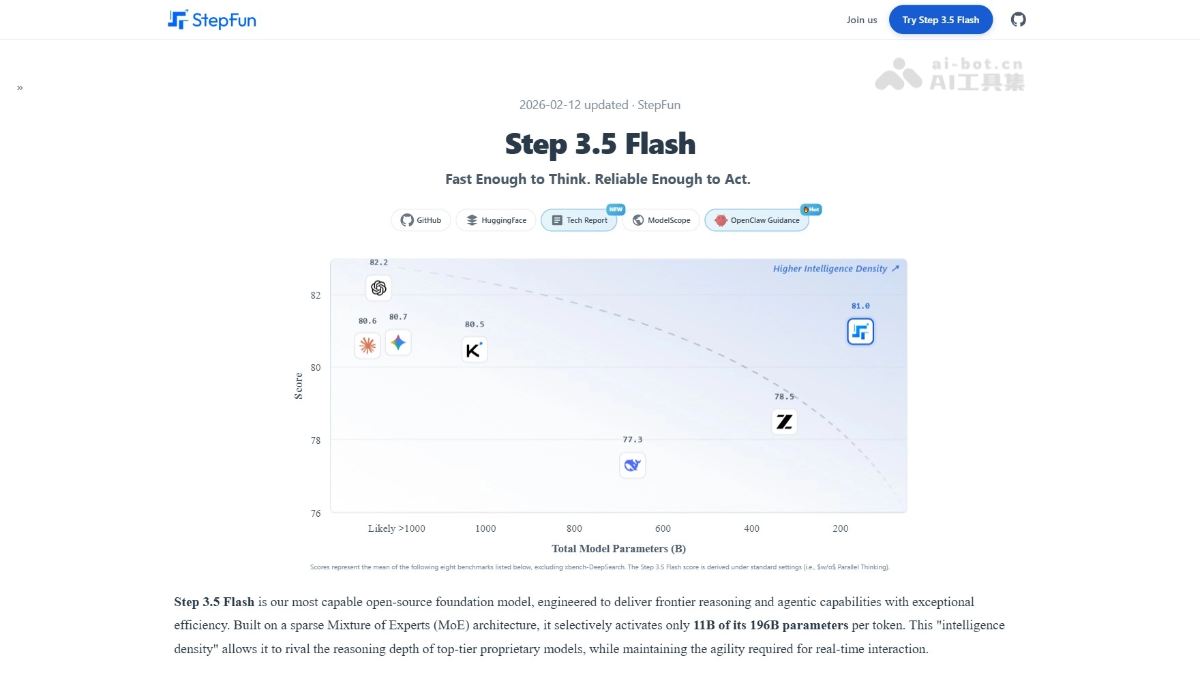
Step 3.5 Flash's main features
-
High-speed inference: The model achieves generation speeds of up to 350 TPS through MTP-3 technology, supporting instant responses for complex multi-step reasoning.
-
Agent capabilities: The model is purpose-built for agent tasks, reaching 74.4% on SWE-bench Verified, and can handle long-chain complex tasks.
-
Efficient long text: Supports a 256K context window and uses a hybrid attention mechanism to reduce the computational overhead of long text.
-
Local deployment: Optimized support for consumer-grade hardware, running smoothly on devices such as Mac Studio M4 Max and NVIDIA DGX Spark.
-
Code generation: The model has strong programming capabilities and supports automatic tool calling and structured reasoning output.
Step 3.5 Flash's technical principles
- Sparse MoE architecture: The model uses a 45-layer Transformer backbone network, with each layer configured with 288 fine-grained routed experts and 1 shared expert. During inference, only the Top-8 experts are activated, and about 11 billion parameters are actually computed per token, balancing the model capability of a 196 billion total parameter scale with the inference cost of a small model.
- MTP-3 multi-token prediction: Through a dedicated prediction head composed of a sliding window attention mechanism and a dense feed-forward network, 4 tokens are generated in parallel in a single forward pass. It raises generation speed in typical scenarios to 100-300 tok/s, with a peak of up to 350 tok/s, significantly reducing decoding latency.
- Hybrid attention mechanism: It adopts an architectural design that alternates 3:1 sliding window attention and global attention layers. The sliding window layers focus on local context, while the global layers capture long-distance dependencies, effectively controlling computational complexity in 256K long-text scenarios while balancing efficiency and performance.
- Inference optimization strategies: The model supports combined deployment of expert parallelism (EP8) and tensor parallelism (TP8), combined with FP8 quantization to reduce memory bandwidth pressure. Through the coordination of speculative decoding and MTP, it achieves efficient service-oriented deployment on Hopper GPUs.
Step 3.5 Flash's project address
- Project official website:https://static.stepfun.com/blog/step-3.5-flash/
- GitHub repository:https://github.com/stepfun-ai/Step-3.5-Flash/
- HuggingFace model library:https://huggingface.co/stepfun-ai/Step-3.5-Flash
- arXiv technical paper:https://arxiv.org/pdf/2602.10604
Step 3.5 Flash's application scenarios
- Intelligent programming development: As the underlying model for tools such as Claude Code and Codex, it provides capabilities including code generation, automatic debugging, and software engineering task processing, reaching a 74.4% pass rate on SWE-bench Verified.
- Autonomous agent execution: Suitable for Agent scenarios requiring long-chain reasoning, such as deep research, web information retrieval, and cross-platform data comparison.
- Real-time conversational interaction: With a generation speed of 100-350 TPS, it supports interactive applications requiring instant response, such as low-latency chatbots, online education tutoring, and intelligent customer service.
- Long Text Analysis and Processing: It can conduct academic paper study, legal contract review, and large-scale codebase comprehension, efficiently extracting and integrating massive amounts of information.
- On-Device Privacy Computing: It can be deployed on local devices such as Mac Studio M4 Max and NVIDIA DGX Spark, meeting the private processing needs of sensitive data in finance, healthcare, enterprise office, and other fields.