
DeepSeek V4 The series model preview version is online, and the most obvious change is that 1M context has become standard across all DeepSeek official services.
The DeepSeek V4 series has two models: the flagship DeepSeek-V4-Pro and the lightweight DeepSeek-V4-Flash.
Looking at the latest benchmark data released by DeepSeek, DeepSeek-V4-Pro's reasoning ability has caught up with top-tier closed-source models, its world knowledge is second only to Gemini-Pro-3.1, and its Agentic Coding benchmark performance is also firmly among the top open-source models.
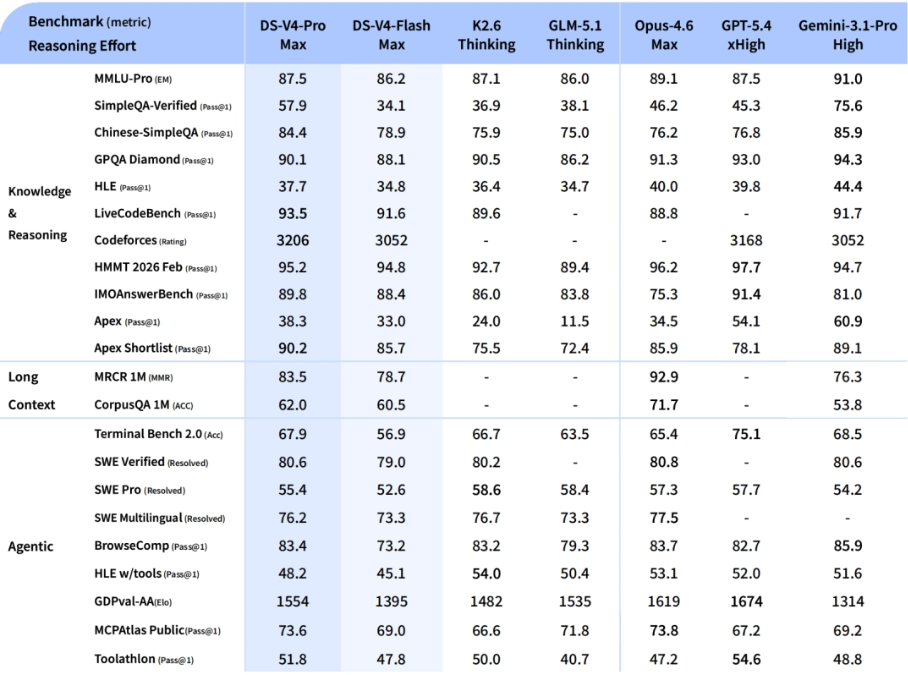
Even more interestingly, the Agentic Coding model used internally by DeepSeek employees has benchmark feedback showing a user experience better than Sonnet 4.5, with delivery quality close to Opus 4.6 non-thinking mode.
Coincidentally, Zhipu recently released GLM-5.1, which also loudly announced that it beat Opus 4.6 in code benchmarks.
Everyone is claiming they can punch Sonnet and kick Opus. But rather than leaderboard scores, I believe everyone, like me, is more concerned with: in a real development workflow, who is actually more usable?
So I connected DeepSeek-V4-Pro and GLM-5.1 all into Claude Code for a Coding PK!
Without further ado, let's go straight to the hands-on test.
01. Hands-On Comparison
Weather Cards
You are a top UI designer at Apple Inc. In the design style of iOS 18 (frosted glass effect, Gaussian blur, dynamic gradients, delicate shadows), create a single HTML file (including complete CSS and JavaScript). Implement a horizontal weather page containing 4 side-by-side animated weather cards:
-Sunny (sun rays, dynamic halo)
-Strong wind (drifting clouds, swaying trees, wind lines)
-Heavy rain (falling raindrops, forming puddles, lightning)
-Blizzard (falling snowflakes, accumulation effect)
The cards need a dark background, support button switching of weather states, and achieve smooth interaction and micro-animations. The code must be directly runnable, with aesthetics as the priority.
Using pure CSS to implement elements such as sun rays, clouds, and lightning really tests the model's imagination for keyframe animations.
DeepSeek-V4-Pro took more than 6 minutes to make all 4 weather elements, and also added 3 mode options: normal, mild, and extreme. It looks pretty good.
The weather card switching is not very smooth, and the visual quality could still be optimized further.
It took less than 4 minutes, and the page layout is similar to DeepSeek-V4-Pro. The animations are not only vivid, but also very smooth and natural.
When switching weather cards, it uses highlight reminders, and the switching is very smooth.
Commercial Website
Make a high-end crystal bracelet product showcase page.
Only one extremely minimal prompt, relying entirely on the large model itself to supplement the design sense and layout of a commercial webpage.
GLM-5.1 still finished in less than 4 minutes. The webpage design is very high-end, with large areas of white space, and the color scheme is also very suitable. Just looking at the first version, it already feels full of premium quality. The small cards on the page all have hover effects, and it is at a level that can be used directly.
DeepSeek-V4-Pro took about 6 minutes, and the webpage layout is very good. However, the crystal rendering is a bit of a letdown. The layer order of the crystal on the homepage was not handled well, and when rotating, the front-back occlusion is very unnatural.
Full-Screen Canvas
Create an interactive full-screen watercolor painting board web tool. After the user selects a brush color, they can click and drag the mouse on the canvas to paint freely. The canvas will produce an effect similar to watercolor pigment slowly spreading after dripping into clear water, overall like painting on the surface of water, with natural, soft, and expansive blending, and an obvious sense of flow.
####Core visual requirements:
– The paint traces appear as continuous soft water ripples. When the user drags the mouse, the color first forms a relatively dense soft blob near the brushstroke, then slowly spreads outward, with the diffusion range gradually increasing and the edges gradually feathering, forming a natural fading transition.
– Colors painted later will cover and overpower earlier colors. Please use a method closer to watercolor mixing, and avoid pure additive blending that causes the image to become brighter and brighter. Colors can blend slightly, but the main color the user just painted should be preserved.
– Each stroke slowly spreads for a few seconds after being laid down, like pigment slowly unfurling in water.
– The website should have slight animation, such as the title slowly floating, the control panel fading in, and buttons glowing on hover. The overall interaction should be smooth, suitable for users to casually open and play with for a few minutes, achieving a stress-relieving effect.
– The control panel uses a frosted glass effect, floating above or on the side of the image, and includes brush color switching, brush thickness adjustment, clear canvas, and save image buttons. The blending intensity adjustment affects diffusion speed, diffusion range, and edge softening degree.
####Technical requirements:
– Implement using HTML, CSS, and native JavaScript.
– Use canvas to draw the main visual effects.
– Do not rely on a backend.
– The code can be placed in a single HTML file and run.
– Adapt to desktop and mobile.
– Mobile supports finger touch drawing.
– The canvas should automatically scale according to the window size.
– The save image function can export the current canvas as a PNG.
DeepSeek completed it in 9 minutes and 31 seconds. All the functions are there, and the brushstroke and blending adjustments are very easy to use. It can clear the canvas and save images. The spreading effect made by DeepSeek is very natural.
Although the blending level is set from 0-100, in practice when adjusted above 25, the colors melt away like cream, and it is difficult to leave traces on the canvas.
GLM-5.1 took about 6 minutes. The interface color scheme is very similar to DeepSeek-V4-Pro. The functions are still quite complete, but the brush trajectory rendering is not very coherent, and the drawn lines are not smooth.
In terms of functionality, they are all implemented quite well.
From the several front-end-oriented cases I tested, whether in the speed of producing code or the final texture of the page, GLM-5.1 is indeed slightly mediocre compared with DeepSeek-V4-Pro.
02. Codex Professional Review
What I talked about earlier is more my personal intuitive impression, but the actual quality of the code still depends on an expert. This time I specially invited a professional outside helper Codex, to help us review it from multiple professional dimensions such as requirement understanding, code structure, performance awareness, and so on.
Weather Card Comparative Analysis
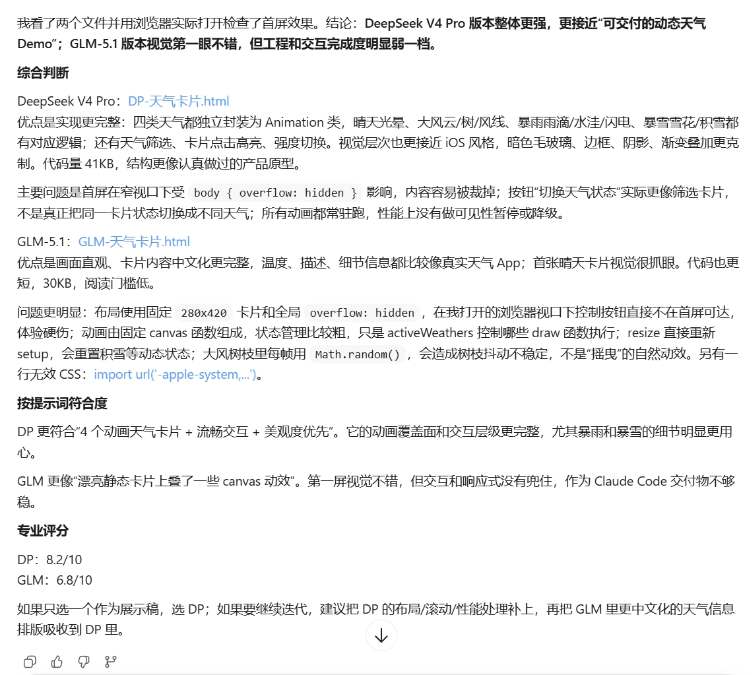
Visually, I think the card generated by GLM-5.1 looks much better, with a clear structure and smooth animation, but in the expert eyes of Codex, DeepSeek-V4-Pro is actually superior.
The weather card generated by DeepSeek-V4-Pro is built up with a large amount of canvas and animation. Not only is the logic rigorous, but the local animation details, material expression, light and shadow, and layering are all handled quite beautifully.
Commercial Website
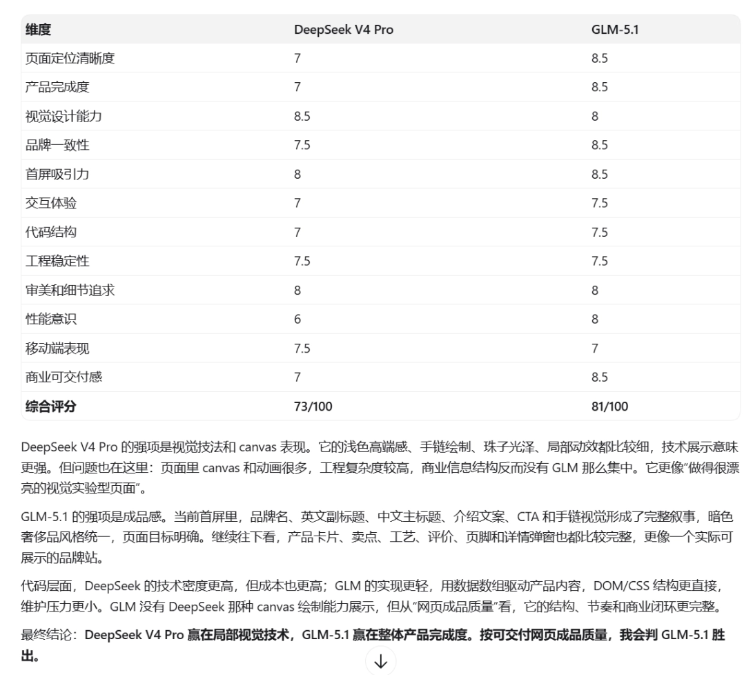
The page generated by DeepSeek-V4-Pro is a typical technology-driven one, with lots of canvas and lots of animation, and some parts are very refined, but the information structure is not well organized.
GLM-5.1's page structure, brand information, CTA, and key visual are systematic, giving it a comprehensive lead in product completeness. Much of the content is driven by data structures, with DOM + CSS handling layout and presentation, making the logic clear, maintenance costs low, and the approach closer to how real teams develop.
Full-Screen Canvas Comparison Analysis
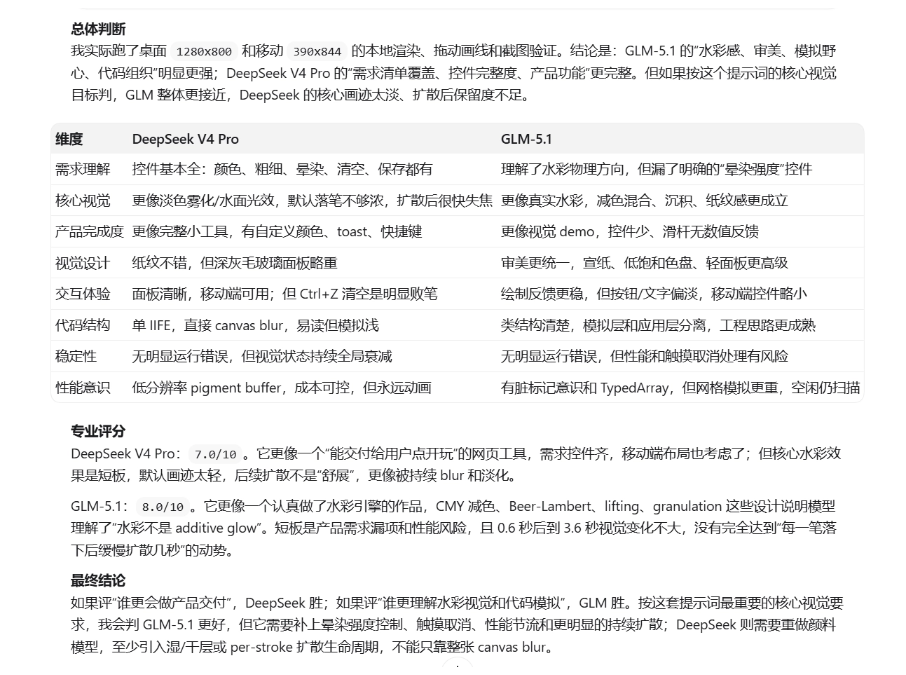
The page generated by DeepSeek-V4-Pro is more like an interactive little tool. The features are comprehensive, but the core visuals are a weak point.
GLM-5.1 focuses on whether what is drawn looks convincing. Once details like CMY subtractive color, pigment deposition, and granulation texture are added, the entire canvas's feel instantly changes.
03. Some Sharing
In the past, when we tested large models, we focused more on whether the features could run through and whether there would be errors. Now, just running through is no longer quite enough.
As AI programming moves into scenarios closer to real delivery, such as web pages, product demos, and interactive tools, we have started to care about more perceptual things: Does the page have a sense of design? Are the features smooth enough to use? Are the motion effects natural?
We have to admit that our standards for judging AI programming are visibly rising. Each large model is also using real progress to gradually raise our expectations for AI programming.
Back to the protagonist of this article, DeepSeek V4. Although what has been released this time is only a preview version, its performance is indeed noteworthy. The underlying data volume is larger, the context has soared to 1M, and with the current discount period, it is extremely cost-effective to use. Although it does not have the astonishing, show-stopping feel of R1 when it first appeared, it is still profoundly significant.
The DeepSeek team has expanded to 300 people and has begun a new round of financing. At present, it has also quietly completed deep optimization and adaptation with leading domestic AI chip manufacturers such as Huawei and Cambricon. Our domestic large models are taking root in a more complete domestic computing power ecosystem.
Now, we are just waiting for the official version of DeepSeek V4.
Original link:Hands-on test of DeepSeek V4 & GLM-5.1: Who is stronger at Vibe Coding?