
What is GLM-5.1
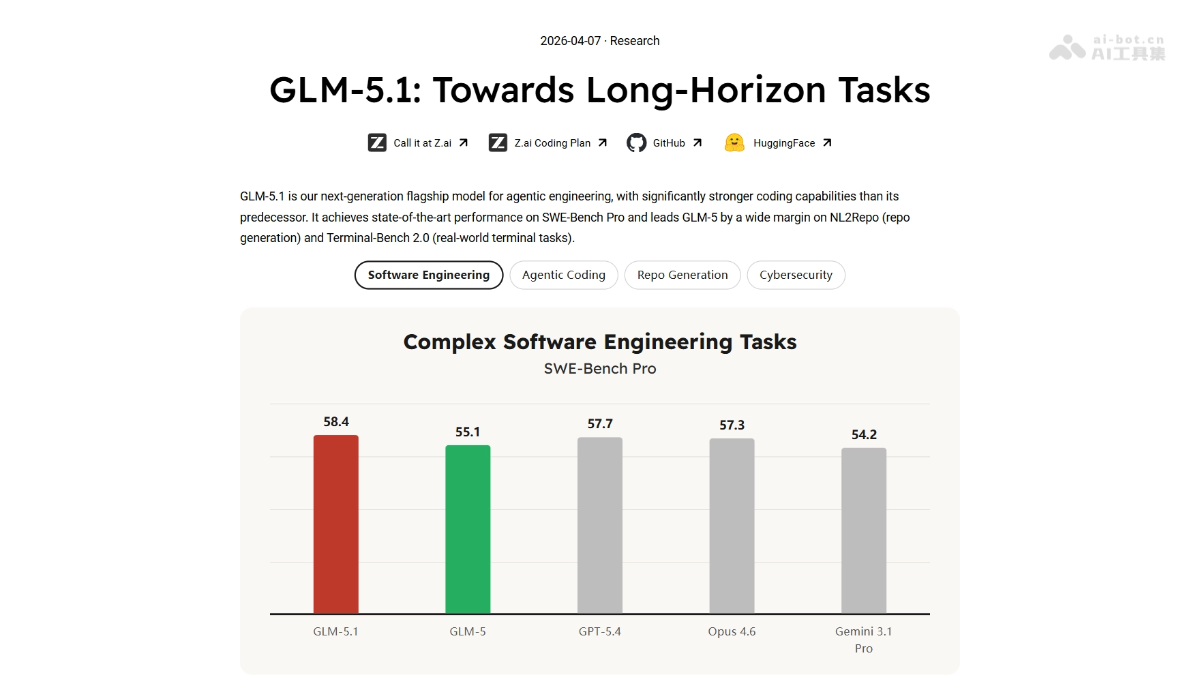
GLM-5.1 is the world's most powerful open-source model released by Zhipu, capable of 8-hour long-horizon task execution. The model ranks first globally on the SWE-Bench Pro benchmark for coding capability, surpassingGPT-5.4andClaude Opus 4.6. GLM-5.1 supports 8-hour long-horizon autonomous work, and can continuously and autonomously plan, execute, correct errors, and evolve in complex software engineering tasks without human intervention. The model supports API access, local deployment, and is compatible withClaude Codeand other mainstream development tools.
Main features of GLM-5.1
-
Long-horizon autonomous work: The model can continuously and independently work for more than 8 hours in a single session, autonomously planning, executing, and delivering complex software engineering tasks without human intervention.
-
Top-tier coding capability: Ranked first globally on the SWE-Bench Pro benchmark, surpassing GPT-5.4 and Claude Opus 4.6, with professional-grade bug fixing and software development capabilities.
-
System-level construction: Can independently complete full system development from architecture to implementation, for example autonomously building a complete Linux system including a desktop environment, window manager, and applications within 8 hours.
-
Deep performance optimization: Continuously optimizes code through hundreds to thousands of autonomous iterations, achieving several-fold performance improvements in tasks such as vector databases and GPU kernels.
How to use GLM-5.1
- Online access: Through the BigModel open platform or the Z.ai website, directly call the API or use the chat interface.
- Local deployment: Download the open-source weights (MIT license) from Hugging Face or GitHub, and run locally with vLLM or SGLang.
- Programming tools: After subscribing to GLM Coding Plan, configure the model name as
"GLM-5.1"in mainstream tools such as Claude Code and OpenCode to use it. - Graphical interface: Use Zhipu's Z Code tool, which supports multi-agent collaboration and remote development, and you can also initiate tasks from your phone and wait offline for the results.
Key information and usage requirements for GLM-5.1
- Model positioning: Zhipu AI's open-source flagship model (MIT license), currently the world's most powerful open-source model
- Core capabilities: Ranked first globally in the SWE-Bench Pro coding test (58.4 points), supports8-hour long-horizon autonomous work, and can independently complete complex software engineering tasks and self-evolve
- Technical features: No human intervention required; autonomously plans, executes, and corrects errors, with long-horizon memory capability to handle thousands of tool calls
- API access: Requires registering for a BigModel open platform or Z.ai account to obtain API access
- Local deployment: Requires downloading the open-source weights from Hugging Face/ModelScope and configuring the vLLM or SGLang inference framework.
- Development tools: After subscribing to GLM Coding Plan, set the model name as
"GLM-5.1"in tools such as Claude Code; during peak hours, 3x quota is consumed, and during off-peak hours, 2x quota.
Core advantages of GLM-5.1
- Ultra-long autonomous work capability: World-leading 8-hour-class Long-Horizon Task processing, capable of continuously working independently and delivering complete engineering results without human intervention, rather than the few minutes to half an hour of traditional models.
- Top-tier coding capability: Ranked No. 1 globally on the SWE-Bench Pro benchmark (58.4 points), surpassing GPT-5.4 and Claude Opus 4.6, reaching a professional level in real-world software engineering bug fixing, system building, and code generation.
- Self-evolution and strategy switching: Possesses a closed loop of "experiment -> analysis -> optimization", able to proactively identify bottlenecks, switch strategies, and self-correct across thousands of tool calls, avoiding getting trapped in local optima.
- Fully open source and open: Model weights freely available, supporting API access, local deployment (vLLM/SGLang), and integration with mainstream development tools (Claude Code, OpenCode, etc.).
GLM-5.1 project address
- Project official website:https://z.ai/blog/glm-5.1
- GitHub repository:https://github.com/zai-org/GLM-5
- HuggingFace model repository:https://huggingface.co/zai-org/GLM-5.1
Comparison of GLM-5.1 with similar competitors
| Comparison dimension | GLM-5.1 | Claude Opus 4.6 | GPT-5.4 |
|---|---|---|---|
| Developer | Zhipu AI (Z.ai) | Anthropic | OpenAI |
| Model nature | Open source (MIT license) | Closed source | Closed source |
| SWE-Bench Pro | 58.4 (No. 1 globally) | 57.3 (No. 3) | 57.7 (No. 2) |
| Long-horizon task capability | 8-hour class (the only open-source one) | 8-hour class (only two globally) | About 1-2 hour class |
| KernelBench L3 | 3.6x speedup | 4.2x speedup | Not disclosed |
| Overall coding ranking | No. 3 globally / No. 1 open source | No. 2 globally | No. 1 globally |
| Deployment method | Local free deployment / API | API only (high cost) | API only (high cost) |
| Core advantages | Open source and commercially usable, long-horizon autonomous work, controllable cost | Strongest peak performance, best long-horizon stability | Breadth of general reasoning, mature ecosystem |
| Relative shortcomings | Peak optimization slightly inferior to Claude | Closed source and uncontrollable, high cost | Closed source, insufficient long-horizon capability |
| Tool compatibility | Claude Code, OpenCode, etc. | Native Claude Code | Codex、ChatGPT |
Application scenarios of GLM-5.1
-
Complex software engineering development: Autonomously fixes high-difficulty bugs in real GitHub repositories, independently builds complete code repositories and large software systems from scratch, covering architectural design, module implementation, and test verification.
-
Deep performance optimization and tuning: Can perform hundreds to thousands of rounds of autonomous iterative optimization on low-level systems such as vector databases and GPU computing kernels, achieving several-fold performance improvements through means such as writing custom CUDA/Triton Kernels.
-
Long-horizon automated development: Supports continuous execution of autonomous programming tasks for several hours in agent tools such as Claude Code, completing complex terminal operations, code refactoring, and multi-step engineering iterations without human intervention.
-
Unattended engineering delivery: Independently undertakes complete software project development at night or during offline periods, achieving end-to-end autonomous delivery from requirements analysis, architecture design, coding implementation, to testing and deployment.