
What is Claude Opus 4.6
Claude Opus 4.6 is the flagship AI model released by Anthropic, and is an upgraded version ofClaude Opus 4.5. The model supports a 1 million token ultra-long context window for the first time, leading comprehensively in programming, reasoning, and complex task processing. Claude Opus 4.6 set new records in benchmarks such as Terminal-Bench 2.0 and Humanity's Last Exam, with its GDPval-AA score surpassing GPT-5.2 by 144 Elo points. With newly added features such as adaptive thinking and context compression, it can autonomously perform enterprise-level tasks such as financial analysis, code review, and document processing, marking a paradigm shift of AI from a tool to an autonomous agent.
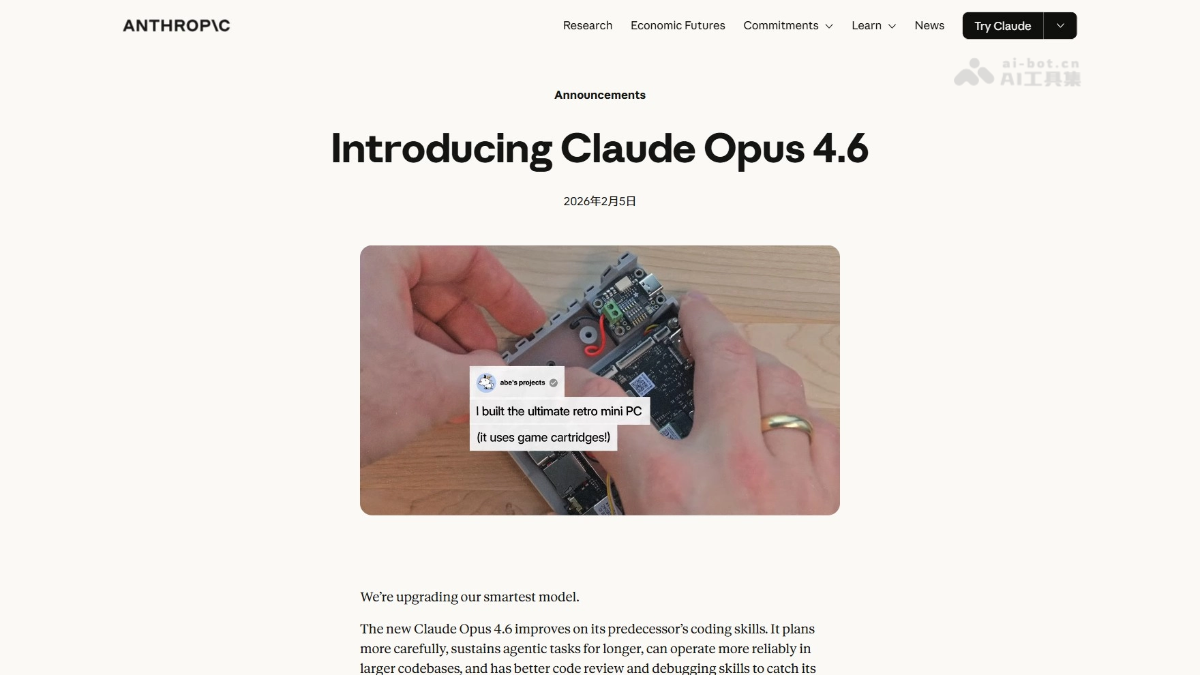
Main features of Claude Opus 4.6
- Ultra-long context processing: Claude Opus 4.6 supports a 1 million token context window for the first time, achieving 76% accuracy on the MRCR v2 test, significantly better than the previous generation model's 18.5%, solving the common "context rot" problem of large models.
- Adaptive thinking mechanism: The model can automatically determine whether deep reasoning is needed based on task difficulty, and developers can manually set four thinking levels: low, medium, high, and max, flexibly balancing quality, speed, and cost.
- Context compression technology: Automatically compresses historical conversations into summaries, freeing up space for new content, and supports Claude in performing longer tasks without interruption due to context overflow.
- Enterprise-level work capabilities: Can autonomously run financial analysis, legal research, document creation, spreadsheet processing, and presentation creation, surpassing GPT-5.2 by about 144 Elo points in the GDPval-AA test.
- Programming and code review: Achieved the highest score in the Terminal-Bench 2.0 agentic coding evaluation, with capabilities in code review, debugging, multilingual development, and maintenance of large codebases, and can sustain long autonomous workflows.
- Online information retrieval: Outperforms all other models in the BrowseComp test, is skilled at finding hard-to-find information online, and combined with a 1 million token context can process and reason over large amounts of web material.
- Office suite integration: Through the Claude in Excel and Claude in PowerPoint plugins, it integrates directly into office software, supporting pivot table editing, chart modification, slide master reading, and brand consistency maintenance.
- Safety and alignment: Shows low misdirection rates, low sycophancy rates, and low over-refusal rates in automated behavior audits, with an overall safety profile comparable to or better than Claude Opus 4.5, making it one of the best-aligned frontier models in the industry.
Performance of Claude Opus 4.6
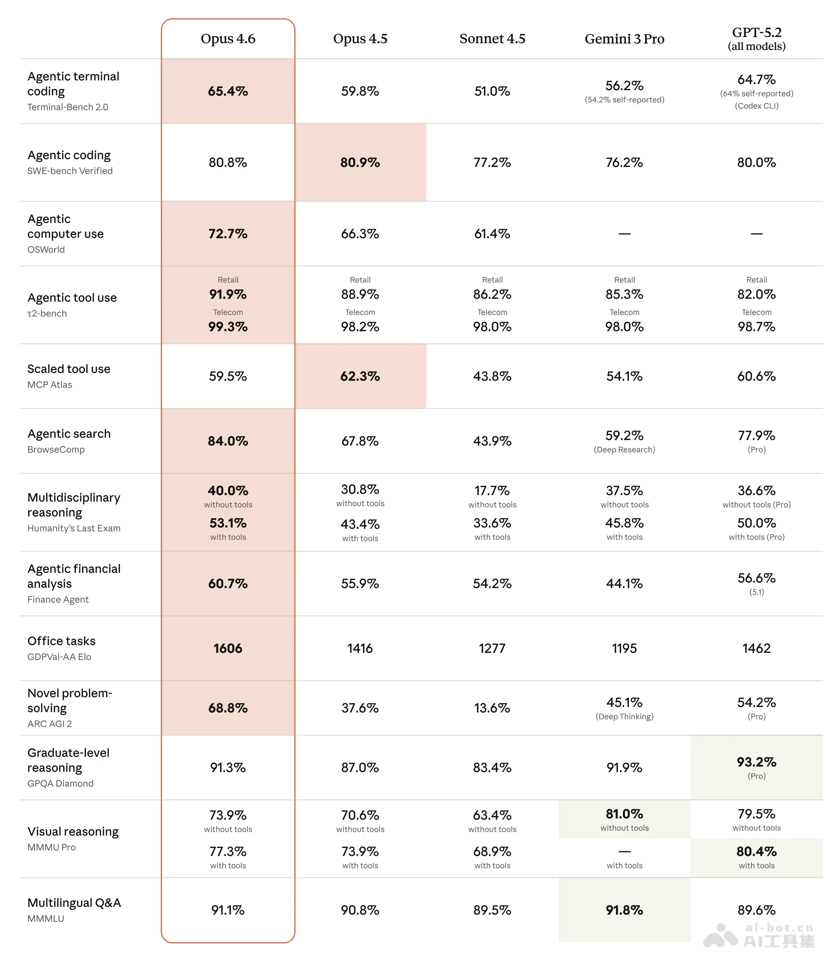
- In the Terminal-Bench 2.0 agentic coding evaluation, Claude Opus 4.6 achieved a score of 65.4%, the highest among all models.
- In the Humanity's Last Exam complex multidisciplinary reasoning test, Claude Opus 4.6 leads all other frontier models.
- In the GDPval-AA real-world knowledge work task evaluation, Claude Opus 4.6 scored 1606 Elo points, about 144 points higher than GPT-5.2 and 190 points higher than the previous generation Claude Opus 4.5.
- In the BrowseComp web information retrieval test, Claude Opus 4.6 achieved 84.0%, better than GPT-5.2 Pro's 77.9%.
- In the ARC AGI 2 fluid intelligence test, Claude Opus 4.6 reached 68.8%, significantly surpassing GPT-5.2 Pro's level of more than 50%.
- In the OSWorld computer operation capability test,Claude Opus 4.6 scored 72.7%, a significant improvement over the previous generation Opus 4.5's 66.3%.
- In the MRCR v2 long-context retrieval test,the 1 million token eight-needle variant achieved 76%, while Sonnet 4.5 only reached 18.5%.
- In the SWE-bench Verified code repair test,an average of 25 trials reached 80.8%, and with prompt optimization it can reach 81.42%.
How to use Claude Opus 4.6
- Using via the Claude web interface: Log in to claude to directly access Claude Opus 4.6, with no additional configuration needed, as the model is fully available on the web version.
- Calling via API: Developers can use the model name
claude-opus-4-6to make API calls. - Using in Claude Code: After installing Claude Code , you can directly call Opus 4.6 from the command line for programming tasks, with support for agent team features, using the
/effortparameter to adjust the thinking level.
Application scenarios of Claude Opus 4.6
- Software development and programming: Claude Opus 4.6 can be used for reviewing and maintaining large codebases, supports multilingual development environments, and allows developers to efficiently manage complex projects.
- Code debugging and repair: The model has code debugging and error repair capabilities, can autonomously locate problems and generate repair solutions, reducing the time developers spend on manual troubleshooting.
- Long-duration autonomous workflows: In complex software engineering tasks, Claude Opus 4.6 can maintain long-duration autonomous workflows without frequent human intervention, making it suitable for large-scale project development.
- Financial analysis: Financial analysts can use Claude Opus 4.6 to run complex financial analysis and modeling tasks, quickly generating professional reports and data insights.
- Legal document review: Legal professionals can use the ultra-long context window to handle the review of hundreds of pages of legal documents, completing large-scale document analysis in one go.