
What is DeepSeek-V4
DeepSeek-V4 isDeepSeeka preview version of a new generation large language model series, featuring a million-character ultra-long context window and achieving leading open-source levels in agent capabilities, world knowledge, and reasoning performance. The model includes two versions, deepseek-v4-pro and deepseek-v4-flash, positioned for high performance and cost-effectiveness respectively. Both are open-sourced and provide API services, supporting dual modes of non-thinking and thinking, offering inclusive infrastructure for long-text processing and agent applications.
Main features of DeepSeek-V4
-
Million-token context processing: Native support for 1M token ultra-long text understanding and memory, a standard feature of official services.
-
Hybrid attention mechanism: CSA and HCA architectures significantly reduce long-context computation and memory overhead.
-
Agent coding enhancement: Deeply optimized forClaude Code、OpenClawand other mainstream agent frameworks.
-
Dual-mode reasoning: Supports non-thinking and thinking modes, the latter can adjust intensity via the reasoning_effort parameter.
-
Multi-domain expert fusion: Integrates expert capabilities in mathematics, code, agents and other domains through OPD distillation.
-
Cost-effective choice: The Flash version achieves reasoning performance close to Pro with fewer parameters, significantly reducing API costs.
Technical principles of DeepSeek-V4
-
CSA compressed sparse attention: Compresses the KV of every m tokens into one entry, calculates index scores via Lightning Indexer and performs Top-k sparse selection, combining sliding window and Attention Sink mechanisms to preserve local dependencies.
-
HCA heavy compression attention: Merges KV entries into a single entry with a larger compression ratio m', maintaining dense attention without sparse selection, further reducing computation.
-
mHC manifold-constrained hyper-connections: Projects the residual mapping matrix onto the doubly stochastic matrix manifold via the Sinkhorn-Knopp algorithm, constraining the spectral norm to not exceed 1, enhancing deep signal propagation stability.
-
Muon optimizer: The model uses hybrid Newton-Schulz iteration to orthogonalize gradient matrices, divided into two stages of fast convergence and precise stability, supporting efficient large-scale MoE training.
-
FP4 quantization-aware training: Performs FP4 quantization on MoE expert weights and the CSA indexer QK path, using FP8 to extend dynamic range for lossless dequantization, reducing memory and computation overhead.
Performance of DeepSeek-V4
- Knowledge capabilities
-
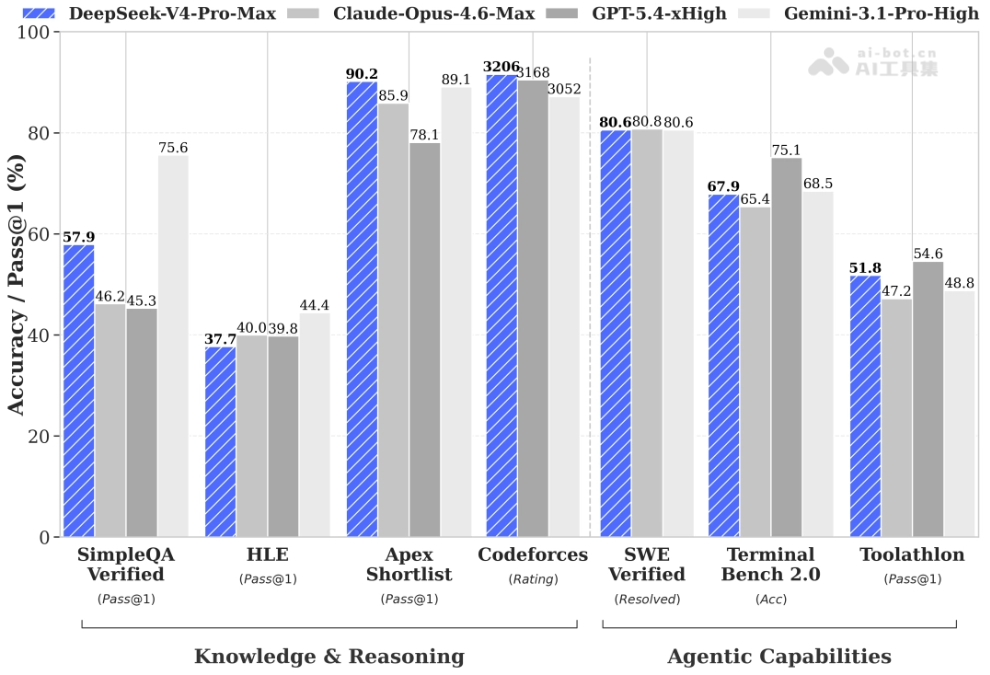
World knowledge leads open source: SimpleQA-Verified reaches 57.9%, surpassing all evaluated open-source models by 20 percentage points, only slightly behind Gemini-3.1-Pro (75.6%).
-
Outstanding Chinese knowledge: Chinese-SimpleQA reaches 84.4%, significantly ahead of K2.6 (75.9%) and GLM-5.1 (75.0%).
-
Educational knowledge approaching frontier: MMLU-Pro 87.5%, GPQA Diamond 90.1%, on par with GPT-5.4, slightly lower than Gemini-3.1-Pro.
-
- Reasoning and coding capabilities
-
Math competitions rival closed-source: HMMT 2026 Feb reaches 95.2%, IMOAnswerBench reaches 89.8%, surpassing K2.6 and GLM-5.1, approaching GPT-5.4 and Opus-4.6.
-
Coding competitions match closed-source for the first time in open source: Codeforces Rating reaches 3206, comparable to GPT-5.4 (3168), currently ranking 23rd among human contestants.
-
Breakthroughs in high-difficulty reasoning: Apex Shortlist reaches 90.2%, surpassing GPT-5.4 (78.1%) and Opus-4.6 (85.9%); LiveCodeBench reaches 93.5%, leading all compared models.
-
- Agent Capabilities
-
Software engineering approaching top closed-source: SWE Verified reaches 80.6%, essentially on par with Opus-4.6 (80.8%); SWE Pro 55.4%, SWE Multilingual 76.2%.
-
Leading open source in terminal operations: Terminal Bench 2.0 reaches 67.9%, surpassing K2.6 (66.7%), GLM-5.1 (63.5%) and Opus-4.6 (65.4%).
-
Excellent tool-calling generalization: MCPAtlas Public 73.6%, Toolathlon 51.8%, performing outstandingly in evaluations covering a wide range of tools and MCP services.
-
- Long-Context Capabilities
-
Strong million-token context retrieval: MRCR 1M reaches 83.5%, surpassing Gemini-3.1-Pro (76.3%); retrieval performance within 128K is highly stable, and strong capability is still maintained at 1M.
-
Long-document understanding in real scenarios: CorpusQA 1M reaches 62.0%, better than Gemini-3.1-Pro (53.8%).
-
- Efficiency Performance
-
Cliff-edge drop in compute: At 1M context, V4-Pro single-token inference FLOPs are only 27% of V3.2, and V4-Flash only 10%.
-
Major KV cache compression: At 1M context, V4-Pro cumulative KV cache is 10% of V3.2, and V4-Flash only 7%.
-
Routed expert FP4 quantization: Expert weights are stored in FP4, and on future hardware the efficiency can theoretically be improved by another 1/3.
-
How to use DeepSeek-V4
- Web/App: Visit theDeepSeekofficial website orofficial App, and choose expert mode (Pro) or fast mode (Flash).
- API calls: Change the model parameter to
deepseek-v4-proordeepseek-v4-flash, and keep base_url unchanged. - Thinking mode: For complex Agent scenarios, it is recommended to enable thinking mode and set
reasoning_effort: max。 - Local deployment: Download the open-source weights via Hugging Face or ModelScope and deploy them yourself.
Key information and usage requirements for DeepSeek-V4
-
Version specifications: Pro version 1.6T parameters/49B activated, Flash version 284B parameters/13B activated, with pretraining data of 33T and 32T respectively.
-
Context length: Both versions support 1M Tokens; the old interfaces
deepseek-chatanddeepseek-reasonerwill be discontinued on 2026-07-24. -
API pricing (per million Tokens): Pro input cache hit 1 yuan/cache miss 12 yuan, output 24 yuan; Flash input cache hit 0.2 yuan/cache miss 1 yuan, output 2 yuan.
-
Compute limitations: The Pro version currently has limited service throughput; prices are expected to drop significantly after Ascend 950 super nodes go on sale in batches in the second half of the year.
Core advantages of DeepSeek-V4
-
Universal access to million-token context: 1M Token ultra-long context has become a standard feature of the official service, breaking through the quadratic compute bottleneck of traditional attention mechanisms and making long-text tasks and test-time scaling truly feasible.
-
Extreme long-context efficiency: Through a hybrid architecture combining CSA compressed sparse attention and HCA heavy compressed attention, under a 1M context, V4-Pro's per-token inference FLOPs are only 27% of V3.2's, and its KV cache is only 10%; the Flash version is even lower at 10% and 7%.
-
A new benchmark for open-source model performance: V4-Pro-Max leads previous-generation open-source models across evaluations such as knowledge, reasoning, and coding competitions; its Agent coding capability outperforms Claude Sonnet 4.5 in internal evaluations, and its delivery quality approaches Opus 4.6's non-thinking mode.
-
Flexible coverage with dual versions: The Pro version (1.6T/49B) targets top-tier performance, while the Flash version (284B/13B) achieves comparable reasoning capability with extremely few activated parameters, with API pricing as low as 1/12 of Pro, making it accessible for scenarios with different budgets.
-
Native enhancement of Agent capabilities: Specially optimized for mainstream Agent frameworks such as Claude Code and OpenClaw, it supports coherent reasoning retention across user message boundaries, and performs excellently in Agent evaluations such as SWE and Terminal Bench.
DeepSeek-V4 project address
- HuggingFace model repository:https://huggingface.co/collections/deepseek-ai/deepseek-v4
- Technical paper:https://huggingface.co/deepseek-ai/DeepSeek-V4-Pro/blob/main/DeepSeek_V4.pdf
Comparison of DeepSeek-V4 with similar competitors
| Comparison dimension | DeepSeek-V4-Pro | Claude Opus 4.6 | Kimi K2.6 |
|---|---|---|---|
| Model positioning | Open-source high-performance MoE | Closed-source top-tier general-purpose | Open-source Agent intelligence |
| Open-source status | Fully open source | Closed-source API | Open source/Open API |
| Total parameters | 1.6T | Not disclosed | Not disclosed |
| Activated parameters | 49B | Not disclosed | Not disclosed |
| Context length | 1M Token | 200K | 1M Token |
| Core architecture | CSA+HCA hybrid attention | Traditional Transformer | MoE+long context |
| MMLU-Pro | 87.5 | 89.1 | 87.1 |
| SimpleQA | 57.9 | 46.2 | 36.9 |
| Codeforces | 3206 | – | – |
| SWE Verified | 80.6 | 80.8 | 80.2 |
| Terminal Bench | 67.9 | 65.4 | 66.7 |
| MRCR 1M | 83.5 | 92.9 | – |
| API input price | 12 yuan/million tokens | About 150 yuan/million tokens | About 60 yuan/million tokens |
| Long-context efficiency | KV cache is only 10% of V3.2's | Standard KV cache | Efficient but details not disclosed |
Application scenarios of DeepSeek-V4
-
Long document analysis: Supports full-text understanding and cross-chapter reasoning for million-word-level papers, reports, and legal contracts.
-
Agent coding: Executes complex code generation, refactoring, and debugging tasks in frameworks such as Claude Code and OpenClaw.
-
Multi-turn tool calling: Retains the complete reasoning history in Agent workflows, supporting coherent thinking across user message boundaries.
-
Knowledge-intensive Q&A: Leads open-source models by a large margin in world knowledge evaluations, suitable for education, scientific research, and professional consulting.
-
White-collar office tasks: The model performs excellently in scenarios such as Chinese writing, information analysis, document generation, and editing.