
In today's rapidly evolving era of scientific research, artificial intelligence technology is reshaping the landscape of academic research at an unprecedented pace. From the screening and analysis of massive literature to the processing and modeling of complex data, and further to the optimization and prediction of experimental design, researchers face unprecedented challenges and opportunities. This article introduces 13 free AI research and academic assistant tools that can efficiently process literature, analyze data, assist experimental design, and inspire new research ideas. They provide efficient, convenient, and zero-cost solutions to support scientific research exploration.
1. AMiner
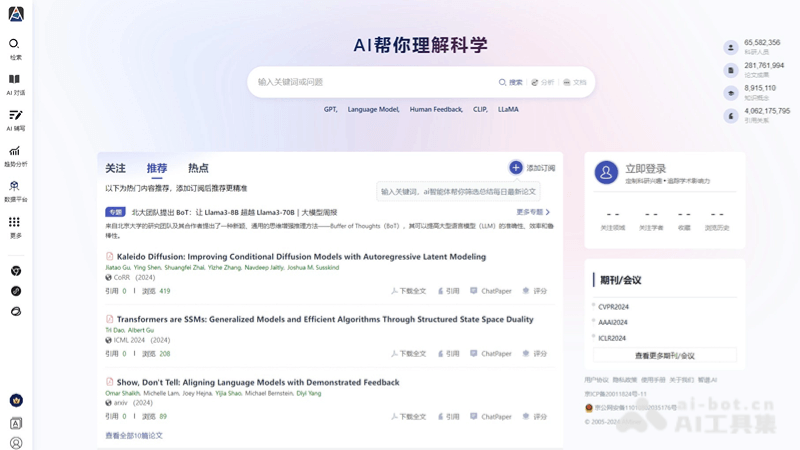
AMinerIt is a scientific and technological intelligence analysis and mining platform created by a team from the Department of Computer Science and Technology at Tsinghua University. It integrates massive academic data, including over 331 million papers, 135 million scholar profiles, and 1.122 billion paper citation relationships. Through data mining and social network analysis technologies, the platform provides functions such as academic search, paper retrieval, scholar profiling, and literature tracking. AMiner supports intelligent Q&A and writing assistance, helping researchers obtain information efficiently.
🚀Product Highlights
- Academic Search and Retrieval:AMiner supports multiple search methods such as keywords, scholars, and institutions, and can quickly locate resources such as academic papers and patents. Users can precisely find the literature they need through rich retrieval conditions, such as author, title, abstract, and more.
- Literature Tracking and Personalized Recommendations:The platform provides a literature tracking function. Users can follow specific scholars, institutions, or topics, and the system will push the latest academic achievements in real time. AMiner provides personalized recommendations based on user interests and behavior, helping users discover more valuable resources.
- Scholar Profiles and Academic Social Networking:AMiner builds personal profiles for scholars, displaying information such as research achievements, academic influence, and collaboration networks. Users can interact with scholars through the platform to learn about their academic backgrounds and research trends.
- Intelligent Q&A and Writing Assistance:AMiner supports intelligent summarization, literature analysis, multilingual translation, and writing assistance.
- Private Literature Library and In-Depth Q&A:Users can upload private PDF documents to build an exclusive knowledge base and conduct in-depth Q&A based on the literature library. It supports multi-turn dialogue to help users deeply understand the details of the literature.
- Rich Data Resources:AMiner integrates massive academic data, including hundreds of millions of papers, tens of millions of patents, and hundreds of millions of scholar profiles. The data sources are authoritative and accurate.
🌐 Official Website:AMiner
2. Xinyi
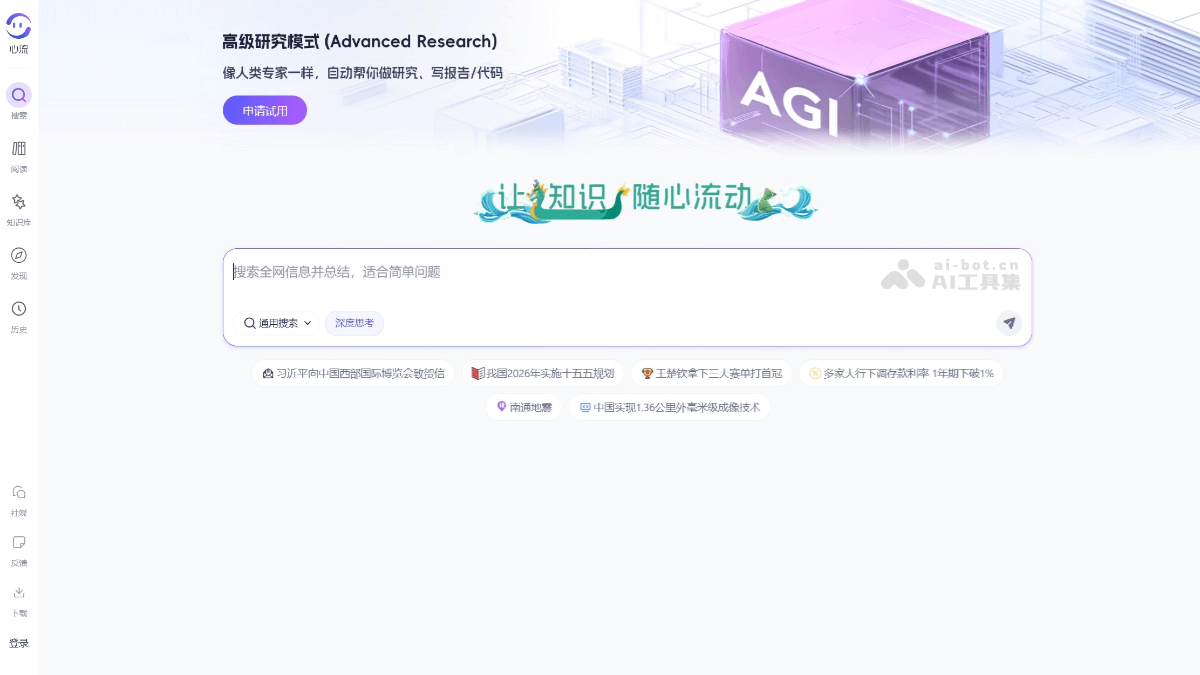
Xinyiis anAI search assistantlaunched by Alibaba, improving users' knowledge acquisition efficiency through intelligent technology. It integrates nearly 30 million academic paper resources, covering authoritative journals such as Nature, IEEE, and ArXiv, and supports functions such as academic Q&A, AI intensive reading, paragraph summarization, intelligent translation, and terminology explanation, helping researchers and students quickly understand and analyze paper content. Web search assists the thinking process and includes functions such as general Q&A, slow reasoning, and private knowledge bases. Xinyi's advanced research model has been launched and can be applied for use. Like a human expert, it automatically handles complex tasks throughout the entire process.
🚀Product Highlights
- Strong Technical Foundation: Based on Taobao's Xingchen large model, it is trained using the Transformer architecture and the semi-self-developed Megatron-ama framework, deeply integrating Taobao's Xingchen large model with NLP technology.
- Intelligent Search and Q&A: Based on advanced search engine technology and deep learning algorithms, it accurately understands users' search intent, supports multi-source search, and integrates multiple resources. It has built a vast professional knowledge graph, can perform deep search and reasoning, and provides precise and professional answers.
- Long-text reading and analysis: Skilled at handling long-text materials such as academic papers and legal documents, it can automatically perform in-depth analysis of text content, extract key information, generate summaries, and highlight key points, and supports functions such as topic classification, sentiment analysis, and trend prediction.
- Assisted creation: For different types of documents, it provides intelligent writing assistance functions, including providing writing framework suggestions, intelligently filling in text content, automatically citing references, and grammar checking and correction.
- Personalized recommendations: Based on users' search history, reading habits, and preferences, it intelligently recommends resources such as the latest research developments, popular papers, and professional books in related fields.
- Multilingual knowledge steward: It uses a hybrid neural translation model and supports mutual translation of Chinese/English/Japanese/German literature, preserving the accuracy of professional terminology and helping to break down language barriers.
- Personal knowledge base: It can dynamically build a user-specific knowledge graph and automatically associate similar literature.
🌐Official website address:Xinliu
3. iFlytek Research Assistant
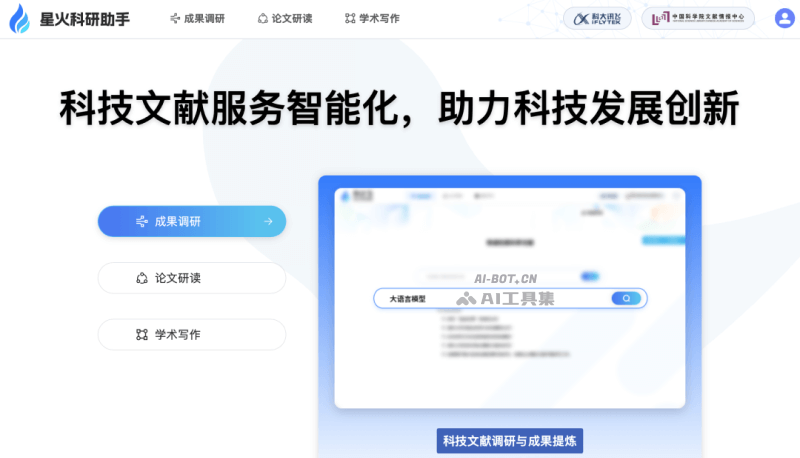
iFlytek Research Assistantis an intelligent knowledge service platform jointly developed by iFlytek and the National Science Library, Chinese Academy of Sciences. Based on a large model for scientific and technological literature, it provides efficient and precise scientific and technological literature services for researchers. The platform supports achievement research and can quickly generate research reviews, helping users grasp the latest progress in their research fields; paper study, intelligently interpreting papers and providing interactive Q&A to improve reading efficiency; and supports academic translation and English polishing, helping users standardize academic expression.
🚀Product highlights
-
Literature management and research:Supports efficient management of literature, including fully automatic literature citation and formatting functions. It can quickly generate literature reviews, helping users extract key information from massive amounts of literature, supports field update tracking, and automatically monitors paper updates in multiple disciplinary fields.
-
Paper study and analysis:Provides intelligent paper study functions, including single-paper interpretation, comparative analysis of multiple papers, and multi-document Q&A. Users can quickly understand the core content of papers through Q&A, and it supports answer traceability to ensure the accuracy and reliability of research.
-
Scientific research agent:iFlytek Research Assistant provides scientific research agent functions, supports the generation of charts such as logic relationship diagrams and Gantt charts, and assists scientific research project management.
-
Intelligent push and data analysis:Based on users' research fields and interests, it intelligently pushes the latest research developments and literature. It has complex data analysis and visualization functions, helping researchers quickly identify potential trends in data.
🌐Official website address:iFlytek Research Assistant
4. Consensus
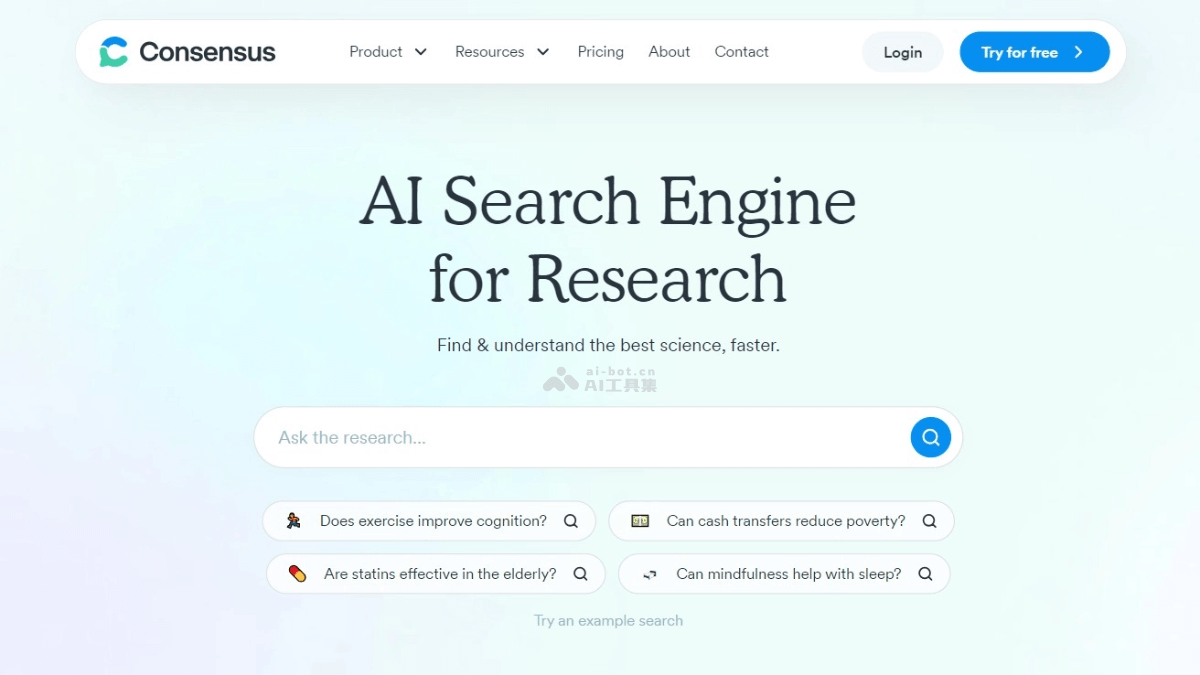
Consensus is an AI-based academic search engine that helps users quickly search and understand scientific literature. Through large language models and vector search technology, it provides access to more than 200 million peer-reviewed research papers. Consensus supports rapid search, AI-generated summaries, the Consensus Meter (showing the degree of consensus on research questions), evidence-supported answers, and prevention of the spread of misleading information, among other things.
🚀Product highlights
-
Broad research coverage:Consensus can search over 200 million research papers in the fields of science and academia, covering various disciplines and meeting users' research needs in different fields.
-
Intelligent search and filtering:Consensus uses AI algorithms to understand complex scientific language, supports natural language queries, and helps users precisely locate the most relevant and high-quality research through advanced filters (such as study design, sample size, publication type, etc.).
-
Paper-level insights:Provides paper-level detailed summaries and key findings, helping users quickly grasp the core content of research papers without reading the full text.
-
Evidence-backed answers:All results from Consensus directly cite scientific papers, ensuring the accuracy and reliability of the information.
-
Interactive exploration:Users can conduct in-depth exploration through related topics and citation networks, with visualization tools to help understand the connections between studies.
🌐Official website address:Consensus
5. PaSa
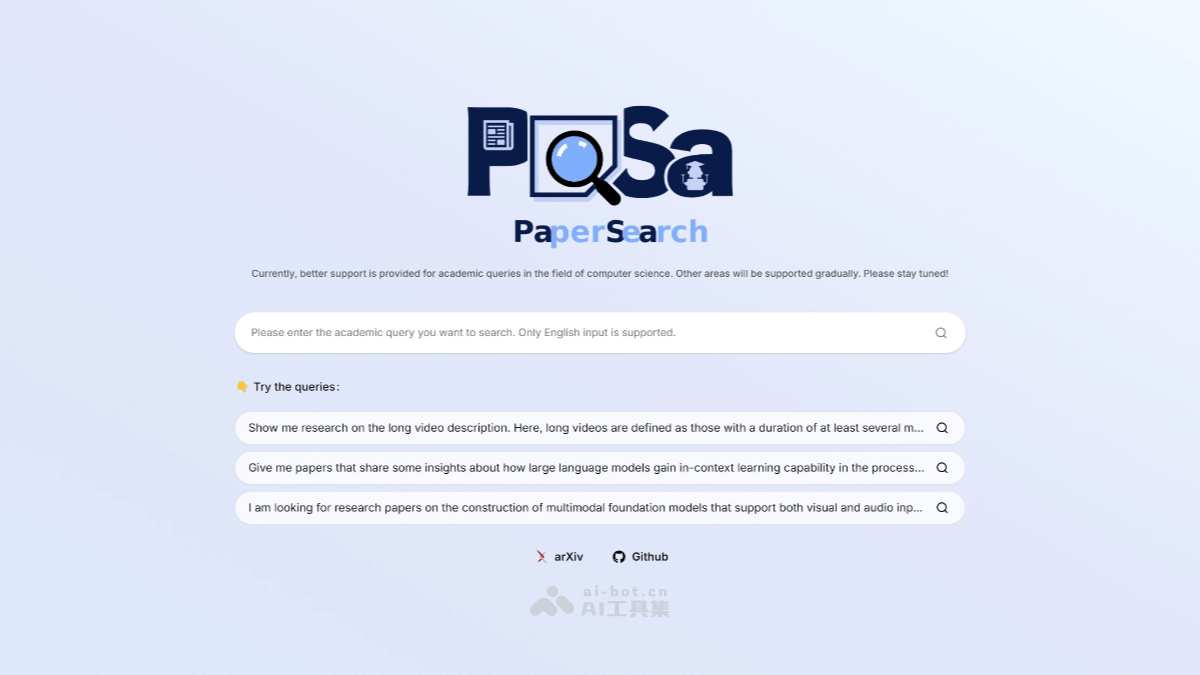
PaSaIt is an academic paper retrieval agent based on reinforcement learning launched by the ByteDance research team. By simulating the behavior of human researchers, it can automatically call search engines and browse related papers to trace citation networks, providing users with accurate and comprehensive academic paper retrieval results. PaSa provides two main LLM agents: Crawler and Selector. Crawler is responsible for collecting academic papers related to user queries, and Selector is responsible for carefully reading each paper and evaluating whether it meets user needs.
🚀Product highlights
-
Efficient retrieval capability: PaSa can complete a detailed academic investigation within two minutes, significantly improving the speed of literature retrieval.
-
Autonomously calls search tools: PaSa can automatically call search engines, generate diverse search keywords based on the academic questions entered by users, and perform multiple searches to ensure comprehensive coverage of relevant literature.
-
Accurate literature screening: Through the two core components Crawler and Selector, PaSa can efficiently collect and screen related papers.
-
CrawlerResponsible for collecting academic papers related to user queries, including discovering more potential literature by expanding citation networks;
-
SelectorCarefully reads the collected papers and screens out the literature that truly meets user needs.
-
-
Supports complex academic queries: PaSa is designed specifically to handle complex academic questions and can understand and process fine-grained academic queries, such as questions involving specific algorithms or research methods.
🌐Official website address:PaSa
6. CNKI AI
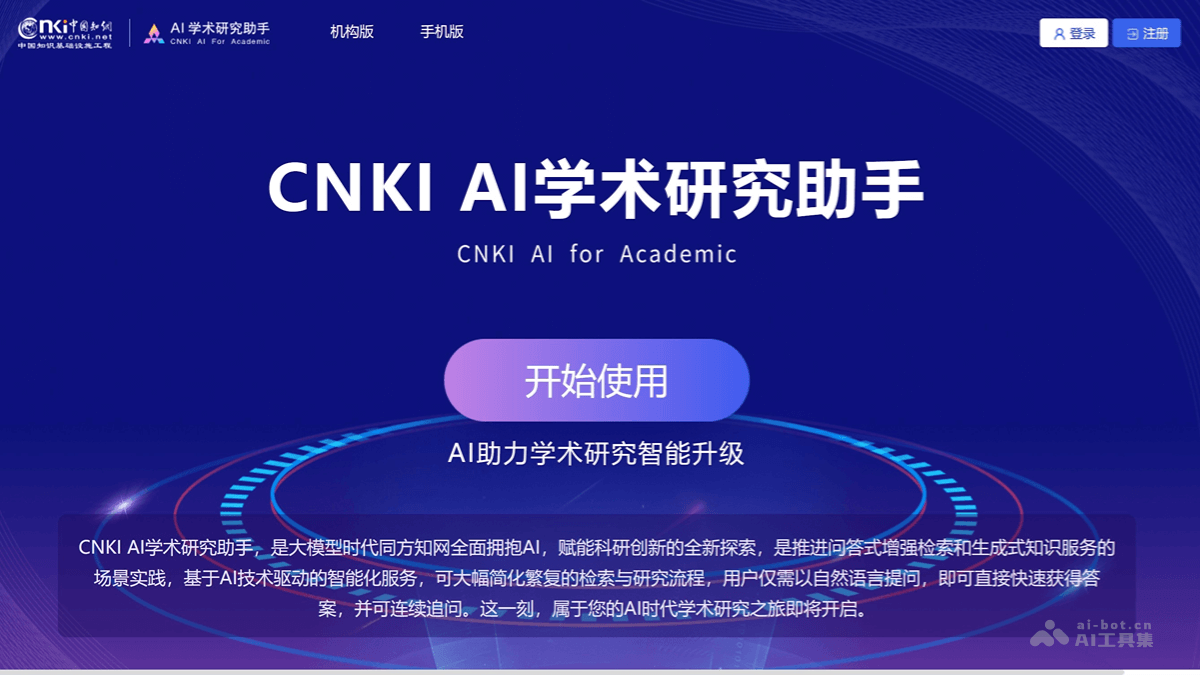
CNKI AIIt is an AI academic research assistant developed by Tongfang Knowledge Network (CNKI AI for Academic), empowering the entire scientific research process. Based on the Huazhi large model and CNKI's high-quality literature resources, and centered on core needs such as frontier exploration, literature study, achievement creation, and knowledge management, it has built four major service systems: AI-enhanced retrieval, AI-assisted study, AI-assisted creation, and the Apple Tree agent. Users can ask questions in natural language and quickly obtain accurate, authoritative, and systematized answers, with support for continuous follow-up questions.
🚀Product highlights
-
Q&A-style enhanced retrieval: Provides two modes: full-database Q&A and fresh Q&A. The former generates comprehensive answers based on CNKI's full-database resources, while the latter focuses on literature resources from the past ten years and provides the latest research developments. Search results can generate mind maps and outlines with one click, helping users quickly grasp the core points.
-
Trustworthy enhancement and controllable generation: AI answers are all based on officially published literature, traceable to the source, effectively avoiding "hallucination" issues. At the same time, users can choose controlled text generation or grouped controlled generation according to their needs, meeting personalized Q&A needs.
-
AI-assisted Reading: Provides functions such as single-article Q&A, article companion reading, and full-text translation, helping users quickly understand the core content of literature and improve reading efficiency. Article companion reading can provide real-time concept explanations, Chinese-English translation, and literature recommendations, enabling barrier-free study.
-
AI-assisted Creation: Supports functions such as conversational writing, intelligent co-writing, and polishing and revision, helping users reduce writing difficulty and inspire creative ideas.
-
Apple Tree Agent: Focuses on complex tasks in scientific research scenarios, generating literature reviews and academic trend analysis with one click, helping users efficiently explore research fields.
🌐Official Website:CNKI AI
7. Lumina
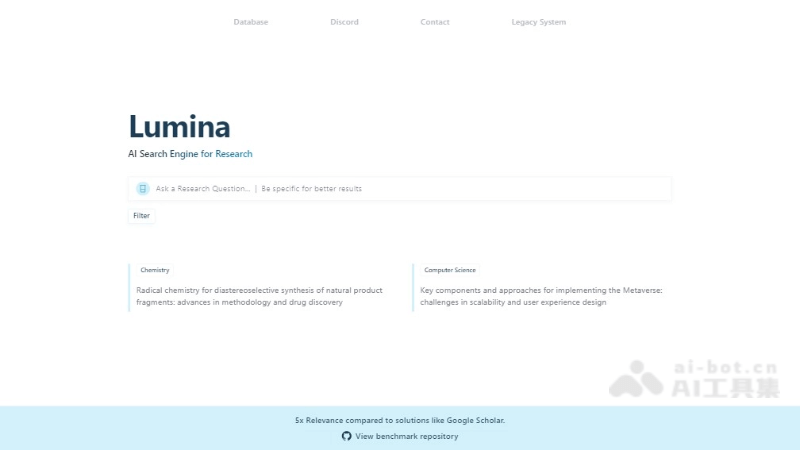
Luminais a free AI academic search engine that, based on advanced AI technology, provides search results with 5 times higher relevance than Google Scholar. Lumina supports searching more than 100 million research objects and features fast response, one-click PDF filtering, multi-dimensional filtering, and AI overview. Users can quickly obtain abstracts and key information of research papers by entering keywords. Lumina supports 24 languages, improving the efficiency and depth of academic research.
🚀Product Highlights
-
Highly Relevant Search Results: Lumina's search result relevance is on average 5 times higher than Google Scholar, allowing it to more accurately match users' search needs.
-
AI-driven Intelligent Experience: Based on advanced artificial intelligence technology, it conducts in-depth analysis of massive academic literature and provides a smarter search experience.
-
Fast Response and One-click PDF Filtering: After users enter keywords, Lumina can provide highly relevant literature search results in a short time and supports one-click filtering of academic papers in PDF format.
-
Multi-dimensional Filtering Function: Users can filter search results in detail based on conditions such as year, citation count, publication type, and specific journals.
-
AI Overview Function: Provides users with AI-generated paper overviews based on search results, helping users quickly grasp the core content of papers.
-
Supports Multiple Languages: Lumina supports 24 languages, providing convenient academic search services for international scholars.
🌐Official Website:Lumina
8. txyz
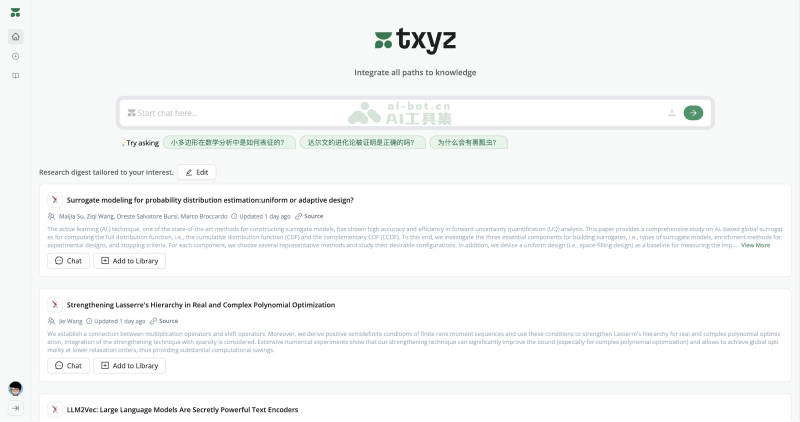
txyz(txyz.ai) is an AI-driven platform for literature reading and academic research assistance, helping researchers and professionals obtain, understand, and manage academic materials more efficiently. Through functions such as intelligent abstract extraction, natural language search, and personalized paper recommendations, it helps users quickly grasp the key points of papers and find the literature they need. txyz supports users in building a personal research library, making it convenient to organize and review research materials. It integrates arXiv academic resources, covering papers in multiple disciplinary fields.
🚀Product Highlights
-
AI-enhanced Literature Reading: Can quickly extract key information and abstracts from academic papers, helping users efficiently understand the core content of literature and save reading time.
-
Natural Language Search: Users can describe research needs in natural language, and AI understanding provides relevant academic papers and resources.
-
Personalized Paper Recommendations: Based on users' research interests and historical behavior, recommends the latest relevant academic papers every day, helping users keep timely track of new developments in the field.
-
Personal Research Library: Users can upload and manage research materials, organize documents through a classification and tagging system, making it convenient for subsequent search and review.
-
Interactive Research Dialogue: Users can interact with AI through a chat interface, ask questions to obtain detailed answers, and assist in deepening understanding of research content.
-
arXiv Resource Integration: Integrated with the arXiv preprint repository, covering academic papers across multiple disciplines, allowing users to directly access and search.
🌐Official Website:txyz
9. Xingyu Research Assistant
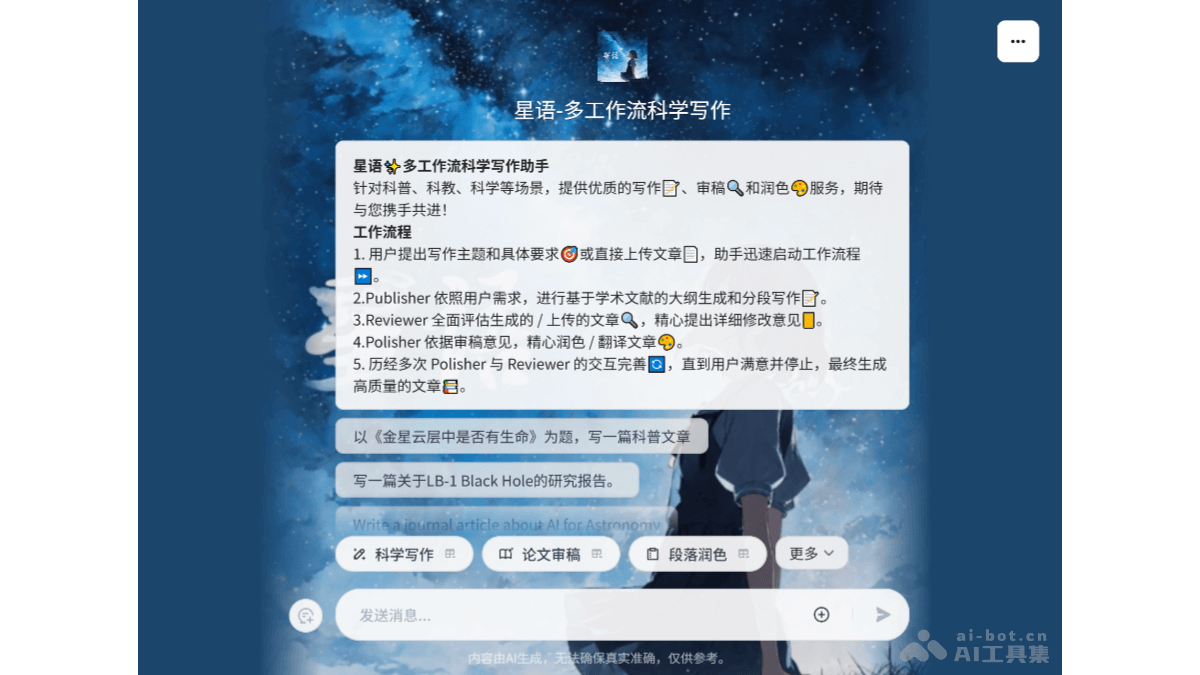
Xingyu Research Assistantis an AI writing assistance tool designed specifically for the fields of popular science, science education, and science, significantly improving the efficiency and quality of research writing, peer review, and polishing. It includes three core modules: PaperWriter_CN_EN can automatically generate high-quality papers, Paper_Polisher_Translator provides polishing and translation services, and Paper_Reviewer is responsible for professional review and proposing revision suggestions. Xingyu Research Assistant supports writing in Chinese and English, and is suitable for various scenarios such as academic paper writing, research report preparation, and popular science article creation.
🚀Product Highlights
-
Efficient Automatic Writing: Based on the topics and requirements provided by users, Xingyu Research Assistant can automatically generate high-quality papers or long-form text content, significantly improving writing efficiency.
-
Precise Polishing and Translation: It can polish the language of articles to ensure precise and fluent expression, and provide Chinese-English translation services to meet the needs of international academic exchange.
-
Professional Review Suggestions: By comprehensively evaluating article quality, Xingyu Research Assistant can propose specific revision suggestions to help authors improve the professional level of their articles.
-
Multilingual Support: Supports both Chinese and English, adapting to research writing needs in different language environments.
-
Academic Literature Support: During the writing process, Xingyu Research Assistant can generate outlines and content based on academic literature, ensuring the academic nature and accuracy of articles.
🌐Official Website:Xingyu Research Assistant
10. Wenfang Sibao
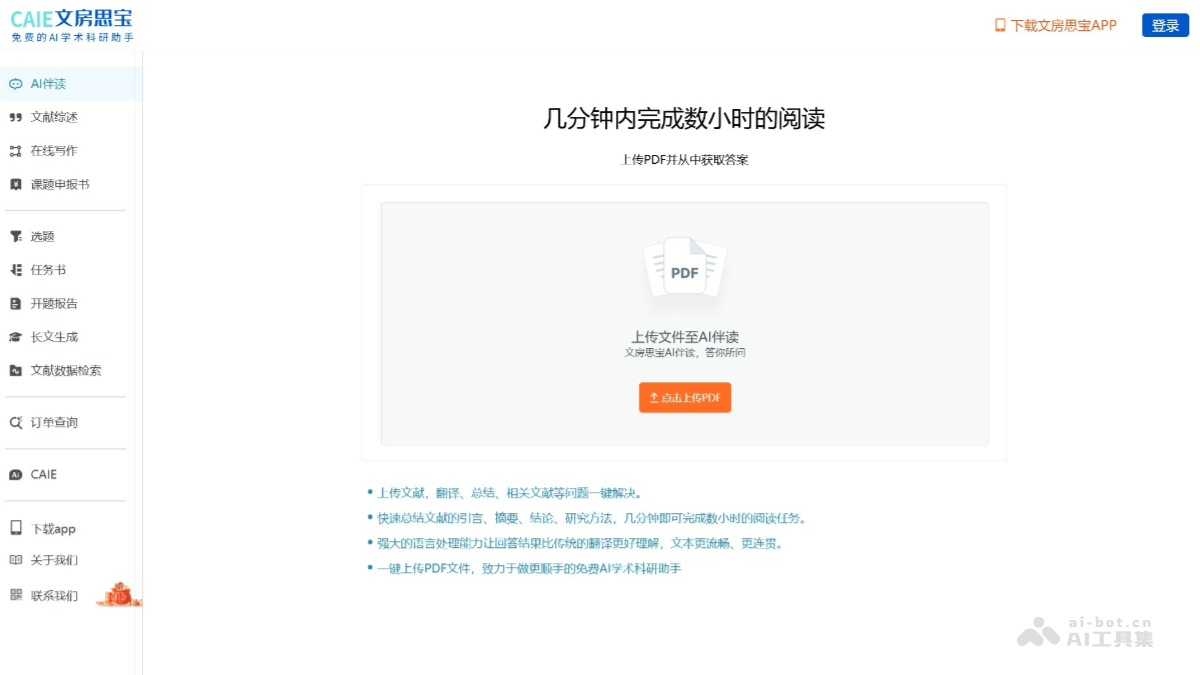
Wenfang Sibaois an AI academic research assistant tool launched based on the CAIE academic large model, designed specifically for the academic research field. It integrates the cultural essence of the traditional "Four Treasures of the Study" and, based on modern AI technology, provides comprehensive support for academic creation. Its functions include literature reading, online writing, project application, literature review, empirical analysis, and sample essay generation. Users can quickly generate paper outlines and content by entering keywords or topics, and it can generate 200,000-word long-form articles. It supports functions such as literature translation, summarization, and related literature search.
🚀Product Highlights
-
Diverse academic functions:Provides functions such as literature reading, translation, summarization, explanation, and read-aloud, and supports processing literature in multiple languages. Intelligently recommends related literature to help users build their own knowledge base.
-
Efficient literature review and project application:Wenfang Sibao can quickly generate a literature review based on the title entered by the user, with content based on real literature data, ensuring authority. One-click generation of project application templates, supporting multiple project application formats.
-
Convenient online writing environment:Provides an immersive writing experience, supporting functions such as topic suggestions, abstract writing, outline generation, and idea integration. Users can edit and modify online based on the generated paper outline.
-
Low plagiarism rate and high-quality output:The first draft of papers generated by Wenfang Sibao has a plagiarism rate below 30%, with smooth sentences, coherent logic, and academic characteristics.
🌐Official website address:Wenfang Sibao
11. ReadPaper
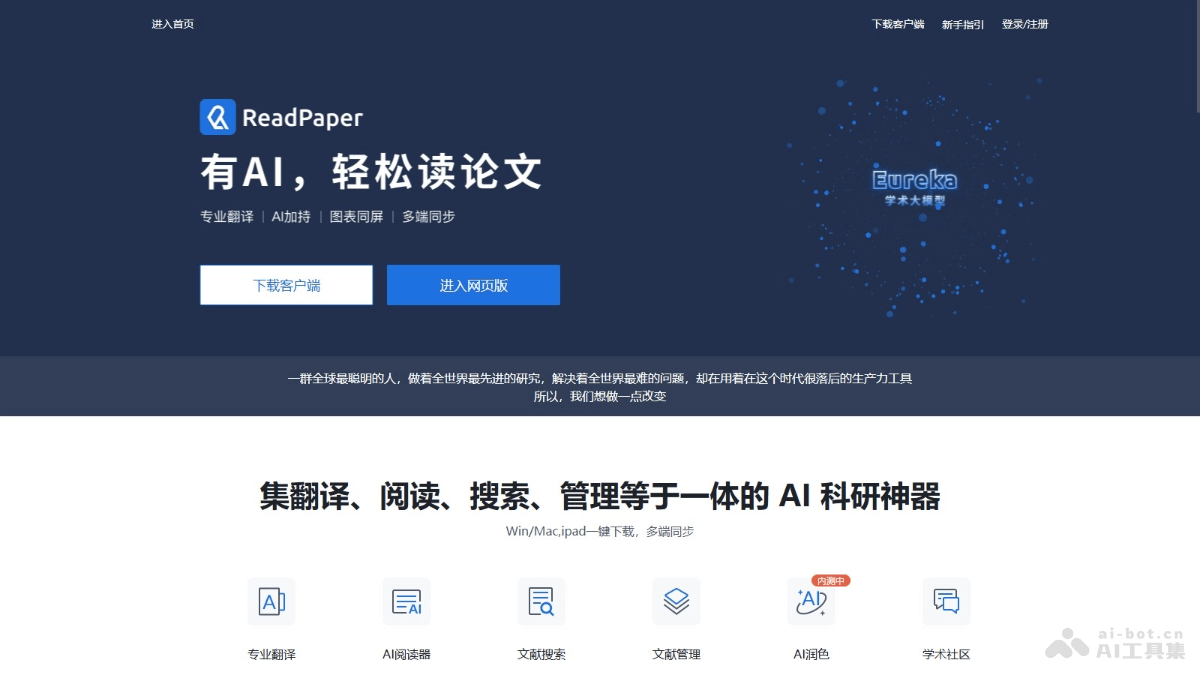
ReadPaper is an AI-driven research tool platform that helps researchers efficiently read, translate, and manage academic papers. It integrates multiple functions such as reference management, AI reader, literature search, academic community, and AI polishing. The platform includes nearly 200 million papers, covering nearly 30,000 universities and research institutions worldwide.
🚀Product highlights
-
Powerful reference management functions: Supports multi-device synchronization (Windows, Mac, iPad), provides local upload, browser plugin import, as well as Word plugin and BibTeX generation, and supports more than 20,000 citation formats.
-
AI reader optimizes the experience: Features word-selection translation, full-text translation, intelligent parsing of charts and citations, and other functions to help users quickly understand the content of papers.
-
Rich academic resources: Includes nearly 200 million papers, covering all disciplines, and supports filtering and sorting by publication time, impact factor, and other conditions.
-
Academic community promotes exchange: Supports creating private groups to facilitate team collaboration and paper sharing, while also providing a public community for users to exchange insights.
🌐Official website address:ReadPaper
12. Agent Laboratory
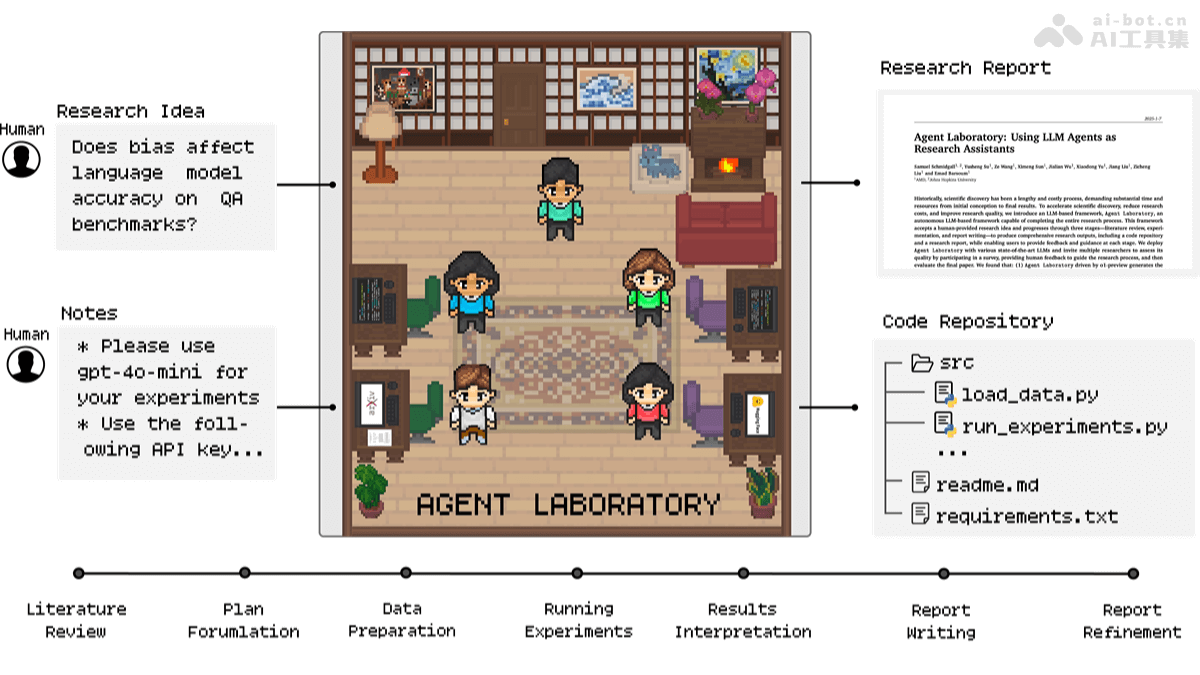
Agent Laboratoryis an autonomous research framework based on large language models (LLM) jointly launched by AMD and Johns Hopkins University. Through collaboration among multiple specialized agents, it helps researchers complete the entire process from literature review and experimental design to report writing. The agents include "PhD" responsible for literature review, "ML Engineer" handling experimental design and code generation, and the "Professor" agent writing research reports.
🚀Product highlights
-
Full-process automation: Agent Laboratory can achieve full-process automation from literature review, experimental design and execution, code generation, and result interpretation to report writing, significantly improving research efficiency.
-
Efficient and low-cost: Compared with traditional research methods, Agent Laboratory can reduce research costs by up to 84%, and can complete the entire process from idea to paper in a short time.
-
Multi-agent collaboration: The system has multiple built-in specialized agents (such as "PhD Student", "Postdoc", "ML Engineer", etc.), each with clearly defined roles, collaborating to complete complex research tasks.
-
High-quality output: Through an iterative improvement mechanism and user feedback guidance, Agent Laboratory can generate high-quality research reports and machine learning code, ensuring the reliability and interpretability of research results.
-
User-friendly interaction: Supports autonomous mode and co-pilot mode. Users can provide feedback at each stage, and the system optimizes based on the feedback, improving the overall quality of the research.
🌐Official website address:Agent Laboratory
13. AI co-scientist
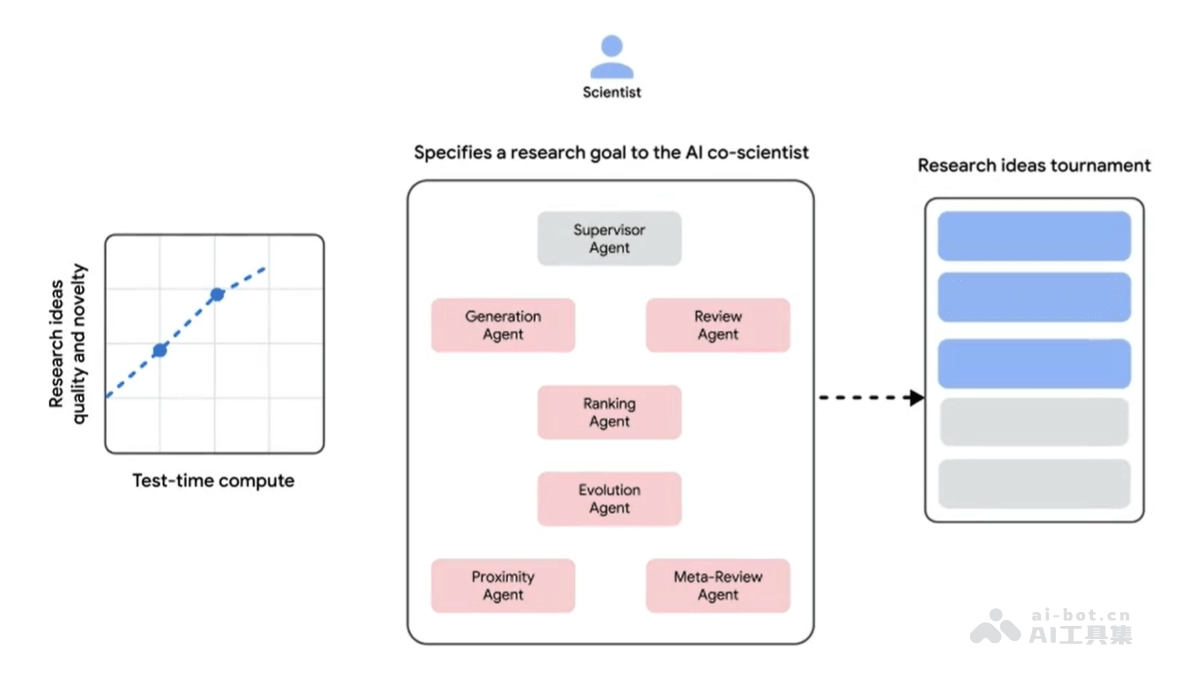
AI co-scientist is a multi-agent AI system launched by Google that assists scientists in scientific discovery through artificial intelligence technology. Built on Gemini 2.0, it uses agents for generation, reflection, ranking, and evolution to work collaboratively, simulating the entire scientific research process. Scientists only need to describe research goals in natural language, and the system can generate verifiable hypotheses, experimental plans, and related literature summaries. Core functions include literature review, hypothesis generation, experimental design, and result analysis. Through automatic feedback, it iteratively optimizes hypotheses, forming a self-improving cycle.
🚀Product Highlights
-
Multi-agent architecture: The system includes multiple agents such as generation, reflection, ranking, evolution, proximity, and meta-review. The agents have clear divisions of labor and work collaboratively, continuously optimizing hypotheses through automated feedback mechanisms, forming a self-improving cycle.
-
Full-process scientific research support: AI co-scientist can provide full-process support from parsing research goals to generating experimental designs. It can conduct literature reviews, hypothesis generation, and experimental design, and can write scientific research reports.
-
Powerful reasoning capabilities: The system uses "test-time compute" technology to dynamically allocate computing resources as needed, enhancing reasoning capabilities. For example, when studying superbug antibiotic resistance, it analyzed more than 28,000 papers and quickly generated high-quality hypotheses.
-
Human-machine collaboration model: AI co-scientist works closely with scientists. Scientists can communicate with the system in natural language, provide feedback, and guide its reasoning process. This improves efficiency while preserving the creativity and critical thinking of human scientists.
-
Significant application results: In the biomedical field, AI co-scientist has achieved multiple results, such as proposing innovative hypotheses in drug repurposing for acute myeloid leukemia, liver fibrosis target discovery, and antibiotic resistance mechanism research, which were verified through experiments.
-
Data integration and scalability: The system integrates various external resources, such as academic databases and specialized AI models, and can process massive amounts of data to discover hidden patterns.
🌐Official Website Address:AI co-scientist