
What is AI co-scientist
AI co-scientist is a multi-agent AI system launched by Google. As a virtual research robot, it assists researchers in handling various tedious research tasks, including research topic selection, literature retrieval, and experimental design. AI co-scientist is based onGemini 2.0 It is powered by multiple agents such as generation, reflection, ranking, and evolution working together to simulate the entire scientific research process. The system can understand research goals, generate innovative hypotheses and research plans, and enhance its reasoning capabilities based on "test-time compute." AI co-scientist has achieved preliminary results in areas such as drug repurposing, target discovery, and antibiotic resistance mechanisms, demonstrating the potential to accelerate scientific discovery.
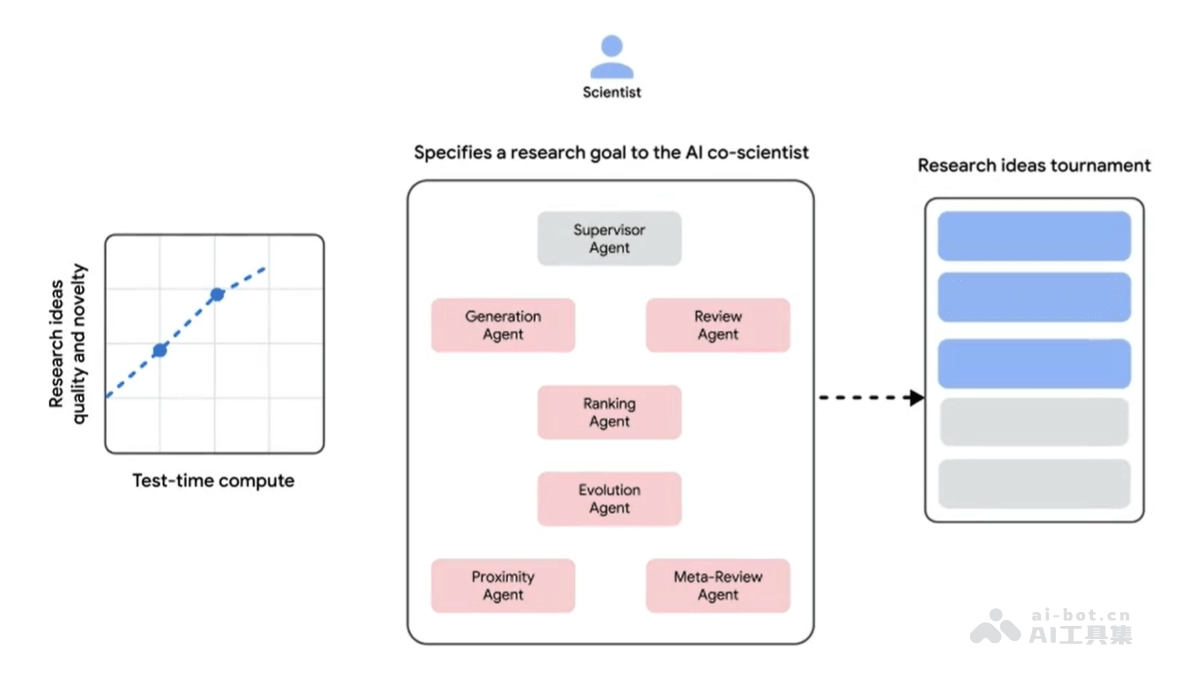
Main features of AI co-scientist
- Understanding research goals: Scientists describe research goals to the system in natural language, and the system understands and generates relevant research hypotheses and experimental plans.
- Generating innovative hypotheses: The system generates novel research hypotheses based on literature exploration and simulated scientific debate.
- Experimental design: The system proposes detailed experimental plans, including experimental steps, expected results, and validation methods, and evaluates feasibility.
- Self-optimization: Based on a "hypothesis tournament" and evolutionary process, the system continuously optimizes the quality of hypotheses.
- Literature review and integration: The system quickly reviews and summarizes relevant literature, integrates existing research results, and provides support for new research directions.
Technical principles of AI co-scientist
- Multi-agent architecture: The system consists of multiple agents, including a Generation Agent, Reflection Agent, Ranking Agent, Evolution Agent, Proximity Check Agent, and Meta-Review Agent. Each agent performs its own role and collaborates to complete complex scientific reasoning tasks.
- Test-time compute: The system dynamically allocates computational resources during the reasoning process and enhances its reasoning capabilities based on extended inference time.
- Elo rating mechanism: The system uses the Elo rating mechanism to automatically evaluate the quality of generated hypotheses and research plans. The higher the Elo rating, the higher the quality of the hypothesis.
- Simulating the scientific method: The system simulates the entire scientific research process (including steps such as hypothesis generation, validation, and improvement) to generate high-quality research plans. The design is inspired by the "hypothesis-validation" cycle in scientific research.
- Natural language processing: Based on Gemini 2.0, the system understands and generates natural language. Scientists interact with the system in a natural way, describing research goals, providing feedback, or receiving system output.
- Tool integration and extension: The system integrates with external tools (such as literature databases and specialized AI models) and uses external tools to extend its capabilities, for example, validating protein structure design through AlphaFold.
Project address of AI co-scientist
- Project official website:https://research.google/blog/accelerating-scientific-breakthroughs-with-an-ai-co-scientist/
- Technical paper:https://storage.googleapis.com/coscientist_paper/ai_coscientist.pdf
- Apply for experience:https://docs.google.com/forms/d/e/viewform
Application scenarios of AI co-scientist
- Drug repurposing: Quickly find new uses for existing drugs, such as finding new drugs for acute myeloid leukemia (AML), saving R&D time and cost.
- Target discovery: Identify new therapeutic targets, for example, proposing new epigenetic targets in liver fibrosis research to facilitate new drug development.
- Drug resistance mechanism research: Explore bacterial drug resistance mechanisms, such as proposing the interaction hypothesis of phage-induced chromosomal islands, providing new ideas for antibacterial strategies.
- Experimental design: Generate innovative hypotheses and detailed experimental protocols for biomedical research to improve research efficiency.
- Interdisciplinary research: Integrate knowledge from multiple fields, break down disciplinary barriers, and accelerate interdisciplinary research on complex diseases.