
What is PaSa
PaSa is an academic paper retrieval agent based on reinforcement learning, launched by the ByteDance Research team.academic papersIt can imitate the behavior of human researchers, automatically invokesearch engines, browse related papers, and track citation networks, providing users with accurate and comprehensive academic paper retrieval results.
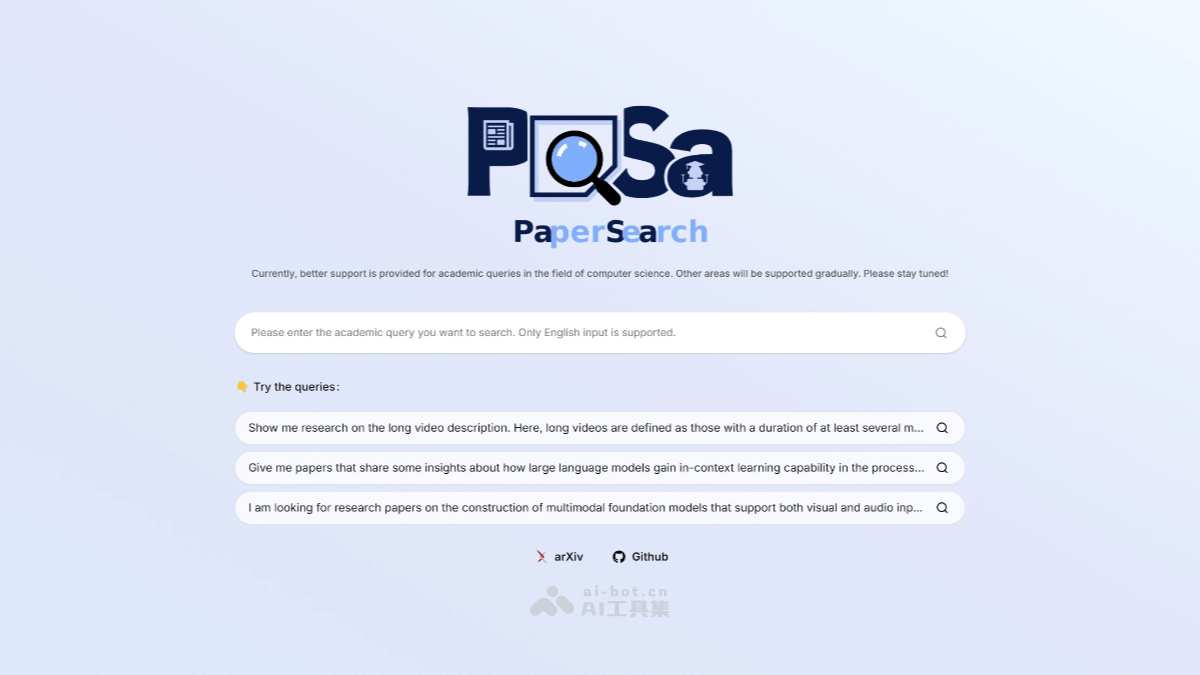
PaSa's main features
- Autonomously invoking search tools: PaSa can automatically invoke search engines, generate diverse search keywords based on the academic questions entered by users, and perform multiple searches to ensure comprehensive coverage of relevant literature.
- Reading and analyzing paper content: PaSa achieves efficient information processing through its core components, Crawler and Selector. Crawler is responsible for collecting related papers, including discovering more potentially relevant literature by expanding the citation network. Selector then carefully reads the collected papers and filters out the literature that truly meets the user's needs.
- Selecting relevant references: PaSa can filter out the references most relevant to the user's query from massive amounts of literature, providing comprehensive and accurate search results.
- Support for complex academic queries: PaSa is designed specifically for handling complex academic questions and can understand and process fine-grained academic queries, such as questions involving specific algorithms or research methods.
- Reinforcement learning optimization: PaSa is trained using reinforcement learning methods, improving search efficiency and accuracy through the synthetic dataset AutoScholarQuery and the real-world query benchmark RealScholarQuery.
- Efficient retrieval capability: PaSa's retrieval speed is extremely fast and can complete a detailed academic investigation within two minutes. In performance tests, PaSa improved by 37.78% and 39.90% over Google Scholar on the Recall@20 and Recall@50 metrics, respectively.
PaSa's technical principles
- Core components: PaSa's core includes two main LLM agents: Crawler and Selector.
- Crawler: Responsible for collecting academic papers related to the user's query through search engines. It can generate diverse search keywords and perform multiple searches to maximize recall.
- Selector: Responsible for carefully reading each paper found by Crawler, evaluating whether it meets the user's needs, and improving the precision of search results.
- Reinforcement learning optimization: PaSa is trained using reinforcement learning (RL) and the proximal policy optimization (PPO) algorithm to address the sparse reward and long trajectory problems in literature search. During training, PaSa improves performance in the following ways:
- Synthetic dataset: The research team built the AutoScholarQuery dataset, containing 35,000 fine-grained academic queries and their corresponding related papers. The data comes from papers at top artificial intelligence conferences.
- Real-world dataset: To evaluate PaSa's performance in real-world scenarios, the team also developed the RealScholarQuery dataset, collecting real-world academic queries.
PaSa's project address
- Project official website:pasa-agent.ai
- GitHub repository:https://github.com/bytedance/pasa
- arXiv technical paper:https://arxiv.org/pdf/2501.10120
PaSa's application scenarios
- Literature research in academic studies: PaSa can help researchers quickly complete the retrieval and investigation of academic papers. By imitating the behavior of human researchers, autonomously invoking search engines, reading papers, and tracing citation networks, it can complete a detailed academic investigation within two minutes.
- University Research and Teaching Support: In university scenarios, PaSa can serve as a research assistance tool, helping teachers and students quickly obtain relevant academic resources. Teachers can use PaSa to quickly retrieve content from academic resource repositories, assisting with literature review generation, research experiment design, and paper translation and polishing.
- Intellectual Property Analysis: PaSa's efficient retrieval capabilities can also be applied in the field of intellectual property.
- Multi-Task Learning and Data Mining: Research from the PASA Big Data Laboratory at Nanjing University shows that PaSa's underlying technology can also be applied in the fields of multi-task learning and data mining.