
What is Agent Laboratory
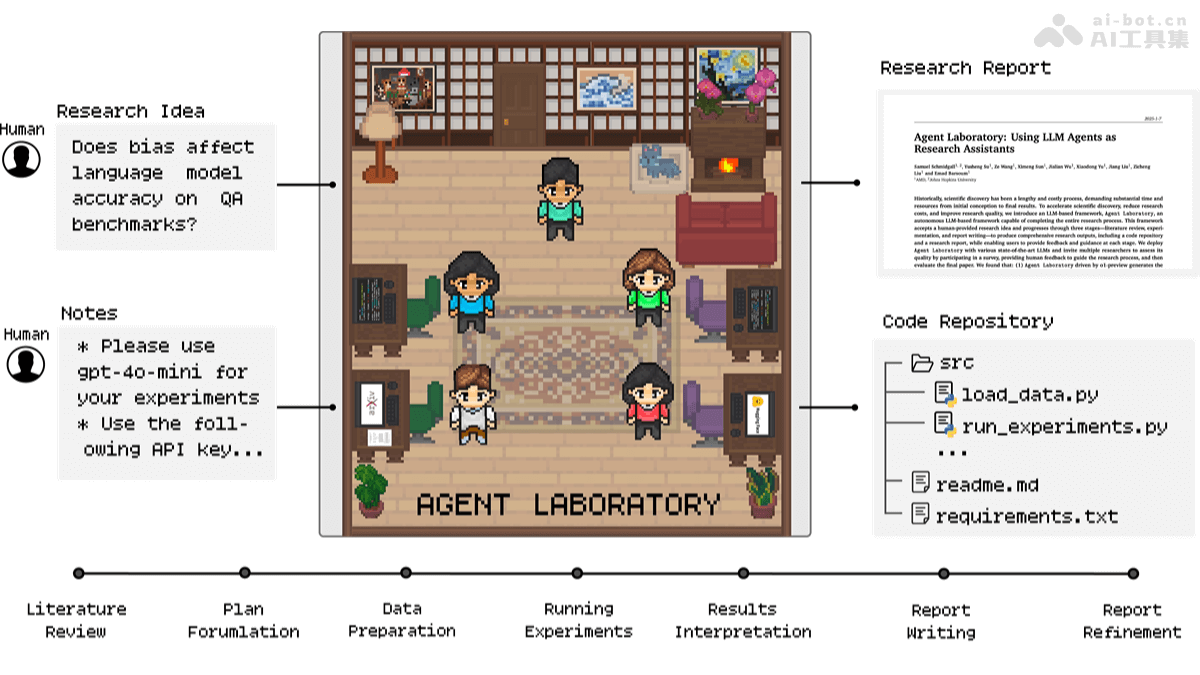
Agent Laboratory is an autonomous research framework based on large language models (LLMs) introduced by AMD and Johns Hopkins University, capable of accelerating scientific discovery, reducing costs, and improving research quality. Agent Laboratory accepts research ideas provided by humans and, based on three stages—literature review, experimentation, and report writing—produces comprehensive research outputs, including code repositories and research reports. Agent Laboratory supports users in providing feedback and guidance at each stage, improving the overall quality of the research. Experimental results show that Agent Laboratory can significantly reduce research costs, achieving an 84% cost reduction compared with previous autonomous research methods. The performance of Agent Laboratory also varies under different LLM backends, among which o1-preview scores highest in usefulness and report quality, and o1-mini scores highest in experimental quality.
Main Features of Agent Laboratory
- Literature Review: Automatically collects and organizes literature related to the research topic, providing references for subsequent research stages.
- Experimental Design and Execution: Based on the literature review and research objectives, formulates detailed experimental plans and automatically executes experiments.
- Code Generation: Automatically generates machine learning code for experiments, supporting multiple LLM backends such as gpt-4o, o1-mini, and o1-preview.
- Result Interpretation: Analyzes and interprets experimental results, providing a basis for writing research reports.
- Report Writing: Generates structured research reports, including sections such as abstract, introduction, background, related work, methods, experimental setup, results, and discussion.
- User Interaction: Supports autonomous mode and co-pilot mode, where users provide feedback and guidance at each stage to improve research quality.
Technical Principles of Agent Laboratory
- Based on Large Language Models (LLMs): Uses pre-trained LLMs such as gpt-4o, o1-mini, and o1-preview to generate natural language text, including literature reviews, experimental plans, code, and research reports.
- Autonomous Agent System: Uses multiple specialized agents (such as the PhD agent, Postdoc agent, ML Engineer agent, and Professor agent) to collaborate in completing tasks such as literature retrieval, experimental design, code writing, result interpretation, and report writing.
- Modular Tools: The mle-solver module automatically generates and optimizes machine learning code, and the paper-solver module generates and optimizes research reports, ensuring the quality of experiments and reports.
- Iterative Improvement Mechanism: Agents engage in self-reflection at each stage, generate improvement measures based on experimental results or error signals, and improve the quality of code and reports through iterative optimization.
- User Interaction and Feedback: Supports autonomous mode and co-pilot mode, where users provide feedback and guidance at each stage, and agents adjust and optimize based on the feedback, improving the overall quality of the research.
Project Addresses of Agent Laboratory
- Project Website:https://agentlaboratory.github.io/
- GitHub Repository:https://github.com/SamuelSchmidgall/AgentLaboratory
- arXiv Technical Paper:https://arxiv.org/pdf/2501.04227
Application Scenarios of Agent Laboratory
- Scientific Literature Review: Quickly collects and organizes related literature, generates literature review reports, and provides background information for research.
- Experimental Design and Execution: Develop detailed experimental plans, automatically generate experimental code, execute experiments and monitor results, improving research efficiency.
- Code generation and optimization: Generate high-quality machine learning code, support multiple programming languages and frameworks, and optimize code performance based on an iterative improvement mechanism.
- Result interpretation and report writing: Analyze experimental results, generate structured research reports, and ensure the clarity and logicality of the reports.
- Multi-domain research support: Suitable for multiple fields such as machine learning, biomedicine, materials science, and social sciences, accelerating the research process.