

What is ljg-skills
ljg-skills is "God of Prompt" Li Jigang's open-source Claude Code custom skill collection, containing 20 deeply refined cognitive tools and 2 automated workflows. The underlying design philosophy of the tools is compression, using minimalist Lisp expressions to encapsulate complete methodologies, breaking down complex cognitive tasks into reusable Skill units. Skills support dual-format output in org-mode and Markdown, can be installed with one click via npx CLI, and can be migrated to OpenClaw and other domestic AI platforms that support Skill systems.
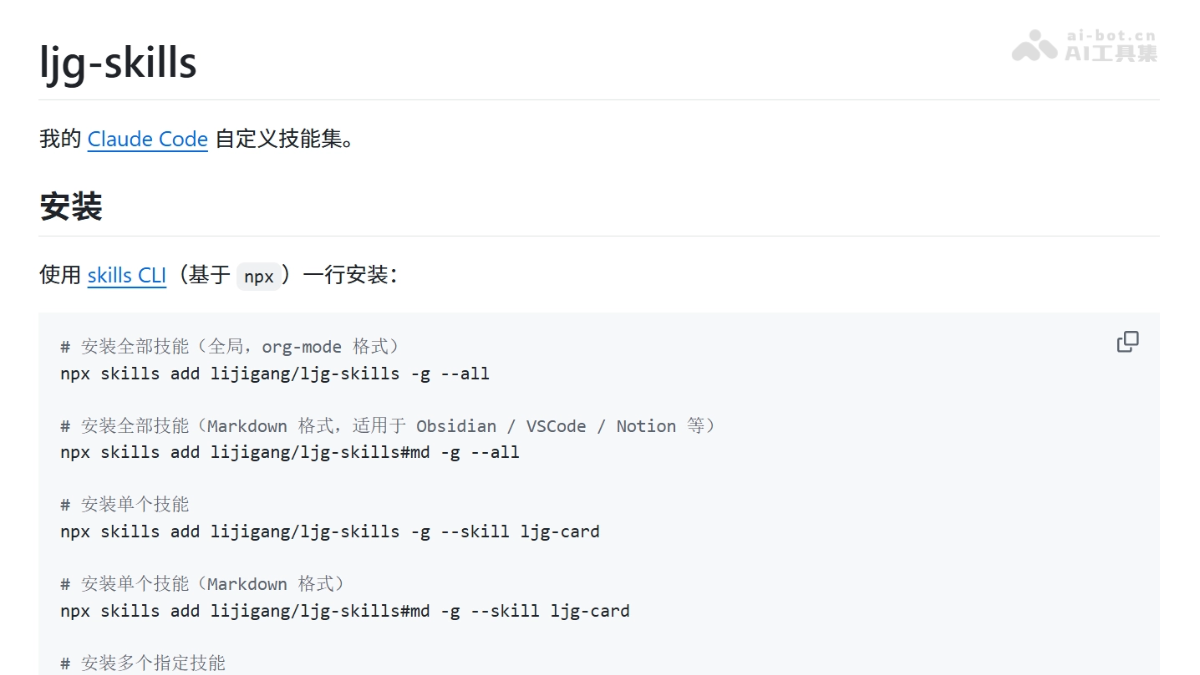
Main features of ljg-skills
- Content creation
-
ljg-writes: Like a scalpel dissecting an viewpoint, thinking it through layer by layer during the writing process.
-
ljg-card: Convert content into PNG visual cards, supporting long images, infographics, comics, whiteboards, and other formats.
-
ljg-present: Generate presentation slides in Takahashi-style or slogan-style, with one keyword per page or assertion sentences in black-and-red two-color blocks.
-
- Learning and research
-
ljg-learn: Dissect a concept from eight dimensions (history, dialectics, phenomenon, language, form, existence, aesthetics, meta-reflection), compressing it into a single moment of insight.
-
ljg-paper: Extract the core ideas of papers for non-academics, emphasizing understanding over criticism.
-
ljg-paper-river: Use backward reading to recursively trace prior literature, telling the history of a problem's evolution from its source.
-
ljg-book: Deconstruct a book with the question as the axis, sorting out the author's consensus, shifting points, conclusions, and spiritual core.
-
ljg-library: Explain a book's original framing perspective thoroughly, and generate a 2050 library borrowing card PNG.
-
ljg-word: Deeply deconstruct the core semantics of English words, finding the moment of insight to understand them.
-
ljg-read: Provide companion reading services including three-layer English translation, structural annotation, in-depth questioning, and cross-domain excursions.
-
- Thinking tools
-
ljg-rank: Given a field, find the irreducibly independent generators behind it, cutting phenomena down to the simplest.
-
ljg-think: Vertically drill deep into an viewpoint or phenomenon until reaching the indivisible essence.
-
ljg-plain: Rewrite any content so that a smart twelve-year-old can understand it, with no loss of information.
-
ljg-invest: Judge from six dimensions whether a project is an "order-creating machine".
-
ljg-qa: Extract the core viewpoints of an article, paper, or book into a Q-A chain, with Q cutting to the point and A structured in four paragraphs.
-
ljg-roundtable: Organize truth-seeking structured multi-person dialectical dialogue, generating an ASCII thinking framework diagram each round.
-
- Relationship analysis
-
ljg-relationship: Through five-layer structural diagnosis and psychoanalysis, help users "see" the true structure of a relationship.
-
- Practical tools
-
ljg-travel: Enter a city name to automatically generate in-depth cultural documents and portable cards covering historical layers, museums, ancient architecture, and archaeological discoveries.
-
ljg-x-download: Download images and videos from X/Twitter posts to local ~/Downloads with one click.
-
ljg-skill-map: Scan all installed skills and render a visual overview.
-
ljg-push: Sync local skills to a GitHub repository's master and md dual branches with one click.
-
- Workflows
-
ljg-paper-flow: Read papers, generate analysis, and create comic cards in one continuous flow.
-
ljg-word-flow: After in-depth word analysis, automatically generate infographic cards in one continuous flow.
-

Follow WeChat and reply "open source" to join theAI open-source project exchange group
How to use ljg-skills
- Clone the repository: run
git clone https://github.com/lijigang/ljg-skills.gitto get all skill files. - Choose a format: the default branch is in org-mode format (for Emacs), and the Markdown branch is for Obsidian/VSCode/Notion.
- Install skills: run
npx skills add lijigang/ljg-skills -g --allto install all skills globally, or add--skill <name>to install a single skill. - Install dependencies: if using ljg-card, you need to enter the directory and run
npm install && npx playwright install chromiumto install the screenshot dependency. - Verify usage: enter the skill name in Claude Code (such as
ljg-card) to trigger it; domestic platforms can be adapted through Skill file migration.
Core advantages of ljg-skills
- Deep refinement: each skill has been studied and polished for half a year; it is not a pile of tools but an encapsulation of cognitive methodology.
- Minimal compression.: evolved from complex prompts of hundreds of words into minimal Lisp expressions, using one cup to hold all kinds of drinks while the structure remains stable.
- Dual-format output: supports both org-mode and Markdown, covering Emacs users and the mainstream note-taking tool ecosystem.
- One-click installation: the npx-based skills CLI supports global/local, single-skill/all-skill, and multi-skill combination installation, with no manual configuration required.
- Workflow chaining: skills can be combined into pipelines (such as paper reading→card generation) to automate complex cognitive tasks.
- Platform migration: the standard SKILL.md format has become a common industry specification and can be seamlessly migrated to domestic platforms such as OpenClaw and Antigravity.
Project address of ljg-skills
- GitHub repository:https://github.com/lijigang/ljg-skills
Comparison of ljg-skills with similar competitors
| Dimension | ljg-skills | Anthropic official Skills |
|---|---|---|
| Positioning | Personal cognitive tool library, oriented toward thinking and creation | Official standard examples, oriented toward general development workflows |
| Quantity | 20 skills + 2 workflow sets | 17 official skills |
| Design philosophy | Cognitive forging; each skill has its own independent creative philosophy and methodology | Function-oriented, focusing on demonstrating the Skill standard format and best practices |
| Skill depth | Deep; a single skill encapsulates a complete cognitive process (such as eight-dimensional concept dissection and paper tracing) | Medium; covers standard scenarios such as document creation, security specifications, and testing |
| Workflow | Native support for skill chain linking (such as paper→card) | Mainly independent skills, with no native workflow combination |
| Output format | org-mode + Markdown + PNG visual cards | Mainly text output |
| Installation method | npx skills CLI / git clone, supporting global and local | Official plugin marketplace / built-in recommendations |
| Cross-platform | Can be migrated to platforms that support SKILL.md, such as OpenClaw and Cursor | Mainly oriented toward the Claude Code / Claude.ai ecosystem |
| Maintainer | Individual (Li Jigang) | Anthropic Official Team |
Application Scenarios of ljg-skills
-
Deep Writing: Use the writing engine to dissect viewpoints, the plain-language engine to simplify expression, and content-to-card generation to create visual cards ready for direct publishing.
-
Academic Research: Use the paper reader to extract the core, paper tracing to track the evolution of literature, and concept dissection to break down key terms.
-
Knowledge Management: Use the book-dissection skill to archive books, the information question machine to turn articles into a Q-A knowledge base, and the library borrowing card for visual presentation.
-
Investment Decision-Making: Use investment analysis to judge from six dimensions whether a project is an "order-creating machine," assisting decision-making.
-
Travel Planning: Enter a city name to automatically generate in-depth cultural documents and portable cards covering history, museums, ancient architecture, and archaeology.


