
What is M2.5
M2.5 isMiniMaxa lightweight flagship large model with 10B activated parameters, focusing onprogrammingand Agentic capabilities. The model supports an ultra-high inference speed of 100 TPS (about 3 times that of Claude Opus), supports full-stack development in 10+ languages (Go, Rust, Kotlin, Python, Java, etc.), complex logical reasoning, and enterprise-level system building. The model reaches SOTA level on benchmarks such as SWE-Bench Verified (80.2%) and Multi-SWE-Bench (51.3%), and possesses "architect-level" task decomposition and planning capabilities. The model adopts an Agent-native architecture and is positioned as the main model for next-generation digital office work.
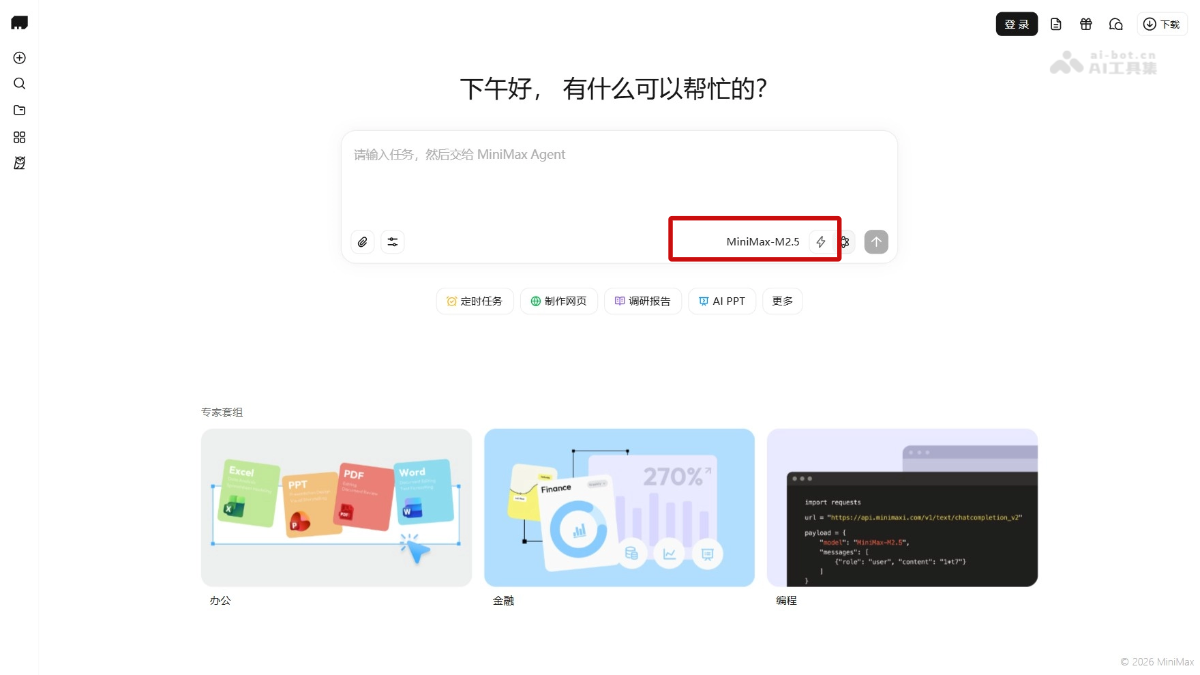
Main features of M2.5
-
Intelligent programming: supports full-stack development in 10+ languages, has architect-level planning capabilities, and can complete the full software lifecycle from system design to test review.
-
Agentic execution: through efficient tool calling and intelligent search, autonomously completes complex tasks with lower token consumption and faster speed.
-
Office automation: directly delivers professional-grade outputs such as Word, PPT, and Excel, transforming industry tacit knowledge into reusable standardized skills.
-
Expert building: supports users in combining domain SOPs and core capabilities to create custom Experts, and the platform has accumulated 10,000+ experts.
-
High cost-effectiveness: running continuously for one hour at 100 TPS costs only 1 US dollar, making unlimited operation of complex Agents completely economically feasible.
Technical principles of M2.5
- Forge native Agent RL framework: by introducing an intermediate layer to completely decouple the underlying training and inference engine from the Agent, it supports access to and optimization of arbitrary Agents, and with asynchronous scheduling and tree-based merged training sample strategies, it achieves about 40 times training acceleration, verifying that model capability scales nearly linearly with compute and task count.
- Agentic RL algorithm and reward design: it continues to use the CISPO algorithm to ensure the stability of large-scale training of MoE models, introduces a process reward mechanism to solve the long-context credit assignment problem, and at the same time uses the estimated real task time consumption as Reward, achieving the optimal balance between model effectiveness and response speed.
- Efficient inference and task optimization: through reinforcement learning, it incentivizes the model to efficiently decompose complex tasks and optimize token consumption. Combined with native 100 TPS inference speed and parallel tool calling capability, it shortens the completion time of SWE-Bench Verified by 37% compared with M2.1 while maintaining top performance.
- Large-scale real-environment training: RL training is conducted based on 200,000+ real environments, covering scenarios such as programming, search, and office work, transforming the real workflows of the company's internal R&D, product, sales, and other functions into training data, continuously improving the model's generalization ability in real tasks.
- Extreme cost architecture design: it adopts a MoE architecture to achieve high-speed and low-consumption inference, provides dual versions of 50 TPS and 100 TPS, and with a caching mechanism reduces the output price to 1/10-1/20 of similar models, realizing for the first time economically feasible unlimited operation of complex Agents.
Performance of M2.5
- Programming capability: it achieved a score of 80.2% on the SWE-Bench Verified test, surpassing Claude Opus 4.6; on the Multi-SWE-Bench multilingual programming benchmark, it reached industry first place with a score of 51.3%; on the VIBE-Pro internal benchmark, it is on par with Opus 4.5 performance is comparable. Cross-scaffold generalization is excellent, achieving a 79.7% pass rate on Droid, surpassing Opus 4.6's 78.9%; on OpenCode it reaches 76.1%, also ahead of Opus 4.6's 75.9%.
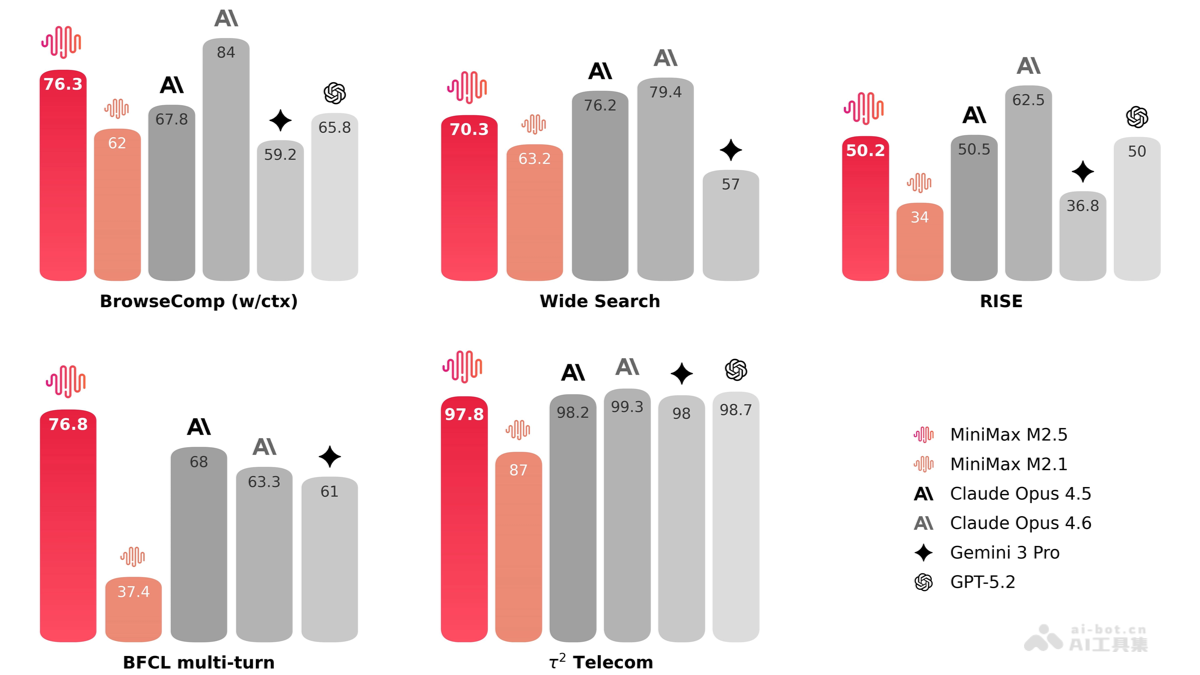
- Search and tool calling: It achieves an industry-leading 76.3% on the BrowseComp benchmark and also leads in Wide Search. In the RISE real interactive search evaluation, it demonstrates expert-level search capabilities. Compared with the previous generation M2.1, it saves about 20% of search rounds across multiple tasks, with significantly improved token efficiency.
- Office scenarios: It achieves an average win rate of 59.0% on the internal Cowork Agent evaluation framework GDPval-MM; it reaches excellent levels on both the Excel competition-based MEWC benchmark and expert-built financial modeling evaluations.
M2.5 project address
- Project official website:https://www.minimax.io/models/text
How to use M2.5
-
Online experience: Visit MiniMax Agentthe official website to directly experience M2.5's conversation and coding capabilities.
-
API call: Developers can go to the API calling platform https://platform.minimaxi.com to register an account and create an API Key for interface calls.
M2.5 application scenarios
-
Intelligent programming: M2.5 can automatically generate full-stack code, debug programs, and optimize algorithms, significantly improving development efficiency.
-
Office automation: The model can handle complex Excel data analysis tasks and automatically generate professional PPT reports.
-
AI Agent: The model supports executing multi-step complex tasks, including in-depth research, information integration, and cross-platform automated operations.
-
Real-time interaction: With its high-concurrency processing capability, the model is suitable for building real-time dialogue systems such as customer service bots and intelligent assistants.