
What is K2.8 Preview
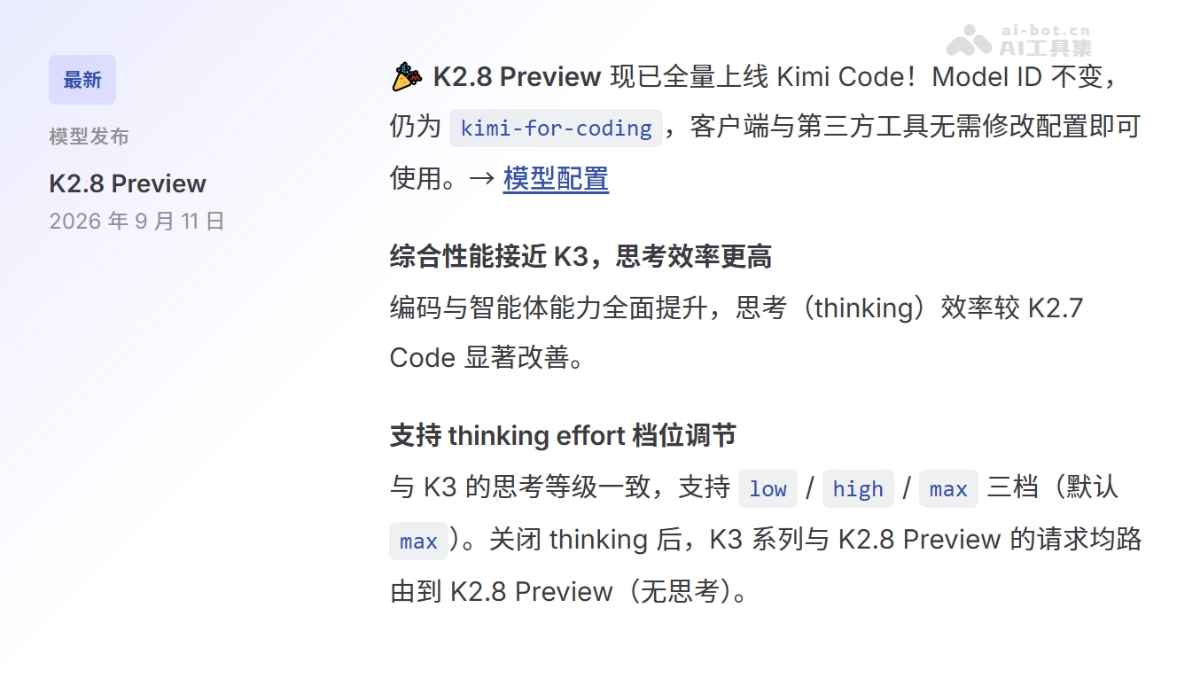
Kimi K2.8 Preview is the flagship model fully rolled out by Moonshot AI on Kimi Code and Kimi Work . According to the official statement, its overall performance is close to the flagship Kimi K3, with improved coding and Agent capabilities, and significantly better thinking efficiency than K2.7. The model supports three levels of thinking—low/high/max—as well as image and video input, and the 1M ultra-long context is open to all members.
Main features of K2.8 Preview
-
Code generation and completion: Positioned as the mainstay for everyday development, it optimizes tasks with clear boundaries such as code completion and modification.
-
Agent capabilities: Coding and agent capabilities are comprehensively improved over K2.7 Code, and it can autonomously advance multi-step engineering tasks.
-
Three levels of thinking intensity: Supports three levels of reasoning effort—low / high / max—aligned with K3's thinking levels, with max as the default.
-
Multimodal input: Supports image and video input, and can handle visual development materials.
-
1M ultra-long context: All membership tiers are open to a maximum of 1 million tokens of context, allowing large-scale codebases to be processed in one go.
-
Seamless upgrade: The Model ID remains
kimi-for-coding, so clients and third-party tools require no configuration changes. -
Intelligent routing: After thinking is disabled for the K3 series, requests are automatically forwarded to the non-thinking version of K2.8 for processing.
Technical principles of K2.8 Preview
-
Tiered reasoning control: Through the reasoning effort mechanism, trade-offs are made in the reasoning budget—the low tier sacrifices thinking depth for speed, while the max tier invests more thinking tokens to gain a higher success rate on complex tasks. In essence, this is an explicit scheduling of the computational resource of "number of thinking tokens."
-
Long-context processing: The 1M window relies on efficient attention implementation. The KDA hybrid linear attention and Attention Residuals route adopted by K3 (which explicitly reduces the computational overhead of attention on long sequences) is an important technical reference for K2.8.
-
Request routing layer: On the product side, the scheduling system seamlessly switches session traffic between K3 and K2.8 based on model availability and the thinking toggle state, ensuring continuity of experience under the same entry point.
How to use K2.8 Preview
-
No configuration required, ready to use out of the box: K2.8 Preview has been fully rolled out,
kimi-for-codinghas been seamlessly upgraded, and existing clients and third-party tools (Claude Code、OpenCode、Codex , etc.) require no configuration changes. -
Subscribe to any membership to use it: All tiers from Adagio (free tier) to Allegro can use it, and directly enjoy the 1M context.
-
Kimi Code CLI: After installing the CLI and logging into your account, starting a session normally means you are using K2.8. You can enter
/modelto view or switch the current model. -
Adjust the thinking tier: Enter
/effortto switch among the three tiers low / high / max. Use a lower tier for simple tasks to save tokens, and use max for complex tasks to trade for a higher success rate. -
Third-party tool integration: Simply configure the model ID in the tool as
kimi-for-coding. If you want speed and are an Allegretto member or above, you can switch tokimi-for-coding-highspeed。 -
Kimi Work scenario: Directly initiate tasks in Kimi Work , and the platform will automatically route to K2.8 Preview.
Core Advantages of K2.8 Preview
- Performance close to flagship: Overall performance is close to K3, coding and Agent capabilities are comprehensively improved over K2.7 Code, and thinking efficiency is significantly improved.
- Zero-threshold access: Available to all membership tiers (including the free Adagio tier), breaking the restriction that K3 requires at least ¥99.
- Faster response: User test feedback shows speed is noticeably better than K3, suitable for high-frequency interaction scenarios such as code completion.
- More controllable behavior: Compared with K3's problems of being overly proactive in ambiguous tasks and sensitive to historical thinking, K2.8 is positioned for daily development, with more stable behavioral boundaries.
- Seamless migration: The Model ID remains
kimi-for-codingunchanged, so clients and third-party tools can upgrade with zero changes. - Flexible thinking levels: Freely switch among three levels, low / high / max; save tokens on simple tasks and maintain quality on complex tasks.
- Multimodal capabilities: Supports image and video input, and the 1M window can swallow an entire large codebase in one go.
Comparison of K2.8 Preview with Similar Competitors
| Comparison dimension | Kimi K2.8 Preview | Claude Sonnet 5 |
|---|---|---|
| Positioning | Low-cost main model, taking over the daily traffic of flagship K3 | Mid-range main model, default model for Claude.ai Free/Pro |
| Overall performance | Officially claimed to be close to K3 (benchmark not published) | SWE-bench Pro 63.2%,OSWorld-Verified 81.2% |
| Context window | 1M token, open to all memberships | 1M token |
| Multimodal | Image + video input | Text + image, no video input |
| Thinking levels | Three levels, low / high / max, aligned with K3 | Adaptive thinking |
| API pricing | Follows subscription membership (¥0–699/month), not billed by token | $2 / $10 per million tokens (returns to $3 / $15 after August 31, 2026) |
| Open weights | Not published (the K series has an open-source tradition, and K3 has been open-sourced) | Closed source, available only via API |
Application Scenarios of K2.8 Preview
-
Large codebase understanding and refactoring: The 1M context can swallow an entire repository in one go, enabling cross-file dependency analysis, batch refactoring, and architecture-level modification suggestions.
-
Daily code completion and development: Positioned as a "daily-life model"; its behavior is more controllable and its responses are faster than K3, suitable for high-frequency completion, debugging, and small feature iterations.
-
Multimodal development assistance: Supports image and video input, allowing direct screenshots of error screens, screen recordings demonstrating bugs, or reference design mockups to generate front-end code.
-
Agent automated workflows: Coding and Agent capabilities are comprehensively improved over K2.7, and it can be used for multi-step task orchestration—a closed-loop process of running tests, fixing failed cases, and submitting PRs.
-
Long document/long log analysis: The 1M window can accommodate extremely long logs, technical documents, or meeting records, enabling full-text search-style Q&A and summary extraction, with zero additional cost within membership.