
What is GPT-6 Luna
GPT-6 Luna is a lightweight model launched by OpenAI, and together with GPT‑6 Sol it belongs to GPT‑6 Astra as a derivative version, positioned for high-frequency, large-scale tasks. The model API price has dropped to $0.1 input and $0.5 output per million tokens, 50% cheaper than the previous generation, and has entered DeepSeek's territory. In terms of performance, the coding test DeepSWE reaches 66.6%, close to Claude Opus 5 at medium strength level, while costing only about 7% of it, suitable for lightweight development, batch processing, and multi-Agent concurrent scenarios.
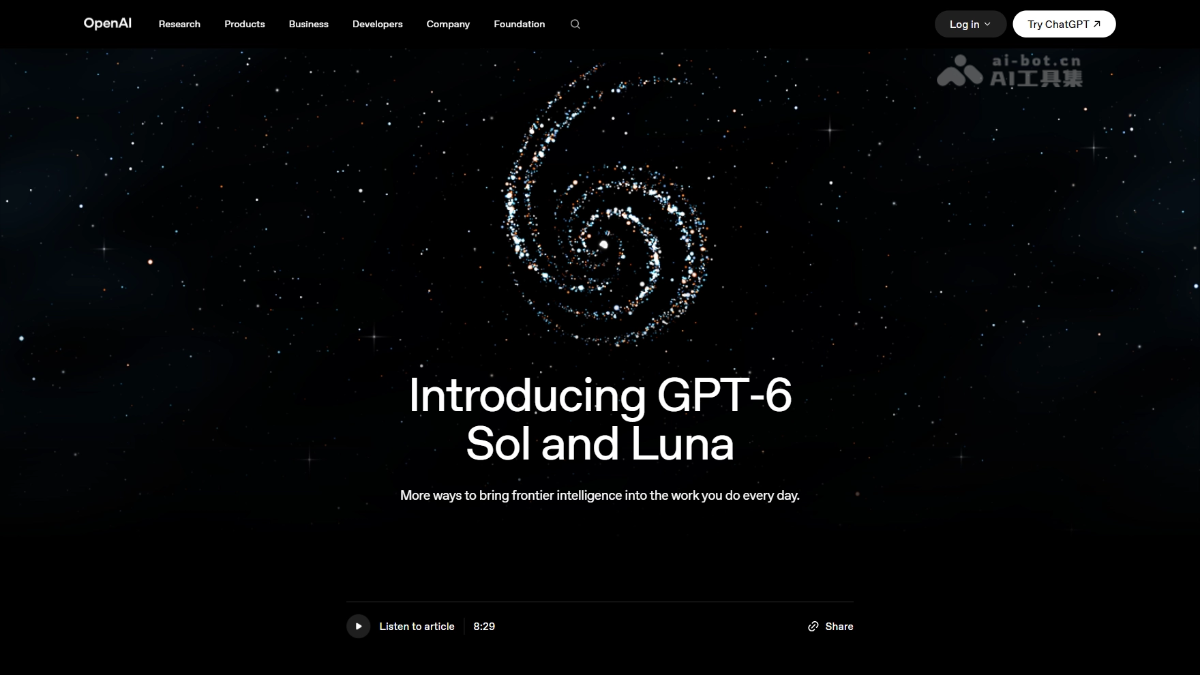
Main features of GPT-6 Luna
-
Lightweight coding: DeepSWE v1.1 scores 66.6%, close to Claude Opus 5 at medium strength level, but task cost is 93% lower.
-
Computer operation: Exceeds GPT-5.6 Sol (medium) on the OSWorld 2.0 test, at only one-tenth of its cost.
-
Professional workflows: At high reasoning strength, AutomationBench score improves by 5.4 percentage points compared with GPT-5.6 Luna, while task cost drops by 58%.
-
Factual accuracy: At high reasoning strength, reaches GPT-5.6 Sol's factual reliability level at about one percent of the cost.
-
Collaboration style optimization: Answers are more concise and clear, with less jargon and fewer redundant details, and clearly state what was checked.
Technical principles of GPT-6 Luna
-
Astra distillation handoff: Uses a training method similar to GPT-6 Astra, compressing the flagship model's capabilities in reasoning, multimodality, alignment, and other aspects into a lighter, higher-throughput runtime version, achieving "capability scaling" rather than simply pursuing peak performance.
-
Inference infrastructure optimization: Reduces serving costs by improving caching mechanisms and inference efficiency, and passes the saved costs directly to users in the form of a 50% price cut. This is the fundamental source of the low price rather than simply compressing model capabilities.
-
Prompt Caching upgrade: The system has a higher default cache hit rate, and cached input reads enjoy a 90% discount; it supports dynamically adjusting reasoning strength and tool switches during a conversation without breaking cache reuse, and introduces explicit breakpoints so developers can precisely control cache prefix boundaries, which is especially critical for long-context Agent scenarios.
-
Tiered reasoning strength: Provides multiple effort settings such as low/medium/high/highest, allowing users to flexibly adjust compute investment according to task difficulty. High reasoning strength can approach the level of the previous generation Sol, while low strength further reduces cost, achieving a dynamic trade-off between cost and capability.
How to use GPT-6 Luna
Method 1: ChatGPT Work / Codex
-
Confirm that you are a Plus, Pro, Business, Enterprise, or Edu user (Free/Go users can only use Luna on the desktop app).
-
Open ChatGPT Work or Codex, and find GPT-6 Luna in the model selector.
-
Enter a task directly to start using it. Luna is suitable for high-frequency, lightweight everyday tasks.
Method 2: API call
-
Log in to the OpenAI developer platform and obtain an API Key.
-
In the request, set the model parameter to
gpt-6-luna, billed at $0.1 input and $0.5 output per million tokens. -
You can monitor the cache hit rate through the Prompt Caching Dashboard in the console, and use explicit breakpoints to optimize long-context reuse to further reduce costs.
Core advantages of GPT-6 Luna
-
Capability Punching Above Its Weight: DeepSWE coding test reaches 66.6%, approaching Claude Opus 5's medium-intensity level, but at 93% lower task cost.
-
Breaking Into DeepSeek's Price Territory: Standard request pricing has entered the DeepSeek V4.1 Flash range and is even cheaper, with no peak/off-peak pricing fluctuations.
-
Improved Factual Reliability: At high reasoning intensity, it reaches GPT-5.6 Sol's factual accuracy level at about one percent of the cost.
-
Big Savings from Caching: Improved Prompt Caching hit rate, cached input reads enjoy a 90% discount, further reducing costs in long-context Agent scenarios.
-
Built for Scale and Concurrency: The lightweight architecture offers high throughput, suitable for high-frequency tasks such as batch processing, lightweight development, and multi-Agent concurrency.
GPT-6 Luna's project address
- Project website:https://openai.com/index/introducing-gpt-6-sol-and-luna/
Comparison of GPT-6 Luna with similar competitors
| Comparison Dimension | GPT-6 Luna | DeepSeek V4.1 Flash |
|---|---|---|
| Input price | $0.10 / million tokens (about 0.7 yuan) | 1 yuan off-peak, 2 yuan peak |
| Output price | $0.50 / million tokens (about 3.5 yuan) | 4 yuan off-peak, 8 yuan peak |
| Cache hit input | 90% discount on cache reads | As low as 0.02 yuan / million tokens off-peak |
| Pricing model | Fixed price, no peak/off-peak fluctuation | Off-peak/peak time-based pricing |
| DeepSWE score | 66.6%(max) | 74.2% |
| Context window | Supports long context + cache optimization | 1 million token context |
| Multimodal | Inherits Astra's multimodal capabilities | Supports image-text understanding |
| Ecosystem entry points | ChatGPT Work, Codex, API full suite | API + open platform |
GPT-6 Luna's application scenarios
-
Lightweight programming: Handles code review, batch modifications, and simple feature development, providing programming capability close to Claude Opus 5's medium level at about 7% of its cost.
-
Multi-Agent concurrent tasks: Supports long-process workflows with large-scale Agent parallel execution; the low unit price makes the cost advantage multiply with concurrency scale.
-
High-frequency daily office work: Handles repetitive work such as email drafting, document summarization, and data organization; fixed low pricing with no peak/off-peak fluctuation makes budgets fully controllable.
-
Computer automation operations: Executes RPA-type tasks such as web browsing and form filling, achieving higher operation scores at one-tenth the cost of GPT-5.6 Sol.
-
Large-scale deployment of AI applications: As the backend model for chatbots and content generation products, its extremely low API pricing brings the marginal cost of high-frequency calls close to zero.