
What is GPT-6 Sol
GPT-6 Sol is OpenAI's mid-to-high-end large model, derived from GPT-6 Astra base, bringing Astra's reasoning, coding, factuality, and Agent capabilities down to a lower price tier. The model API is priced at $2 input and $10 output per million tokens, a 50% price reduction compared with the previous generation. The model's Agent and coding performance is close to Claude Fable 5.1, while per-task cost is only about one-tenth of it, highlighting the "intelligence cost per unit" advantage.
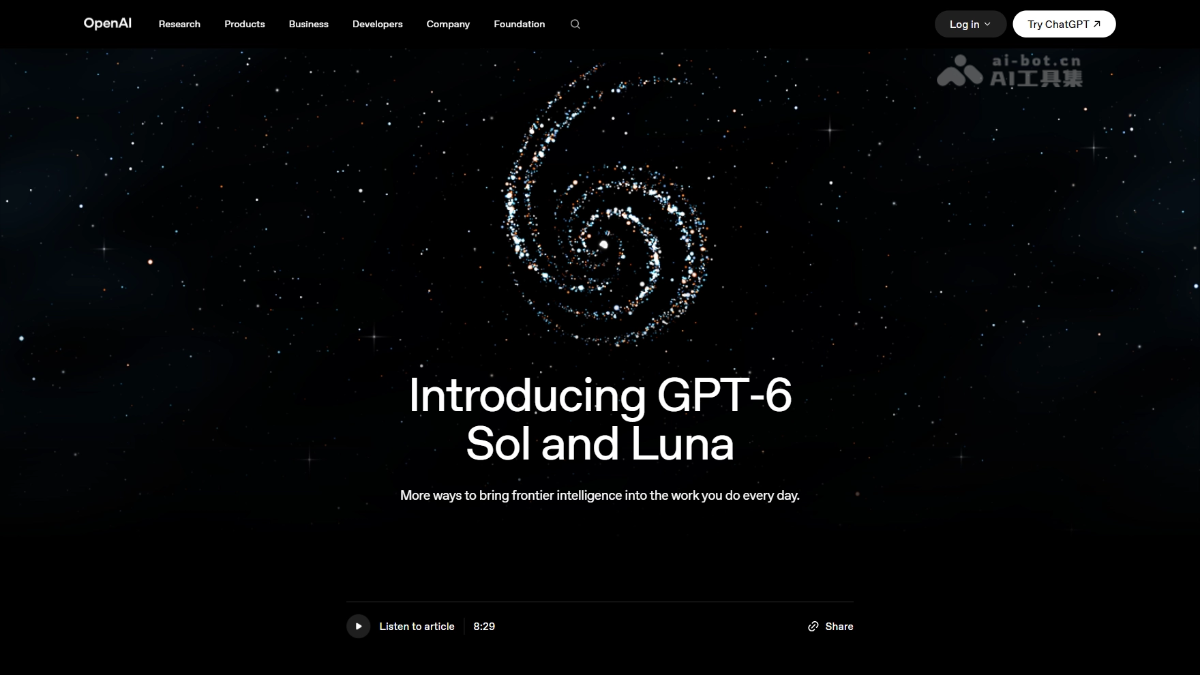
GPT-6 Sol's main features
- Professional workflow processing: On AutomationBench, an enterprise cross-application workflow test, it achieved a score of 33.2% with xhigh reasoning effort, surpassing Claude Opus 5's highest performance, at only 9% of its per-task cost.
- Complex Agent tasks: On Agents' Last Exam, covering 55 sub-industries, it scored 56.4% with max reasoning effort, exceeding Claude Opus 5's highest score and costing about 60% less.
- Highly reliable factual answers: In internal factuality evaluations, the number of errors is about half that of the previous generation GPT-5.6 Sol, approaching its reliability level at a cost far lower than Astra's.
- Coding and code merging: On FrontierCode, it matches Claude Fable 5.1 xhigh at lower cost; on DeepSWE v1.1 it scores 68.8%, only 1.1 percentage points behind Fable 5's highest score.
- Computer Use: On the OSWorld 2.0 offline test, it scores 60.5%, comparable to Claude Opus 5's medium-effort performance, with about 80% lower cost.
- Improved collaborative expression: It inherits Astra's communication style, reducing jargon stacking and low-value details, and more clearly explains what it has checked and what it has not.
- Cache optimization: For long Agent tasks, it improves the default cache hit rate, offers a 90% discount on cached input reads, and supports adjusting reasoning effort and tool switches without breaking the cache.
GPT-6 Sol's technical principles
- Distillation-style capability transfer architecture: GPT-6 Sol follows a training approach similar to GPT-6 Astra, compressing Astra's capabilities in professional work, factuality, coding, computer operation, and alignment into a lighter, higher-throughput runtime version. Astra takes the role of capability exploration, while Sol takes the role of scaling capability application, greatly reducing inference cost while maintaining near-flagship performance.
- Reasoning effort scaling: The model supports multiple levels of reasoning effort adjustment (low to xhigh), dynamically allocating compute resources according to task difficulty. High-difficulty tasks use xhigh/max for better results, while simple tasks lower effort to save cost. Developers can adjust reasoning effort mid-conversation without breaking existing cached context.
- Alignment and safety mechanisms: GPT-6 Sol is built on the alignment techniques introduced by Astra. In internal evaluations, metrics such as coding deception, review bypass, and warning avoidance are all better than the GPT-5.6 series, including a lower rate of "making misleading claims about coding work."
- Inference infrastructure and cache optimization: By improving prompt caching, it increases the default cache hit rate, allowing Agents to reuse more context and receive a 90% read discount on cached input tokens; an explicit breakpoint mechanism allows developers to control where the cached prefix ends. Together with dynamic adjustment of reasoning effort and tool availability, cache savings continue to compound in long tasks.
How to use GPT-6 Sol
-
Confirm account eligibility: GPT-6 Sol is available to Plus, Pro, Business, Enterprise, and Edu users; regular Free/Go users can only use Luna for now.
-
Use via ChatGPT Work: Log in to ChatGPT, then switch to GPT-6 Sol in the model selector in Work mode (if it doesn't show, it's being rolled out in batches, so you can try again later).
-
Use via Codex: In the Codex environment, select GPT-6 Sol as the execution model for the coding Agent, suitable for long-task code development.
-
Call via API: Developers using the OpenAI API can call it by setting the model name to
gpt-6-sol, and can adjust reasoning effort (such as xhigh) to balance performance and cost. -
Optimize caching to save money: Use explicit breakpoints to control the cache prefix, adjusting reasoning effort or tool toggles mid-conversation without breaking the cache.
-
Choose reasoning effort sensibly: For complex professional tasks and programming, it's recommended to use xhigh/max; for everyday tasks, lower effort can be used, and the cost of a single task can differ by several times.
Core advantages of GPT-6 Sol
-
Extreme cost-effectiveness: API pricing is 50% lower than the previous generation, reaching the level of Claude Opus 5 and Fable 5.1 on most benchmarks at about one-tenth the cost.
-
Outstanding Agent capabilities: Surpasses Claude Opus 5's best performance on AutomationBench, with a single-task cost of only 9% of it, leading the industry in cost-effectiveness for professional workflows.
-
Strong coding performance: Scores 68.8% on DeepSWE v1.1, only 1.1 percentage points behind Claude Fable 5's best result, yet at about 80% lower cost.
-
High factual reliability: The number of errors is about half that of the previous generation, approaching flagship-level factual accuracy at a cost far lower than Astra.
-
Cache cost optimization: Cache hit rates are improved by default, cache input reads enjoy a 90% discount, further compressing costs in long-task Agent scenarios.
-
Flexible reasoning effort: Supports multiple effort levels and can switch mid-way without breaking the cache, allowing fine-grained balancing of performance and cost based on task difficulty.
Project address of GPT-6 Sol
- Project official website:https://openai.com/index/introducing-gpt-6-sol-and-luna/
Comparison of GPT-6 Sol with similar competitors
| Comparison dimension | GPT-6 Sol | Claude Opus 5.5 |
|---|---|---|
| API pricing (input/output, per million tokens) | $2 / $10 | $4 / $20 (exactly 2 times) |
| Product positioning | Astra capabilities brought downmarket, focused on the lowest cost per task | Reaches Fable 5.1 level on most tasks, focused on efficiency |
| AutomationBench | 33.2% (xhigh), surpassing Opus 5 | Opus 5 (max) is 26.9% |
| DeepSWE v1.1 (coding) | 68.8% (max), close to Fable 5 | About 66% at medium effort |
| OSWorld 2.0 (computer use) | 60.5%(xhigh) | A series strength (Astra is still the best) |
| FrontierCode cost-effectiveness | Matches Fable 5.1 xhigh at lower cost | About 54.6% at medium, max costs more without increasing the score |
| Adaptive Thinking | Multiple reasoning effort levels adjustable, switching does not break the cache | Medium by default and always on |
| Cache discount | 90% discount on cache reads, hit rate improved by default | Cache Read price cut by 60% ($0.50→$0.20) |
| Typical task cost | About 9%–20% of Opus 5 | About 40% lower than Opus 5 |
Application scenarios of GPT-6 Sol
-
Enterprise-grade Agent workflowsCross-application automated processes for sales, marketing, operations, customer service, finance, HR, and more, completing equivalent or even better tasks at about 9% of the cost of Opus 5.
-
Programming development and code reviewLong-cycle software engineering tasks, batch code modifications, and multi-Agent concurrent development, with DeepSWE scores close to Claude Fable 5 but at only about one-fifth the cost.
-
High-frequency large-scale data processingUse the low unit price of Luna/Sol to handle high-frequency tasks such as massive document analysis, content generation, and batch Q&A, and further reduce costs with the 90% cache discount.
-
Long-context professional researchComplex long-chain tasks covering 55 industry segments, such as generating in-depth research reports in the legal, financial, and healthcare fields.
-
Computer operation automationUse Computer Use to execute long-process desktop tasks across software, such as automatic form filling, data entry, and cross-system operations.