
What is Claude Fable 5.1
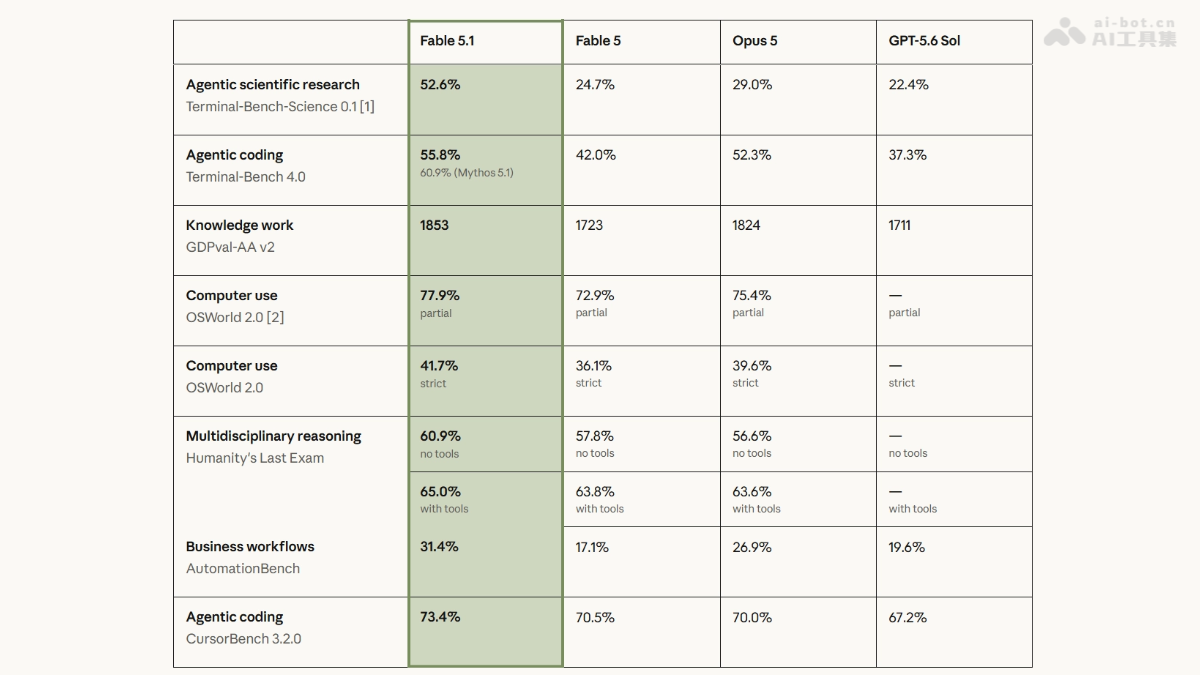
Claude Fable 5.1 is Anthropic's flagship large model, positioned as one of the strongest AI models currently publicly available. The model is designed for complex reasoning, long-horizon Agent tasks, and knowledge work. It leads the previous generation across all 8 benchmark tests, including scientific research, coding, and computer operation, and achieves the previous generation's high-tier performance even at low reasoning tiers. At the same time, cache read costs are reduced by 75%, typical workload costs drop by about 25%, and highly Agentic tasks save up to 45%, unifying stronger performance with higher cost-effectiveness.
Main features of Claude Fable 5.1
-
Complex reasoning: Designed for multi-step deep reasoning, it can trace the root causes of problems and stably execute long-horizon tasks lasting hours or even dozens of hours.
-
Agent workflows: Supports autonomous planning, tool calling, and multi-step task orchestration, suitable for coding, scientific discovery, and business process automation.
-
Scientific research: Has practical capabilities in protein design, astronomical data analysis (such as generating high-resolution topographic maps of Venus based on NASA radar images), and computational biology.
-
Software development: Leads in multiple coding benchmarks, can locate root causes of rare system crashes, optimize code performance, and support long development sessions.
-
Computer operation: Has GUI understanding and automated control capabilities, and can complete complex cross-application tasks in environments such as OSWorld.
-
Knowledge work: Handles knowledge-intensive tasks such as document analysis, writing, and multidisciplinary reasoning, with higher adherence to style prompts.
Technical principles of Claude Fable 5.1
-
Shared foundation architecture: Based on the same underlying model as Mythos 5.1, it achieves tiered access through differentiated safety measures. Fable is open to the public, while Mythos provides higher capability boundaries only to vetted cybersecurity and life sciences organizations.
-
Adjustable reasoning intensity: Built-in multiple reasoning intensity tiers from low to max allow users to dynamically trade off between response speed, API cost, and accuracy according to task complexity, with low and medium tiers achieving the previous generation's high-tier performance.
-
Context caching optimization: By reducing cache read costs by 75%, the model significantly cuts the overall overhead of highly Agentic tasks when reusing already processed context, reducing typical workload costs by about 25% and heavy Agent tasks by up to 45%.
-
Anti-distillation protection: Adds a signature to each chain-of-thought block to verify that the conversation prefix has not been tampered with; if the context is edited, verification fails, directly blocking the distillation attack path of extracting the model's reasoning capabilities by tampering with historical conversations.
-
Long-horizon stability mechanism: Improves error propagation control in multi-step tasks, preventing small early errors from amplifying over dozens of subsequent steps and causing total collapse, while also clearly reporting attempted approaches and blockage points when encountering obstacles.
-
Enterprise privacy architecture (EFS): Stores data in the customer's own cloud infrastructure rather than Anthropic's servers, with necessary human review performed by the customer rather than Anthropic, achieving zero-data-retention-level privacy protection while maintaining safety monitoring.
How to use Claude Fable 5.1
-
API call: Developers specify the model ID through the Anthropic API
claude-fable-5-1Can be integrated into your own applications or workflows. -
Web chat: Directly visit Claude and select Fable 5.1 in the chat interface for everyday Q&A, writing, and knowledge work.
-
Claude Code: Use it in command-line tools, with high reasoning effort enabled by default, suitable for complex coding and long-horizon development tasks.
-
Claude Cowork: Invoke it in collaborative scenarios, with medium reasoning effort used by default, balancing response speed and task quality.
-
Cloud platform deployment: Access it through cloud providers such as Amazon Bedrock, Google Cloud, or Microsoft Azure to meet enterprise-grade infrastructure needs.
-
Adjust reasoning effort: Switch among five levels—low, med, high, xhigh, and max—according to task difficulty to control cost and response latency.
Core advantages of Claude Fable 5.1
-
Comprehensive performance leadership: It comprehensively surpasses the previous-generation Fable 5 and GPT-5.6 Sol across 8 public benchmarks, including scientific research, coding, and knowledge work, setting a new standard.
-
Extreme cost-effectiveness: Cache read costs are reduced by 75%, total cost for typical workloads drops by about 25%, and highly agentic tasks can save up to 45%.
-
High performance at lower levels: Low and medium reasoning levels can achieve the performance of previous-generation high or even very high levels, completing harder tasks with fewer resources.
-
Long-horizon stability: It excels at executing complex multi-step tasks lasting hours or even tens of hours, can trace root causes of problems, and prevents early small errors from causing total collapse.
-
Validated in real scientific research: It has achieved verifiable breakthroughs in areas such as protein design (nearly 50% hit rate), high-resolution Venus terrain map generation, and GPU kernel optimization for computational biology.
-
Tiered safety architecture: It shares underlying capabilities with Mythos 5.1 but adopts differentiated safety measures, both opening the strongest model to the public and supporting high-risk professional research through controlled access.
-
Enterprise privacy protection: Through Enterprise Frontier Safeguards (EFS), data is stored in the customer's own cloud, achieving zero-data-retention-level privacy and security.
Project address for Claude Fable 5.1
- Project official website:https://www.anthropic.com/claude-fable-and-mythos-5-1
Comparison of Claude Fable 5.1 with similar competitors
| Dimension | Claude Fable 5.1 | GPT-5.6 Sol |
|---|---|---|
| Scientific research | Terminal-Bench-Science 0.1 score 52.6% | 22.4% |
| Agent coding | Terminal-Bench 4.0 score 55.8% | 37.3% |
| Knowledge work | GDPval-AA v2 score 1853 | 1711 |
| Business processes | AutomationBench score 31.4% | 19.6% |
| Computer operation | OSWorld 2.0 has data (77.9% partial) | No public data |
| Cost-effectiveness | Cache reads reduced by 75%, typical workloads save 25% | No equivalent price reduction |
Application scenarios of Claude Fable 5.1
-
Complex software development: It can trace and locate the root cause of rare system crashes that have plagued engineering teams for years, and supports continuous coding and multiple parallel experiments lasting tens of hours.
-
Life sciences protein design: Using open-source tools to design high-affinity protein binders, achieving an experimental validation hit rate of nearly 50% across 12 targets, with affinity reaching 10 times that of the industry competition's best solution.
-
Astronomical data analysis: Based on radar images from NASA's Magellan spacecraft more than 30 years ago, generating elevation maps for about one-third of Venus's surface with resolution improved to 2-3 kilometers and accuracy increased by 25%.
-
Enterprise business process automation: Executing complex multi-step business workflows across systems, with scores on the AutomationBench benchmark nearly doubling compared to the previous generation, jumping from 17.1% to 31.4%.
-
Computing infrastructure optimization: Automatically writing custom GPU kernels and caching intermediate results, increasing inference speed of 7 open-source deep learning models by up to 2.5 times and reducing GPU computing costs by 30%-60%.