
What is ChatGPT Work
ChatGPT Work is a new Agent built into ChatGPT launched by OpenAI, driven byCodexandGPT-5.6ChatGPT Work can perform operations across apps and files, and when necessary, keep working for hours, directly turning user goals into finished products. The product supports extracting messy context from sources such as Slack, Notion, Microsoft 365, and Google Drive, and generating expert-level shareable presentations, documents, and spreadsheets.
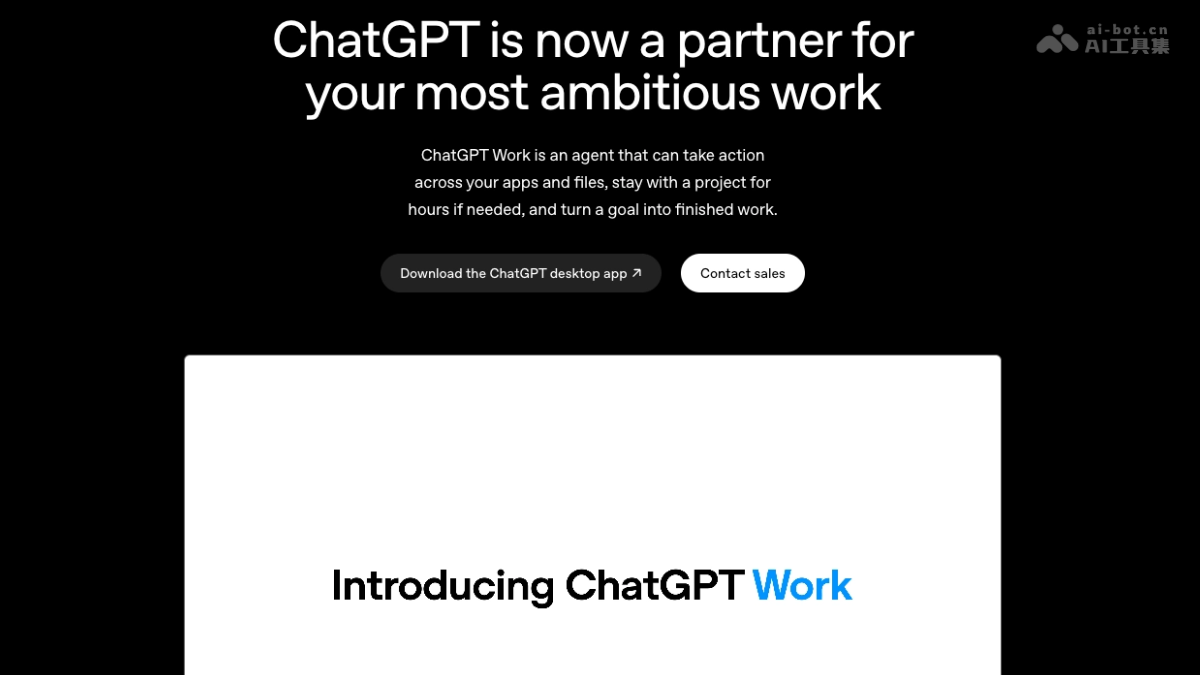
Main features of ChatGPT Work
-
Long-horizon execution across apps: Automatically operates across multiple apps and files, continuing for hours to complete complex projects.
-
Goal-to-deliverable transformation: Directly transforms natural language goals into deliverable finished products.
-
Multi-source data integration: Automatically extracts and organizes information from Slack, Notion, Microsoft 365, Google Drive, and more.
-
Polished content generation: Creates fully editable presentations, financial models, and structured documents.
-
Ultra mode support: Pro and Enterprise users can enable multi-agent parallelism to accelerate complex tasks.
How to use ChatGPT Work
-
ChatGPT entry point: Initiate tasks directly in the ChatGPT Work interface, and select GPT-5.6 Sol/Terra/Luna and the effort level.
-
Effort settings: Regular users use medium, complex tasks use max, and Pro/Enterprise can use ultra.
-
Cross-app authorization: Connect external data sources such as Slack, Notion, Microsoft 365, and Google Drive.
-
Continuous operation: After a goal is set, the Agent executes automatically, can run in the background during this period, and returns results when completed.
Core advantages of ChatGPT Work
-
Long-horizon autonomy: Unlike a single conversation, it can track project progress and iterate for hours.
-
End-to-end delivery: The product can generate code or text, and directly produce editable finished products such as presentations and documents.
-
Design system understanding: It can infer the design specifications of a reference template and apply them consistently, producing more professional output.
-
Multimodal integration: Automatically aggregates information scattered across different SaaS tools, reducing manual organization costs.
-
Secure and controllable: A layered security system ensures data security and permission compliance during cross-app operations.
Comparison of ChatGPT Work with similar competitors
| Comparison dimension | ChatGPT Work | Manus |
|---|---|---|
| Core positioning | General office Agent | General-purpose autonomous AI Agent |
| Driving model | GPT-5.6 / Codex | Multi-model mix (Claude/GPT, etc.) |
| Scope of work | Documents/spreadsheets/PPT/cross-app data integration | Research/reports/code/data analysis/office work |
| Execution method | Runs continuously in the background, returns results when completed | Autonomous execution on a cloud virtual machine, viewable in real time |
| Deliverables | Editable presentations/documents/spreadsheets | Complete reports/websites/code/data tables |
| Human-AI collaboration | Completes automatically after the goal is set | Observe progress in real time and step in to adjust at any time |
| Cross-application capabilities | Slack/Notion/365/Drive, etc. | Browser/code editor/terminal, etc. |
| Use cases | Enterprise knowledge work/business/finance | General research/content creation/data analysis |
Use cases of ChatGPT Work
-
Quarterly business report: Automatically extract data from CRM, financial systems, and communication tools to generate a complete presentation with visual charts.
-
Product requirements document: Integrate user feedback, design mockups, and technical specifications, and output a structured PRD according to the company template.
-
Financial forecast model: Read historical data from multiple sources and build a spreadsheet with formulas and assumptions according to a reference template.
-
Project progress tracking: Synchronize status across Jira, Asana, and Slack, and automatically generate a weekly report that includes risk alerts.
-
Academic literature review: Extract key findings from Zotero, Notion, and PDFs to generate a review document with citation formatting.