
The large model world these past two days has been nothing short of a clash of titans.
xAI released Grok 4.6, its intelligence index directly matching GPT-5.6 Sol, with no price increase at all;DeepSeek-V4-Pro the official version launched, scoring 87.9 on Terminal Bench, only 0.1 points lower than Claude Fable 5 .
Yesterday, Zhipu GLM-5.3 made its grand finale entrance. Looking at the benchmark data first, GLM-5.3's performance on 9 authoritative leaderboards was all impressive, with the programming experience improving by 50% compared to GLM-5.2 , and further gains in complex software engineering, long-horizon tasks, and Agent capabilities, directly breaking into the first tier dominated by Fable 5 and GPT-5.6 Sol.
That familiar open-source champion and Chinese model champion has returned to its peak.
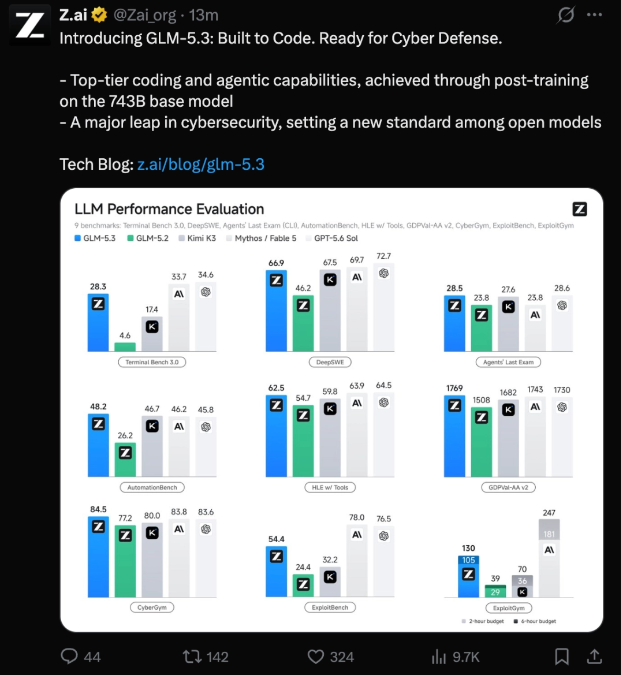
The key point is that GLM-5.3's base is still the same 743B GLM-5.2, with no architecture changes and no re-pretraining—all improvements were hard-won entirely through post-training.
Stronger performance, yet lower consumption
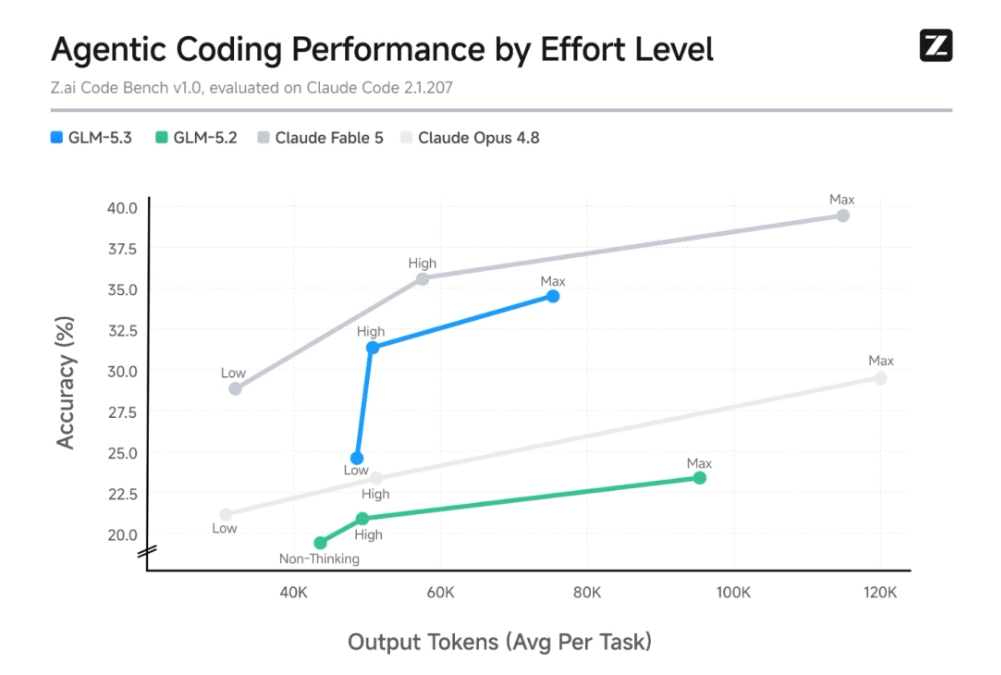
Z.ai Code Bench evaluations show that GLM-5.3 at the Max full-power tier scored 34.5%, burning an average of only about 75K output tokens; GLM-5.2 had to burn 96K to score 23.4%, while Claude Opus 4.8 burned 120K to score 29.5%.
But benchmark scores are benchmark scores—as for the actual experience, we still have to try it ourselves.
01. GLM-5.3 Hands-On Test
Currently, GLM-5.3 is already available on Zhipu's official programming tool ZCode, efficiency tool AutoClaw, and is live for all GLM Coding Plan users and open for subscription.
The API will also be available soon, and the complete model weights will be open-sourced within two weeks,
We opened ZCode, selected GLM-5.3 as the model, and switched the mode to full access.

Create a DJI Mavic 3 Pro with a single sentence
Let's enter a simple prompt to get a feel for it:
Use Three.js to create a 3D model of a DJI Mavic 3 Pro drone.
In less than 2 minutes, GLM-5.3 output the result, with quite high efficiency:
The attention to detail is also good. GLM-5.3 used LatheGeometry to shape the streamlined fuselage; even the gimbal damping plate and front obstacle-avoidance cameras are clearly visible, and it even recreated the iconic gold ring of the Hasselblad lens.
We can manually adjust the propeller speed, adjust the screen size, and rotate the viewpoint. The features are comprehensive and smooth—there's nothing to complain about regarding this level of completion.
Recreating the Green Gold Daytona watch
I uploaded a reference image of a Rolex Green Gold Daytona and asked GLM-5.3 to do a 3D recreation.

After we entered the prompt, GLM-5.3 finished it in just over ten minutes.
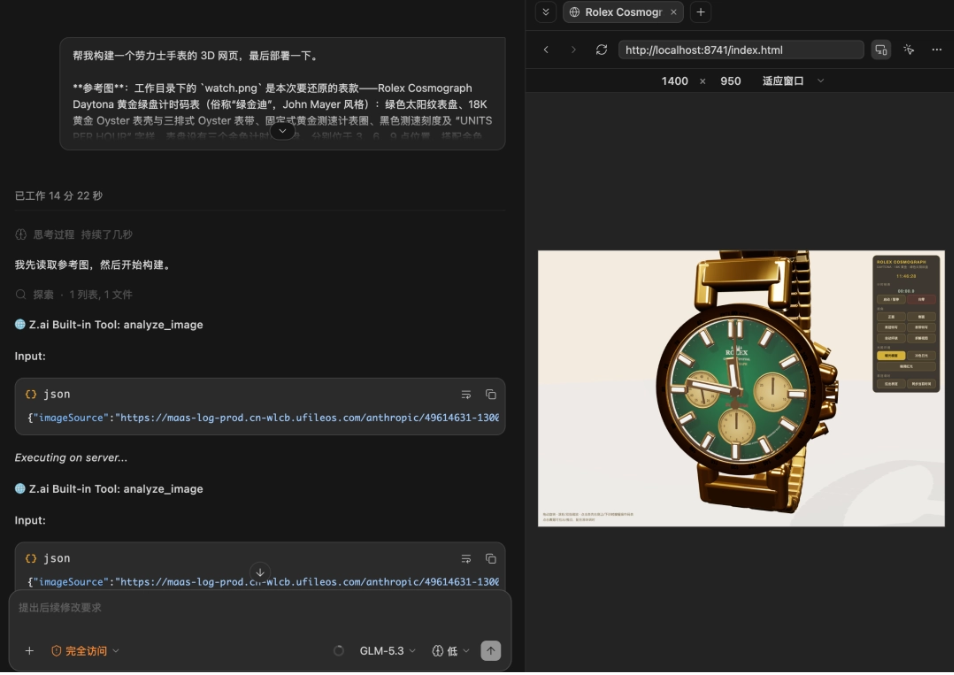
Let's take a look at the generated result together:
There's nothing wrong with the functional logic, but the watch's screen is a bit off-putting, like a contact lens floating in mid-air. There are also some minor issues with the strap connections.
We asked ZCode to continue optimizing it,ZCode quickly located and fixed the issues。
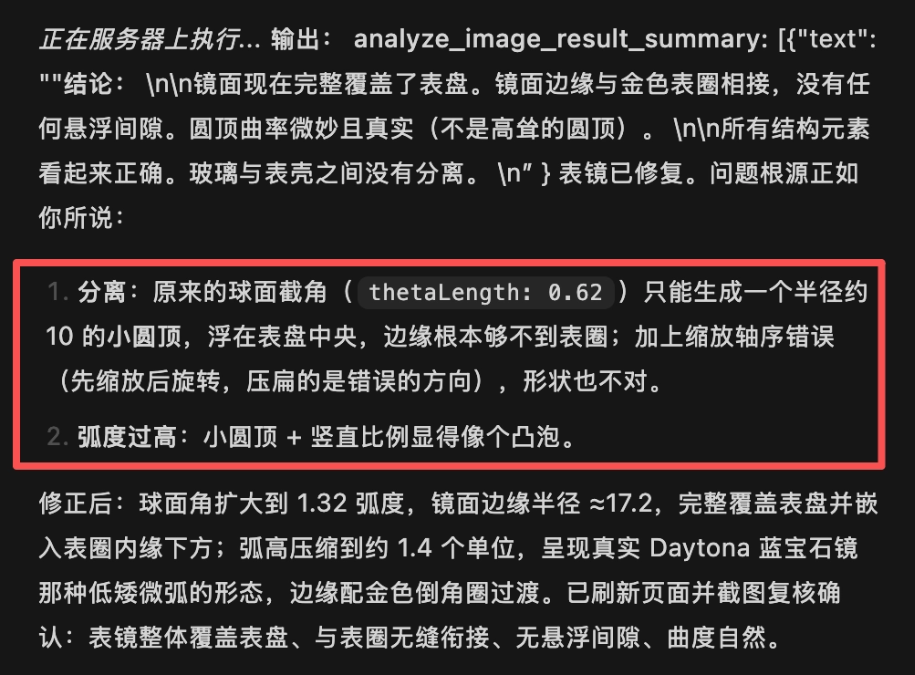
Opening the page, the hands point to the same time as my system time, the hands can be manually adjusted, and it also supports changing viewpoints and exploded views.
3D miniature city weather
I tried asking GLM-5.3 to generate a miniature city weather system for Shanghai:
The weather rendering effect is very accurate, with lightning, sunlight, and visibility switching in real time according to the weather.
And it really can query the hourly weather conditions:
However, in terms of city modeling, it still lacks Shanghai's iconic features. When we uploaded a real photo of Shanghai for optimization, GLM-5.3 was able to quickly and precisely fill in the landmark buildings in the original model.

02. Cybersecurity Capabilities
If programming is GLM-5.3's basic skill, thencybersecurity capabilityis GLM-5.3's secret weapon for breaking through the ceiling.
This time, Zhipu fed massive amounts of vulnerability discovery data into the model, and the result was an astonishing emergence of capabilities:
- CyberGym score of 84.5, topping the open-source SOTA;
- ExploitBench 54.4, more than double that of the previous generation。
In real-world practice, GLM-5.3, working with domestic security teams to scan real codebases,uncovered a total of 2,436 vulnerabilities, spanning 269 open-source projects.
The most surreal part is that one of the high-risk vulnerabilities was written in 1981, hidden for 45 years without anyone discovering it, and was ferreted out by AI.
This means GLM-5.3 already possesses the divine sense to surpass ordinary security experts and conduct deep code audits.
03. Some Sharing
GLM is like a full-stack partner who enters with a mature solution and can even reverse-audit security vulnerabilities.
The process from inspiration to finished product is being rapidly shortened, and the productivity threshold is being flattened.
An individual creator with an idea can single-handedly have the development efficiency of a team.
The battlefield for large models has shifted from competing on parameters to competing on delivery. Zhipu has proven through extreme post-training that even without stacking architectures or changing the base, engineering-driven alignment can achieve a violent leap in intelligence.
GLM-5.3 has drawn the starting line for building products directly at an industrial-grade level.
Although closed-source models maintain a first-mover advantage behind high walls, the open-source forces represented by GLM are filling the generational gap at a faster pace, turning the most cutting-edge technology from the private fortress of a few giants into a productivity foundation shared by the entire industry.
Domestic open-source models can go head-to-head with the top players of Silicon Valley, allowing everyone to stand on the shoulders of giants and define their own product starting line.
Original link:GLM, the world's number one in open source, is back, and with its first move it dug up a bug from 45 years ago!