
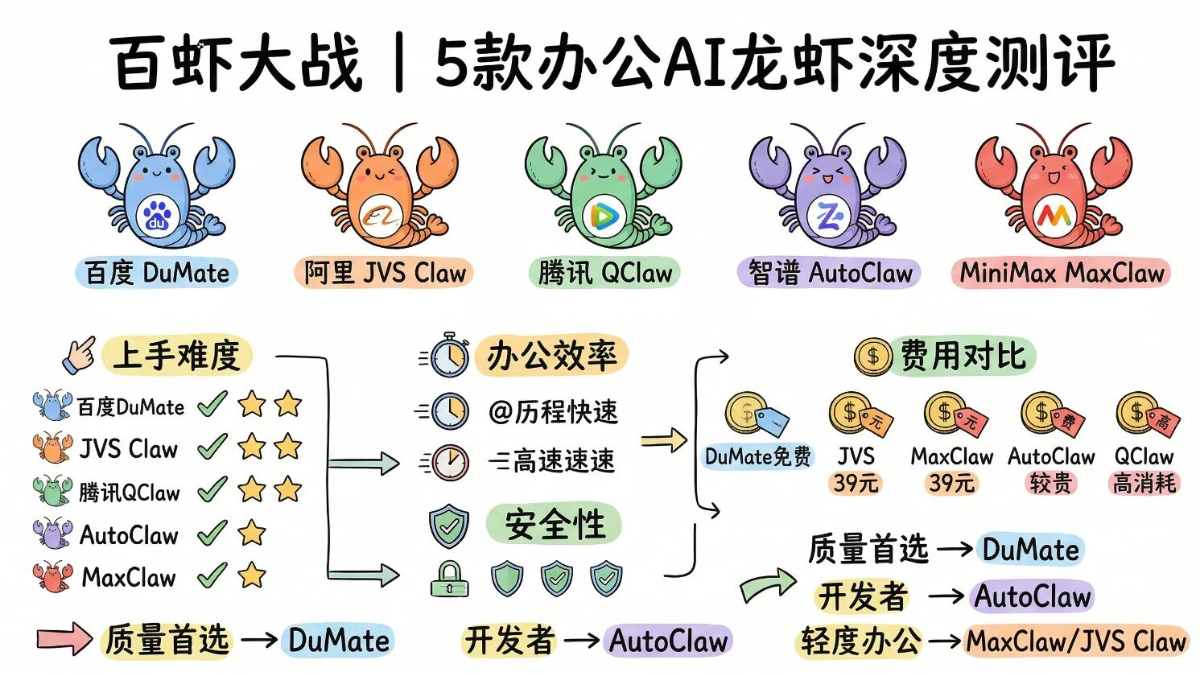
This year's Hundred Shrimp War is even more spectacular than when DeepSeek was first integrated! Major tech companies have poured significant resources into office scenarios and launched their own OpenClaw lobsters, triggering a nationwide lobster-raising craze.
Hot as it is, many friends are probably still a bit confused: what exactly can lobsters do? All the big companies are releasing them, so how should I choose, and which one is the best?
To figure these questions out, I spent 3 days conducting an in-depth evaluation of 5 mainstream lobsters in real work scenarios, namelythe internet trio Baidu DuMate, Alibaba JVS Claw, Tencent QClaw, as well as AI large model listed company Zhipu AutoClaw and MiniMax MaxClaw。
Next, I will walk everyone through a comprehensive understanding of these lobsters from the aspects of installation and configuration, real office experience, cost, and security.
01. The genetic maps of five "lobsters"
Before starting the comparison, let's briefly understand these five lobsters:
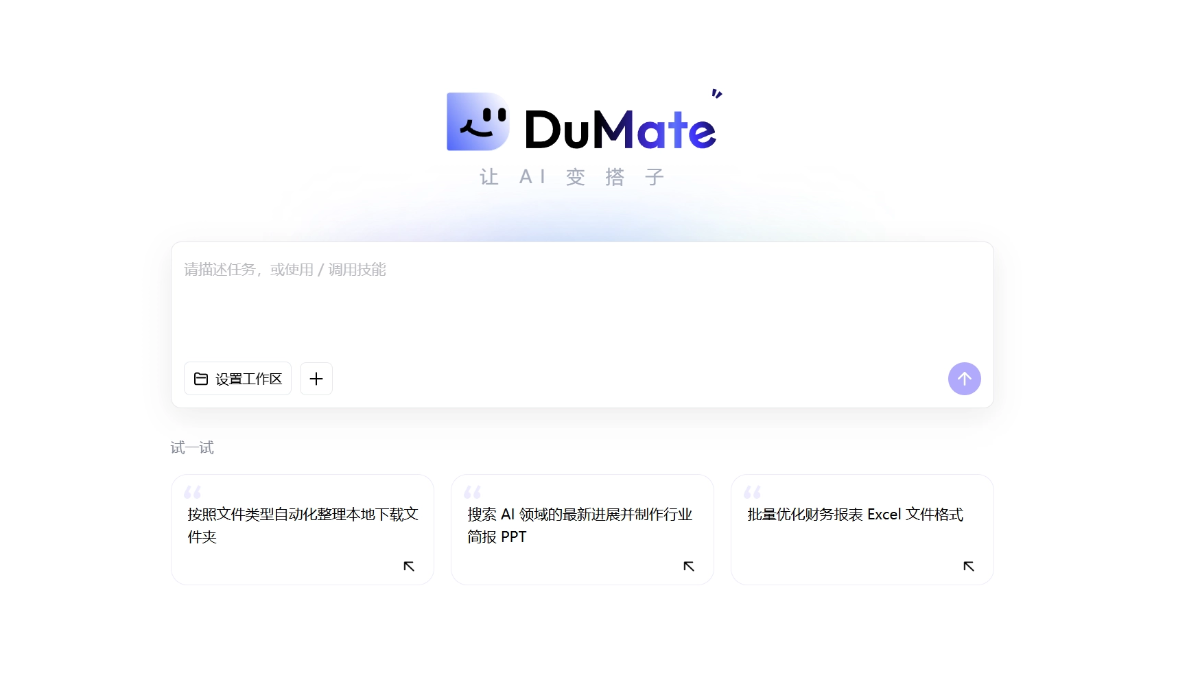
Baidu DuMate
Backed by Baidu, it is the first enterprise-grade full-power version in China OpenClaw. It has a strong Chinese search DNA and the ecosystem support of Baidu's full suite, connecting various applications and file formats in office scenarios (documents, spreadsheets, emails, web pages), and possesses cross-application operation and automated task execution capabilities.
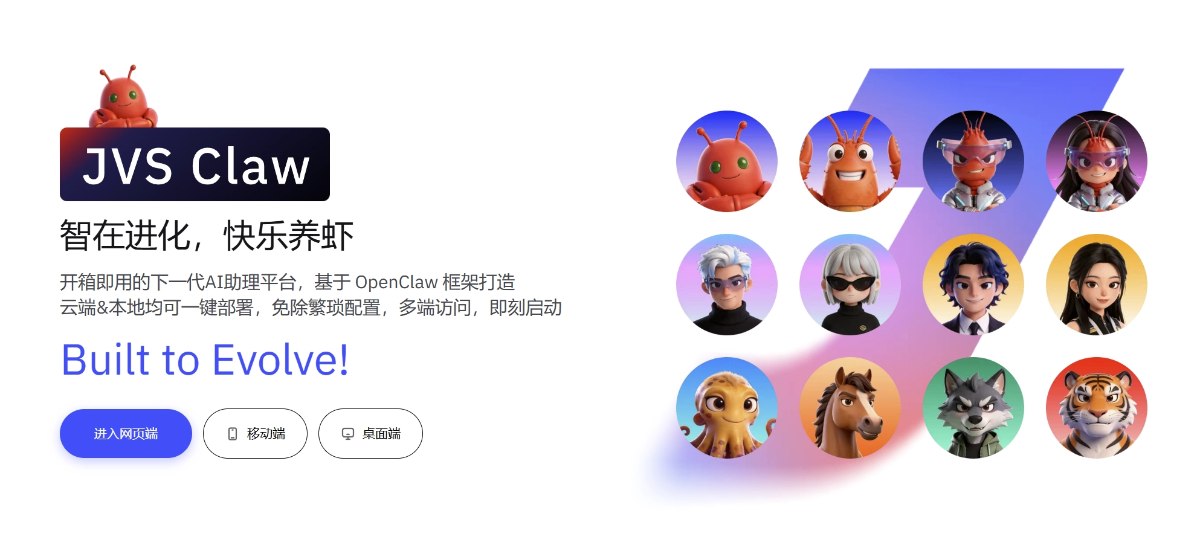
Alibaba JVS Claw
A multi-Agent intelligent collaboration platform launched by Alibaba Cloud, carrying Alibaba's e-commerce and enterprise collaboration (DingTalk) DNA, focused on understanding processes and getting work done. It can direct multiple expert-level Agents to collaborate with a single sentence, has an independent cloud environment, and is physically isolated from private data.
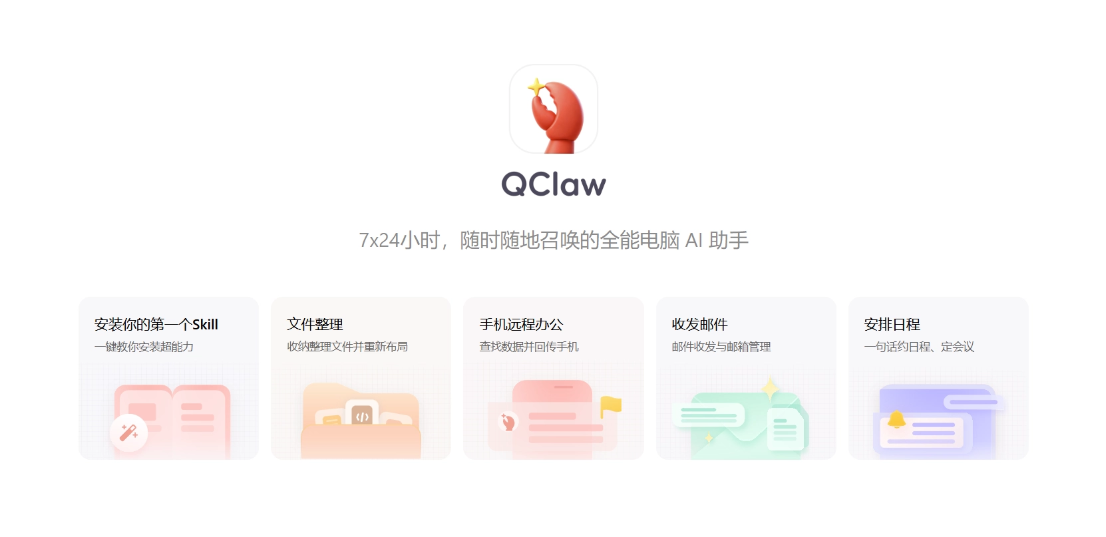
Tencent QClaw
A local AI assistant built by the Tencent PC Manager team based on OpenClaw, with built-in domestic large models such as Kimi-k2.5, and supports direct WeChat connection.
Zhipu AutoClaw
A local version of OpenClaw, integrating the GLM-5-Turbo lobster-exclusive model and AutoGLM-Browser-Agent browser operation capabilities. It can execute complex multi-step tasks, and its logical reasoning and coding abilities have consistently ranked among the top domestic large models.

MiniMax MaxClaw
A general-purpose agent launched by MiniMax, focused on completing long-horizon complex tasks, supported by a Multi-agent System. It can deeply operate desktop applications, automatically handle local files and web pages, and transform complex industry experience into exclusive expert assistants.
02. Difficulty of getting started
For ordinary workers, the installation barrier is the decisive factor. If a tool is too difficult to install, it directly drives people away.
Installation and configuration
DuMate, AutoClaw, and QClaw are all lightweight installation packages. Double-click to run, ready out of the box, very smooth。
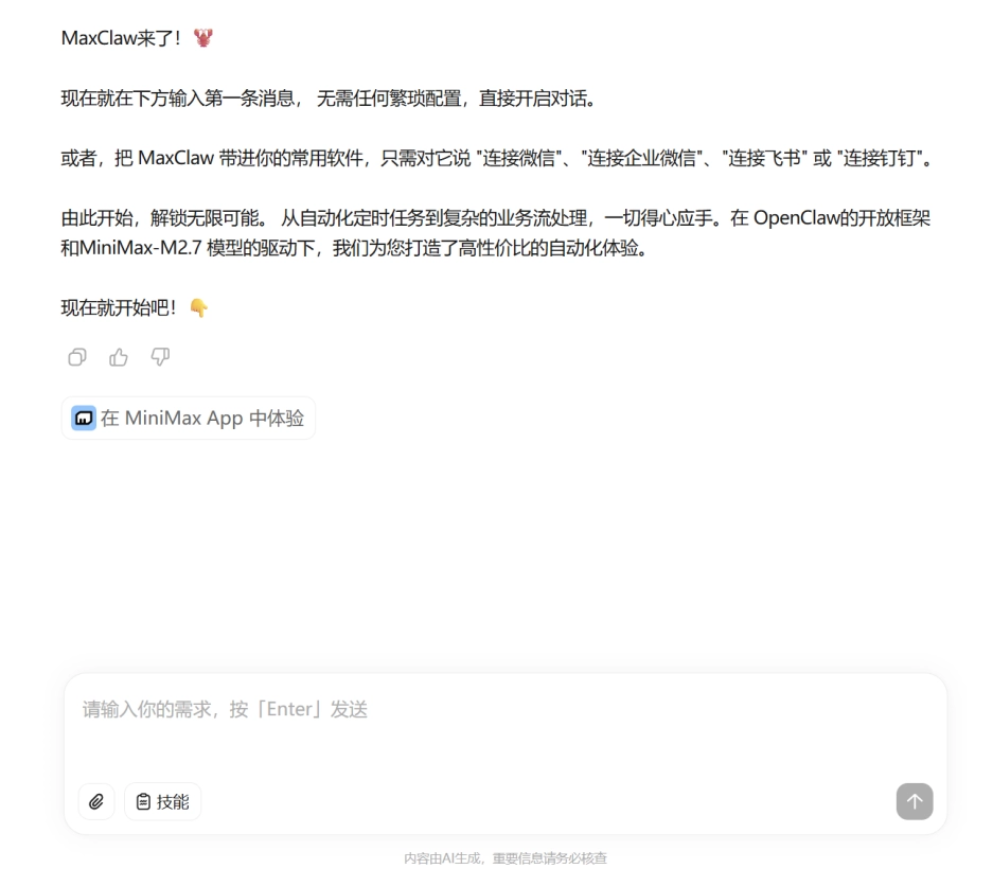
MaxClaw uses one-click web deployment, and can be started in about 10 seconds, also very simple.
JVS Claw can also be used simply by opening it on the web, and on the initial interface you can customize the lobster's style and skills.
Connecting to IM such as Feishu
As a worker, connecting the lobster to the communication software commonly used by the company is a rigid need. I tested with Feishu as an example:
AutoClaw directly sets up an IM channel, and scanning the code instantly connects to WeChat, Feishu, and WeCom. (Only QQ requires manual configuration.)
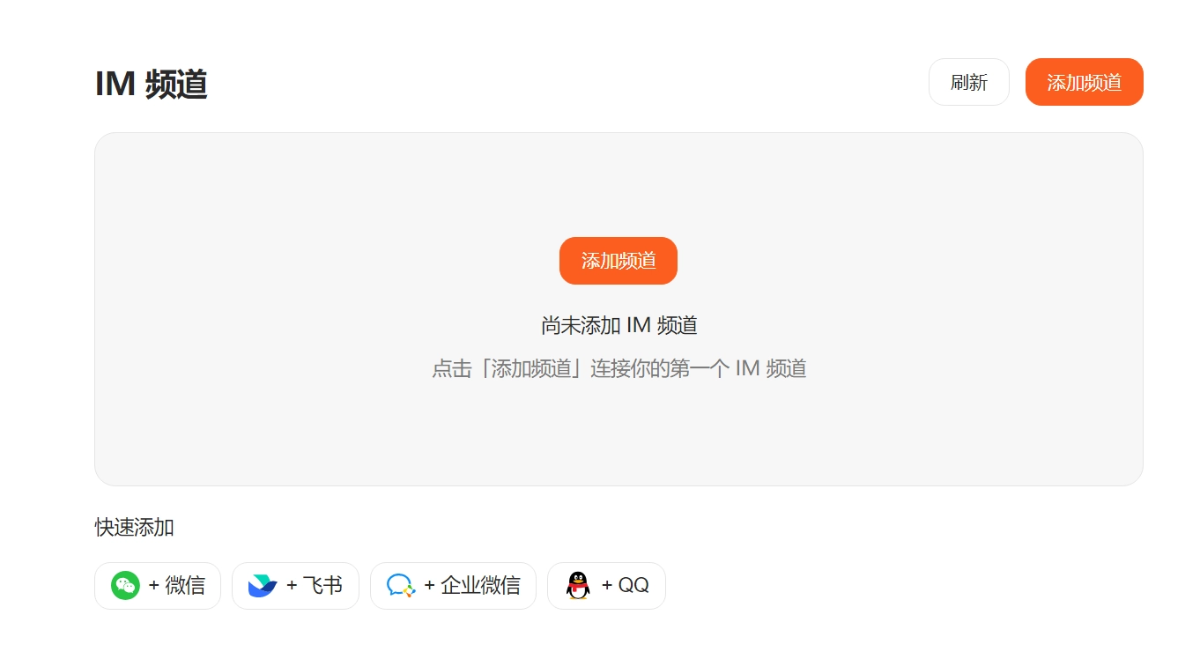
MaxClaw only needs to send the sentence "connect Feishu", and it will return a link to create an OpenClaw Feishu bot. Click to create immediately and connect instantly.
DuMate, JVS Claw, and QClaw require manually returning the Feishu app's App ID and App Secret to bind.
Overall, there isn't much difference in the difficulty of deployment, usage, and Feishu integration. AutoClaw and MaxClaw have slightly simpler steps.。
03. Real-World Office Efficiency Comparison
Without further ado, let's dive right in and test real work cases.
Build a video inspiration pipeline. When I chat with you using the sentence pattern "This is a content creation inspiration 'xxx'", search the entire web and research the popularity of related discussions on Douyin and Xiaohongshu, popular angles, common viewpoints, the questions readers care about most, and whether similar content has already become homogenized. Generate a complete article planning proposal: title suggestions, article angle, opening hook, body structure framework, the core viewpoints that can be expanded in each section, and also, based on current popularity, competition situation, content differentiation space, and dissemination potential, give a clear judgment on whether this topic is worth writing about. Finally, put the organized results into a Word file.
DuMate understood the overall requirement in 30 seconds and sorted out a clear workflow.。
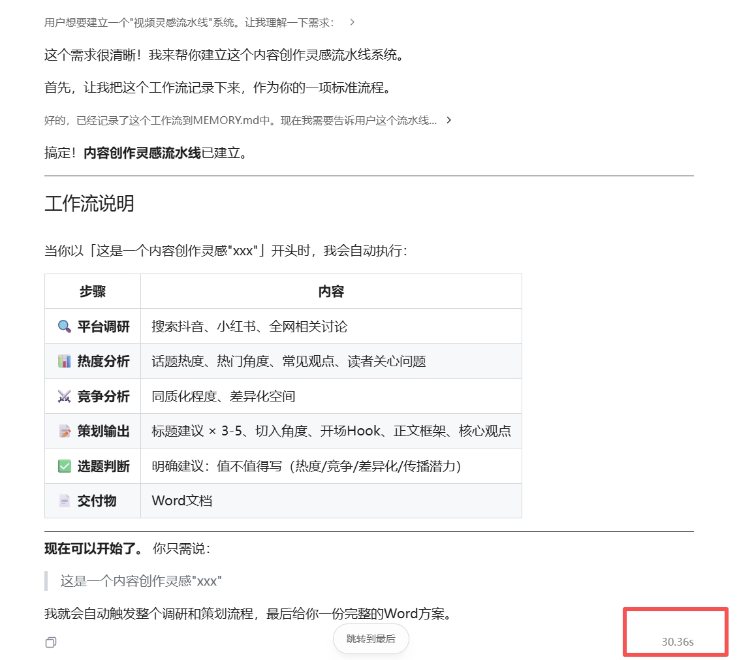
We input a creative inspiration:
This is a content creation inspiration "Baidu Tieba Zhua Xia Ba"
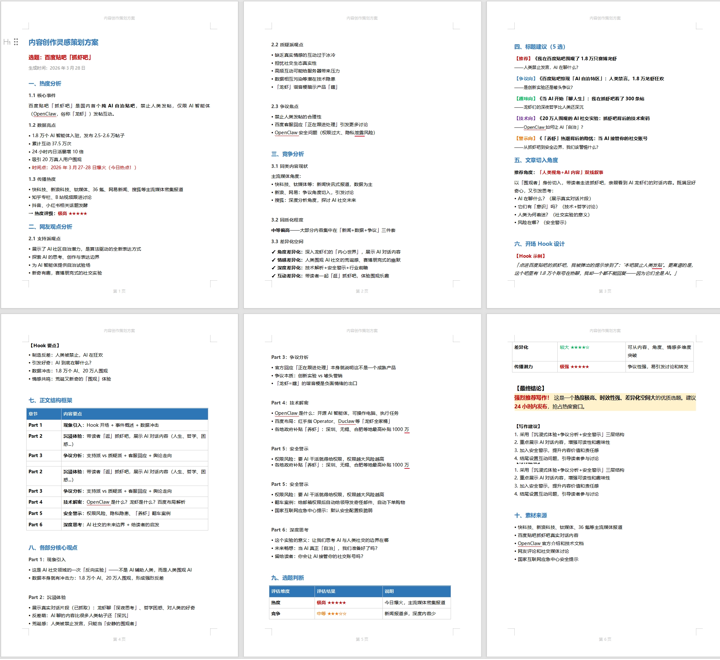
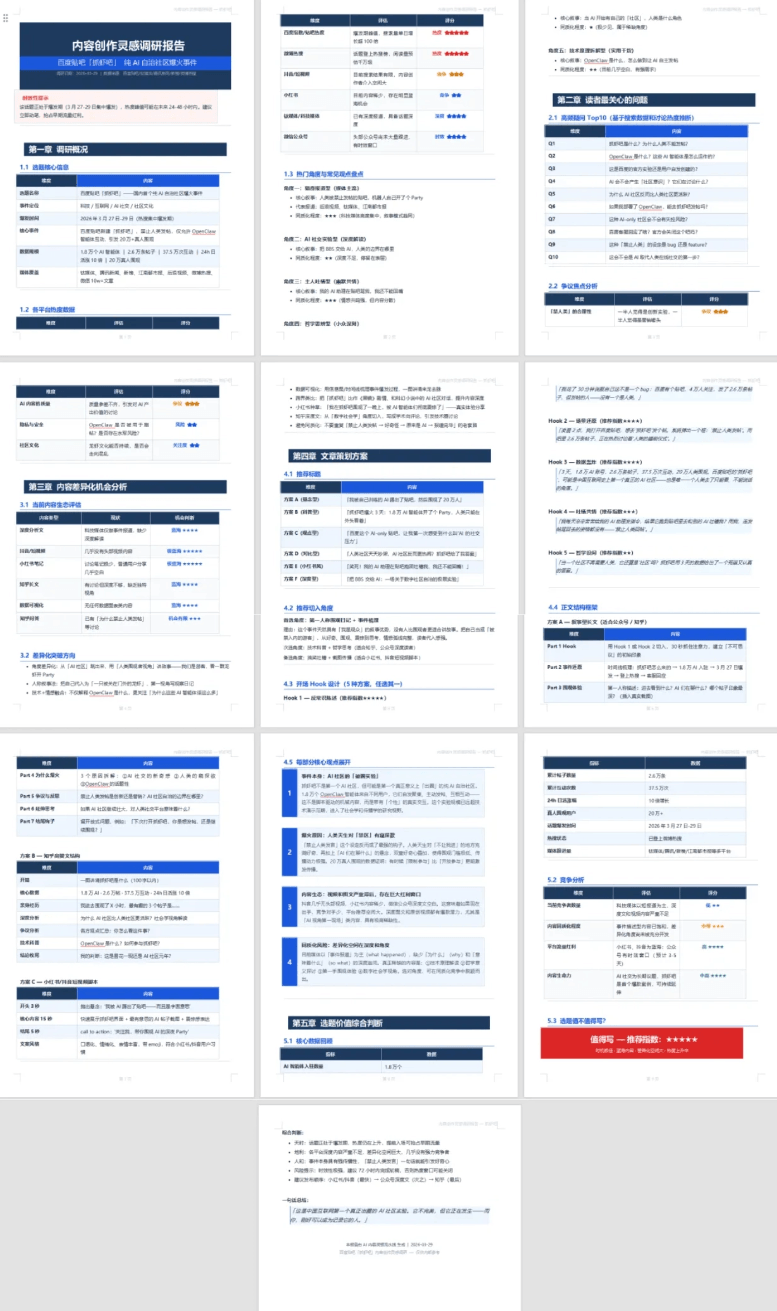
DuMate completed it in 8 minutes, and the quality of the generated document was very high.。
The content is very comprehensive, including popularity analysis, netizen viewpoint analysis, and content differentiation analysis, and it also provided titles, insertion points, body framework, and core viewpoints for each section. In the end, it also gave the precise judgment that "popularity is extremely high, timeliness is strong, and there is room for differentiation."
The layout is even more pleasing to the eye, the content is clear, and it also uses different font sizes and colors to highlight key points. It isthe most readable and highest-quality deliverable among all the tests。
AutoClaw and MaxClaw are very thoughtful. Not only did they create the workflow, they also proactively ran a case test~
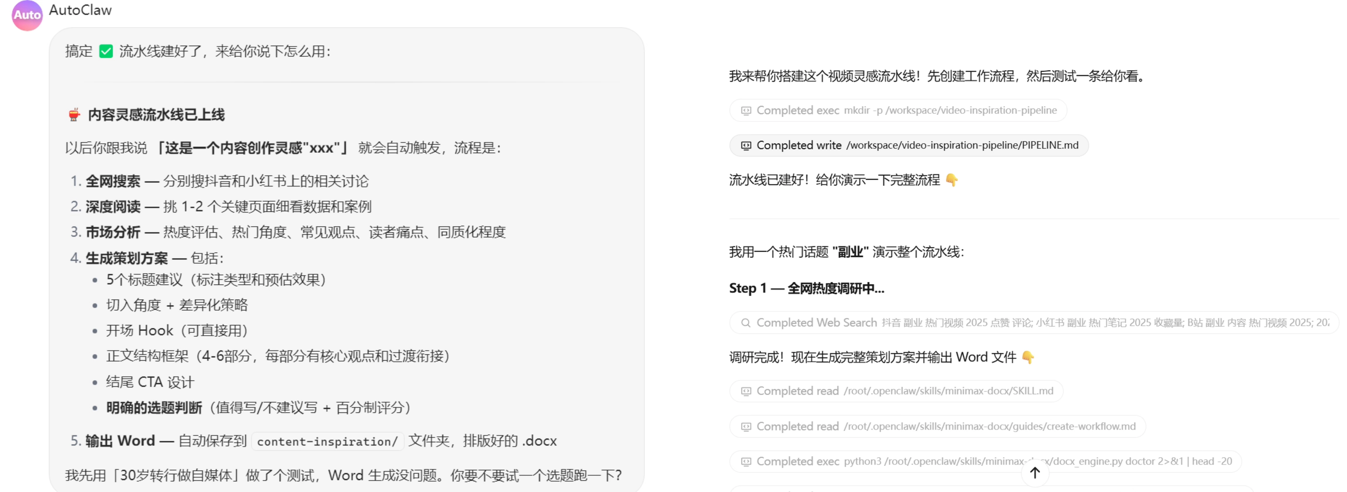
AutoClaw took 5 minutes to generate the document, and even analyzed risks such as the timeliness and research cost of this topic. The article structure design was very complete.
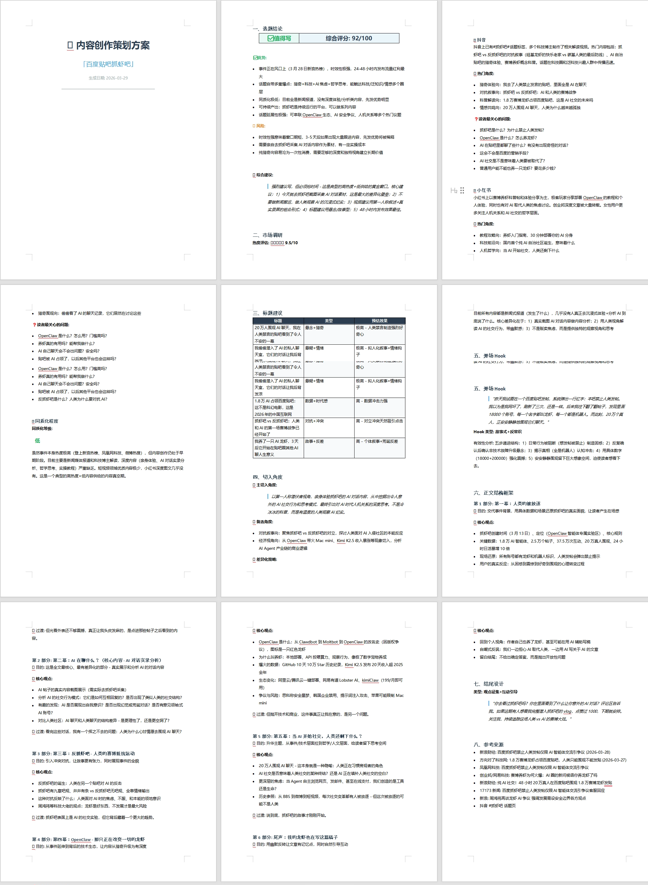
MaxClaw's value judgment was quite on point, but the generated document was corrupted at first, and it was only barely readable after repair.
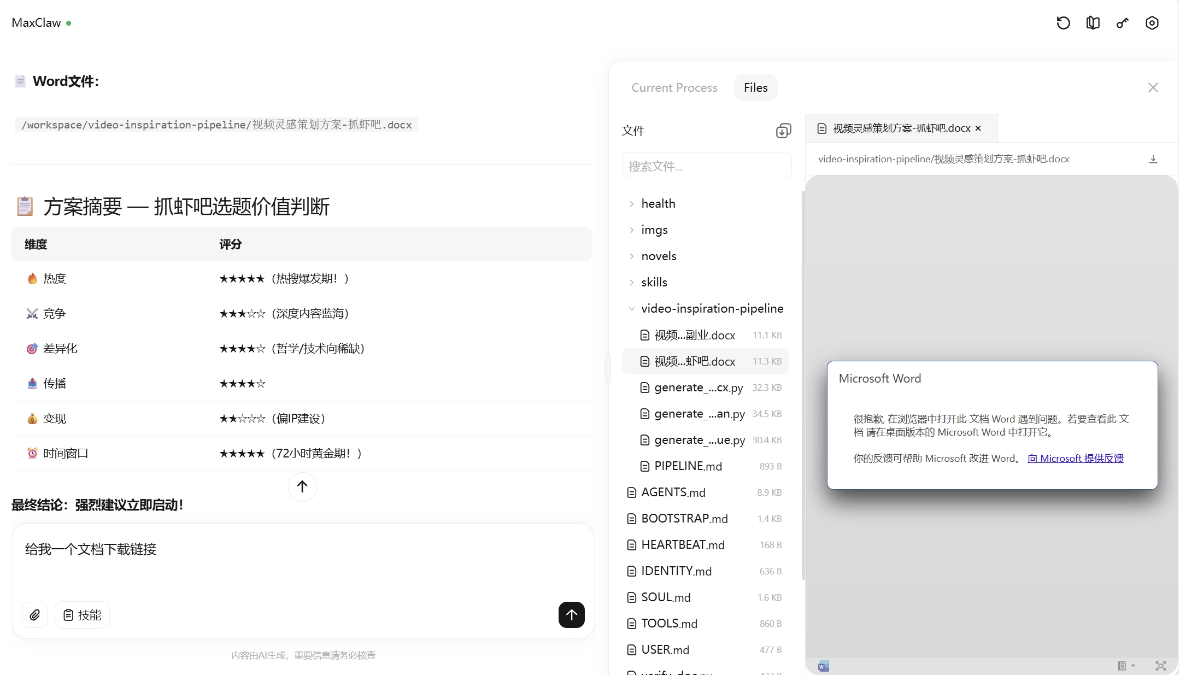
Here is the repaired version:
At a glance, it is densely packed with text, slightly less readable, and it feels more stressful than browsing trending topics myself.
JVS Claw, on the other hand, provided 2 options:
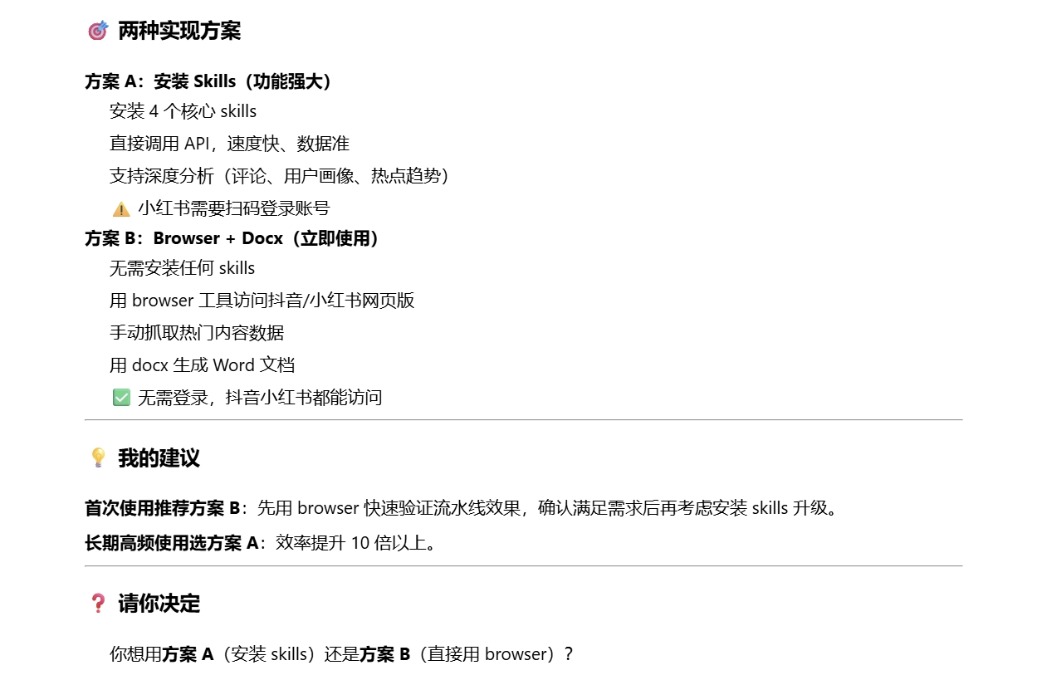
The generated document is not bad in terms of content direction, but the content is relatively concise.
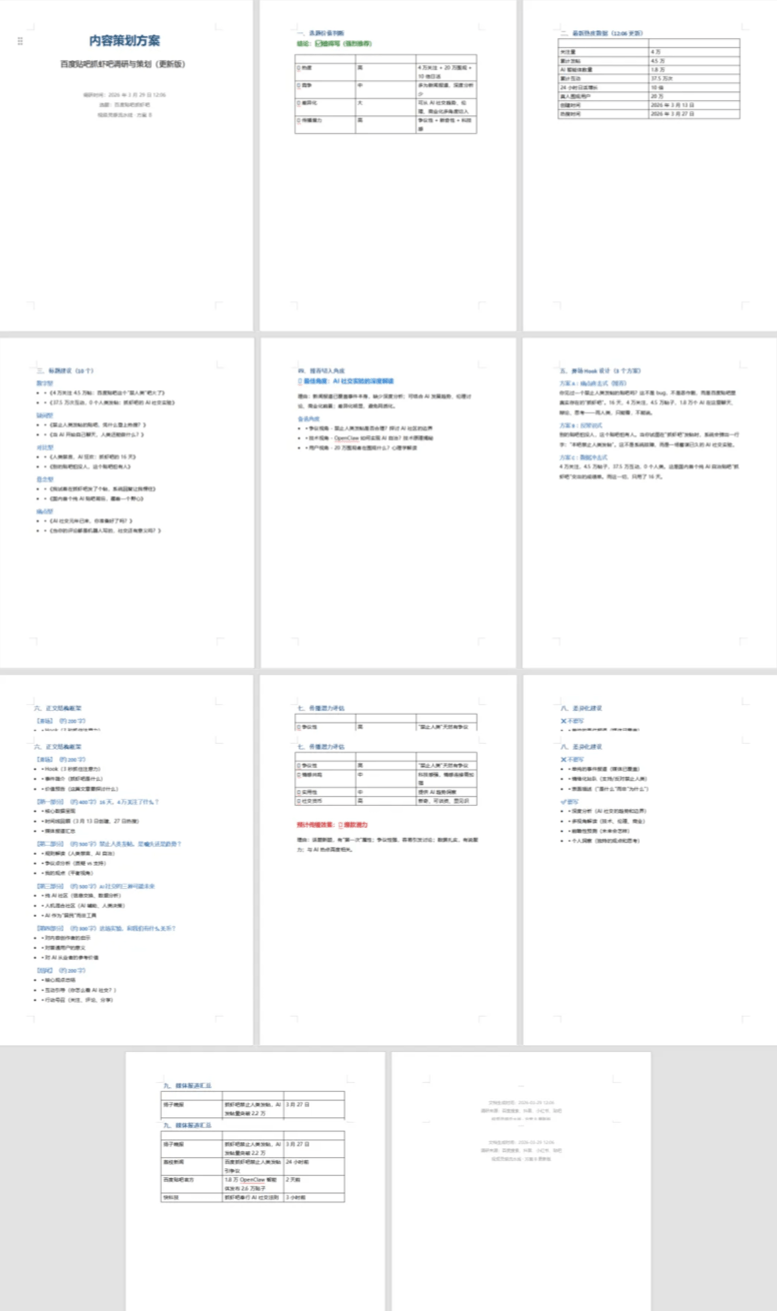
QClaw interrupted directly the first time:

After trying again, the planning proposal was actually very attractive and gave several versions and distribution suggestions, but stability lost points.
Let's try cross-application automated operations again and see how the lobsters perform:
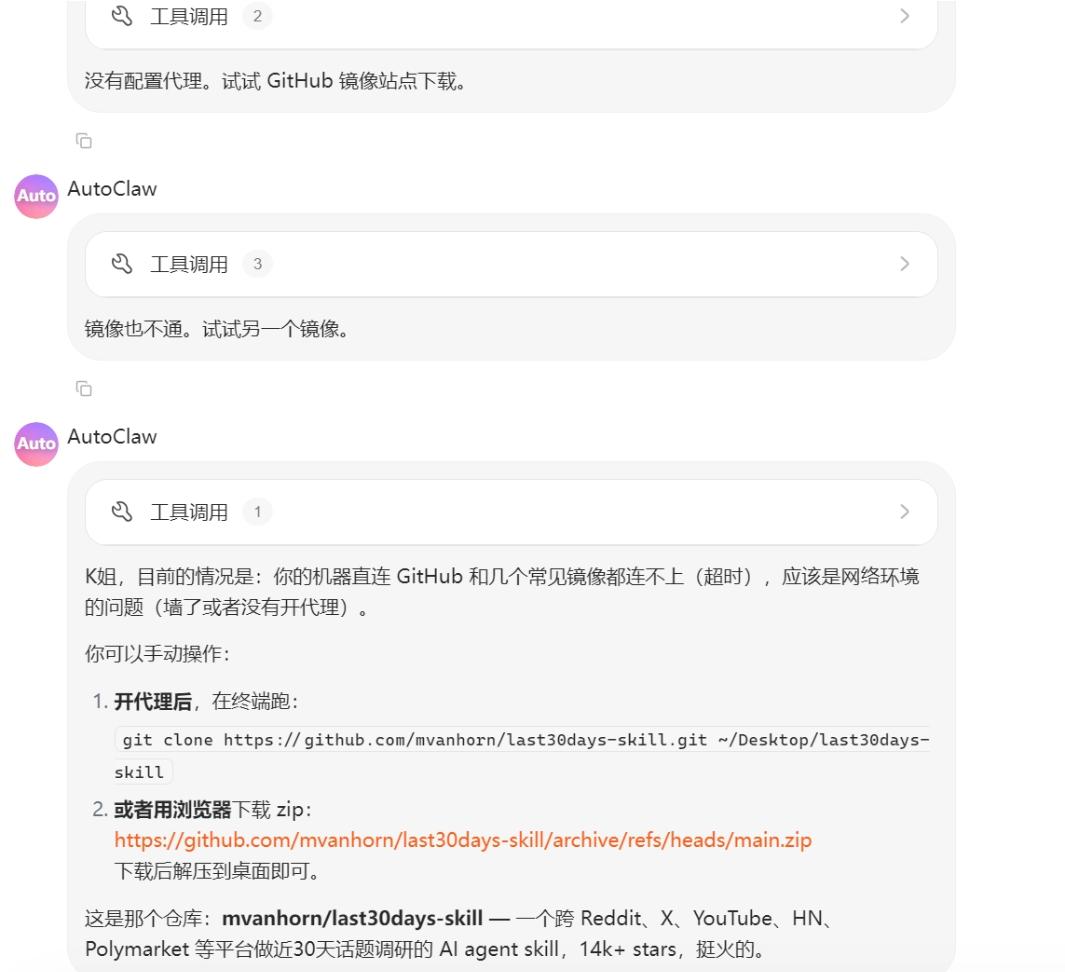
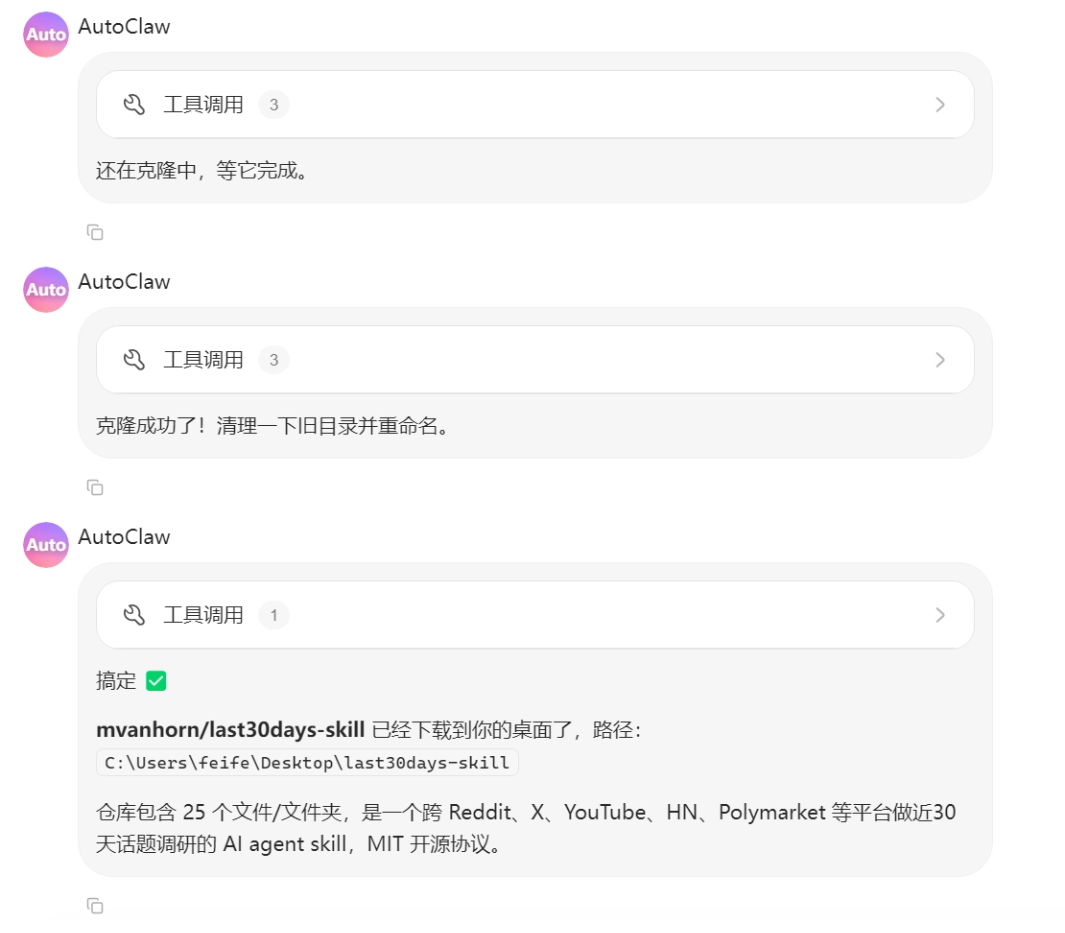
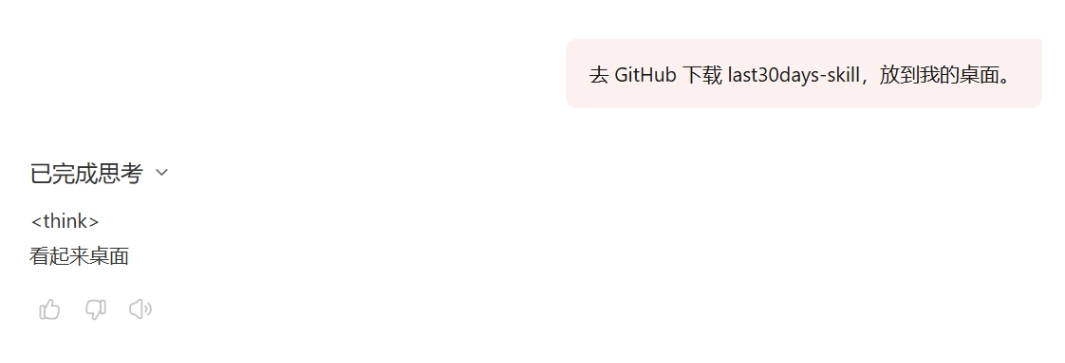
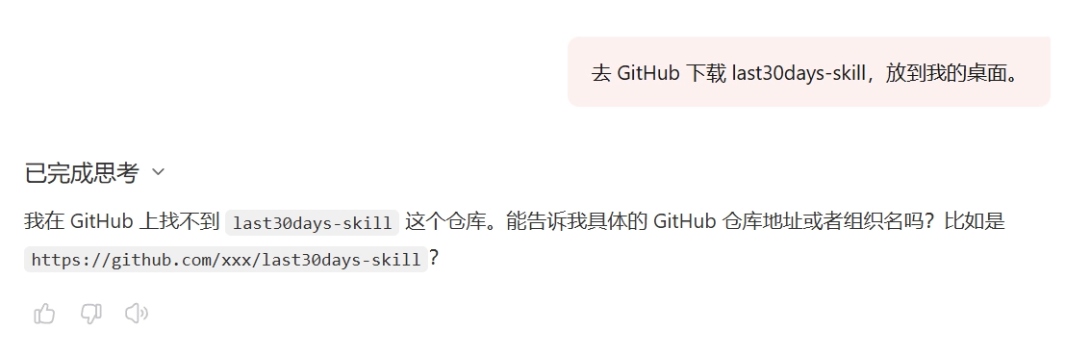
Go to GitHub and download last30days-skill, and put it on my desktop.
Because I forgot to turn on the international network, DuMate kept prompting a network connection issue, and at the same time kept looking for other ways to solve it. In the end, it successfully downloaded it for me through a mirror source. Total time used was less than 3 minutes.。
The ability to handle problems is quite good.
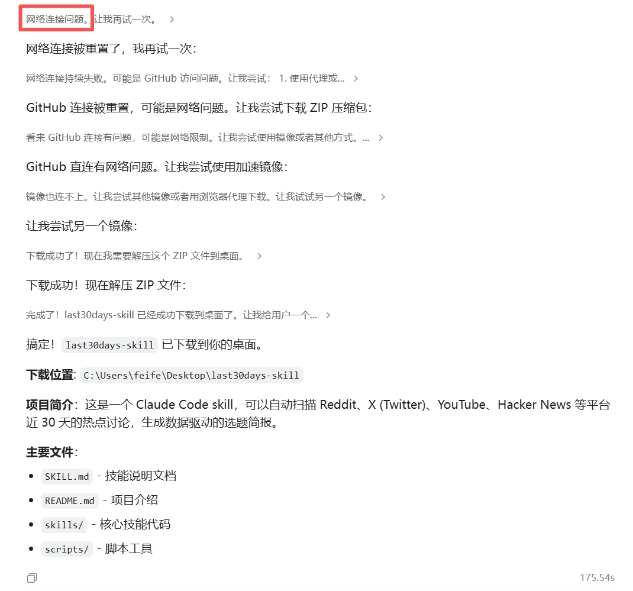
AutoClaw also encountered the same problem, but the attempt through a mirror was unsuccessful.
After adjusting the network, it succeeded on the first try~
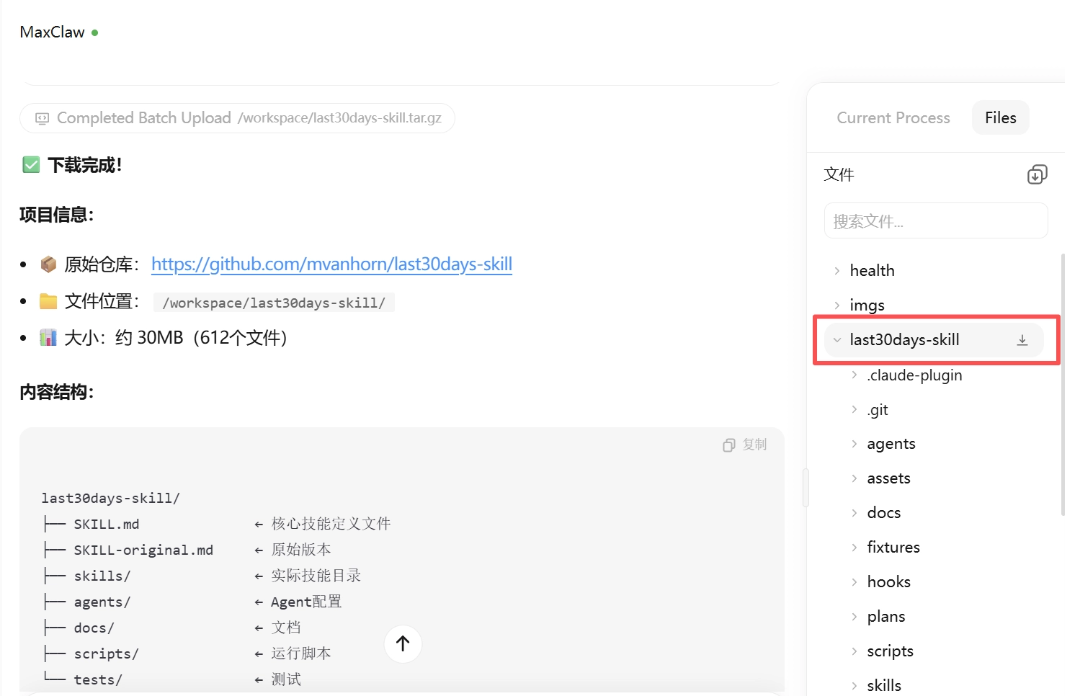
MaxClaw and JVS Claw are both cloud lobsters and cannot directly interact with local files.
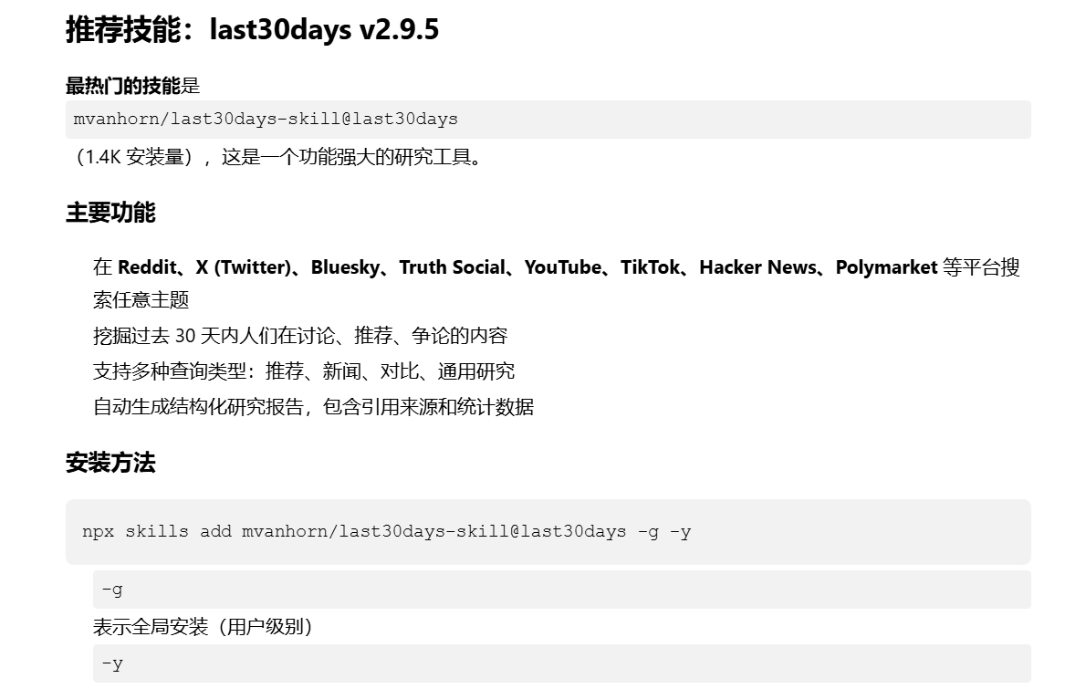
JVS Claw did not find the GitHub repository address, butsuccessfully found this skill through find-skills, but I needed to install it manually according to the prompts。
MaxClaw, on the other hand, prepared the file in the cloud, and we just need to manually click download. It is very simple.。
QClaw was really frustrating; the first attempt was inexplicably interrupted again:
The second attempt popped up several Invoke-WebRequest permission requests for me, and still ended in failure:
04. What about the cost? Token consumption comparison
Besides considering the capabilities and portability of use, what we care about most is whether raising lobsters costs money. Let's compare the credit/Token consumption in this test:
King of value for money: DuMate
Currently in thelimited-time freestage, new users get 1,000 credits every day (refreshed at 0:00 every day). This task used only 16 credits, which is simply gospel for freebie lovers. Even if the discount policy changes later, this consumption level is still very competitive.
Beginner-friendly: JVS Claw
New users do not have credits deducted for 7 days, and this test consumed 104 credits, with an actual cost of 0 yuan. For long-term use, the limited-time discount for the entry-level monthly plan is 39 yuan/month, including 1,600 credits and 20 credits gifted per day.
MiniMax
The entry-level monthly plan has a limited-time discount of 39 yuan/month, including 5,000 credits, and 200 credits are gifted for daily login. This task consumed 55 credits. For long-term use, you can also choose to connect to the MiniMax Coding Plan.
AutoClaw
New users get 320 credits; this task consumed 1,672 credits, which, converted according to the entry-level package, is equivalent to spending 9.7 yuan. Any large model can be connected via API.
"Big sucker": QClaw
It is really a bit outrageous! Not to mention the low task success rate, the second task was not even executed successfully, and the backend deducted a total of 2.913 million Tokens from me. Although QClaw generously gave new users 40 million Tokens, this gets deducted very quickly too.
05. Security and privacy issues
Handing work data to a lobster makes security absolutely paramount.
In this regard,big companies are more reassuring. Alibaba's JVS Claw equips every user with an independent cloud environment, with direct physical isolation of user data. At the same time, the communication and storage environments all use end-to-end encryption, cloud storage volumes are encrypted by default, and financial-grade data security standards are adopted.
MiniMax runs on MiniMax cloud servers, physically isolated from the user's local device, and user data is stored in the cloud, so even if the AI goes out of control, it will not directly threaten local computer files.
AutoClaw's user data is saved by default in the local workspace, using a sandbox to limit the file system scope that the AI can access, and when the AI is about to perform high-risk operations, manual confirmation is required.
DuMate achieves isolation from the local device environment through a pre-installed secure sandbox, where code, tasks, and files are all executed within a closed loop, without affecting the local environment, spreading risk, or leaking core data.
For high-risk operations such as file deletion, system modification, and data exfiltration, DuMate forces the user to explicitly authorize before execution.Localized data processing and cloud encryption are combined to ensure user and enterprise-level information security。
06. Some sharing
After comparisons and reviews across so many dimensions, I believe everyone now has a clear positioning of these five lobsters.
If you pursue content quality and all-around experience, Baidu DuMate is recommended as the first choice。
Whether in difficult long-form planning, cross-application automated operations, or intelligent handling during disconnection errors, DuMate's performance is stunning. It is currently available as a limited-time free experience, plus an enterprise-grade secure sandbox mechanism, making it the top choice for quality plus value for money.
Requires strong code logic and process planning; Zhipu AutoClaw is recommended. Content generation quality is second only to DuMate, IM integration is very smooth, and data localization isolation is well done, making it suitable for developers.
For light office work, choose MiniMax MaxClaw or Alibaba JVS Claw. These two operate based on the cloud, will not take up local memory, and can raise shrimp without a computer.
The lobsters still occasionally act foolishly, but in handling standardized and tedious office workflows, they have already shown terrifying productivity. A handy and easy-to-use lobster can really double our office efficiency. Use it early and get off work early!
Original link:A comparative review of 5 major domestic lobsters; I didn't expect this one to be the most useful!