
What are AI Programming L1-L5
The L1-L5 classification system for AI programming is a classification of the automation capabilities ofAI programming tools, from basic code completion to full-process development, reflecting the different application levels of AI in software development. Tools from L1 to L5 gradually increase the degree of automation in software development, lower the development threshold, and allow developers to focus on higher-level tasks.
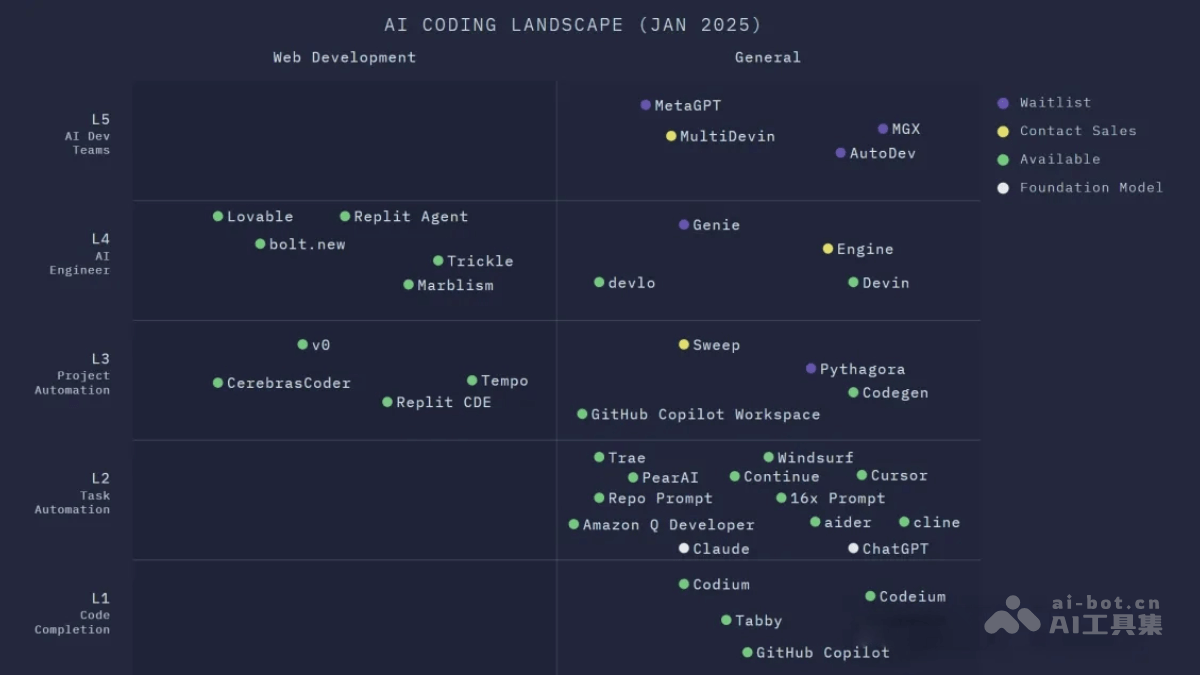
Introduction to the L1-L5 Classification of AI Programming
L1: Code Completion
- Main Features: Focuses on providing code-level autocompletion, helping developers quickly input common code snippets, simplifying the development process, and improving efficiency.
- Representative Products:
- GitHub Copilot: Simplifies the coding process through intelligent suggestions and code completion features.
- Tabby: An open-source code completion tool.
- Codium、Codeium: A paid code completion tool.
L2: Task-Level Automation
- Main Features: Can generate code snippets based on natural language descriptions, supporting feature development, bug fixing, and code refactoring. Requires high-quality prompts and context support to generate accurate code.
- Representative Products:
- ChatGPT: Generates code snippets based on natural language descriptions, supporting feature development, bug fixing, and code refactoring.
- Claude: Similar to ChatGPT, supports task-level code generation.
- aider: A command-line tool that simplifies the prompt generation process.
- 16x Prompt: A desktop application that helps developers obtain high-quality code from LLMs.
- Cursor、Continue、PearAI: An IDE extension that integrates LLMs into the development environment.
L3: Project-Level Automation:
- Main Features: Can generate the code framework for an entire project, directly generating preliminary code from requirements documents. Through integration with project management tools and code platforms, it automates requirements collection, code generation, and deployment.
- Representative Products:
- Codegen: Analyzes project requirements and generates related pull requests.
- Sweep: Automates requirements collection, code generation, and deployment.
- Pythagora: Partially open source, supports project-level automation.
- v0 by Vercel: Generates website code, focusing on front-end development.
- Tempo by Tempo Labs: A project-level automation tool.
- CerebrasCoder: Generates website code, focusing on front-end development.
L4: From Requirements to Production
- Main Features: Can achieve full-process automation from product requirements documents to final production deployment. Can manage the entire development activity, including code deployment and production environment maintenance, allowing non-technical personnel to quickly generate complete software products.
- Representative Products:
- Devin: Achieves full-process automation from requirements to production deployment.
- Marblism: Manages the entire development activity process, supporting non-technical personnel in quickly creating software.
- Genie: Developed by Cosine, supports full-process development.
- Engine、devlo、Gru: Other L4 tools.
L5: AI Development Team
- Main Features: The highest level of AI programming, involving collaboration among multiple AI agents, simulating a complete development team, each responsible for different parts of the project.
- Representative Products:
- AutoDev: An AI development team concept proposed by Microsoft, currently in the research stage.
- MGX: Designed by the MetaGPT team, currently in the waitlist stage.
Application scenarios of AI programming L1-L5
- L1 application scenarios: Suitable for simple code writing tasks, reducing the time and errors of manual input.
- L2 application scenarios: Handles complex development tasks, requires high-quality prompts and context support, and generates accurate code.
- L3 application scenarios: Manages simple projects, generates basic code, and requires manual intervention to ensure code quality.
- L4 application scenarios: Non-technical personnel can quickly generate complete software products, lowering the development threshold and improving development efficiency.
- L5 application scenarios: AI systems can replicate an entire software development team, programming and collaborating across all aspects of software creation, achieving a high degree of automation.