
What is AutoDev
AutoDev is anAI programming toolintroduced by Microsoft researchers, specifically designed to autonomously plan and execute complex software engineering tasks, such as coding, debugging, testing, and version control. AutoDev's goal is to improve the efficiency and quality of software development while reducing developers' burden on certain repetitive or tedious tasks.
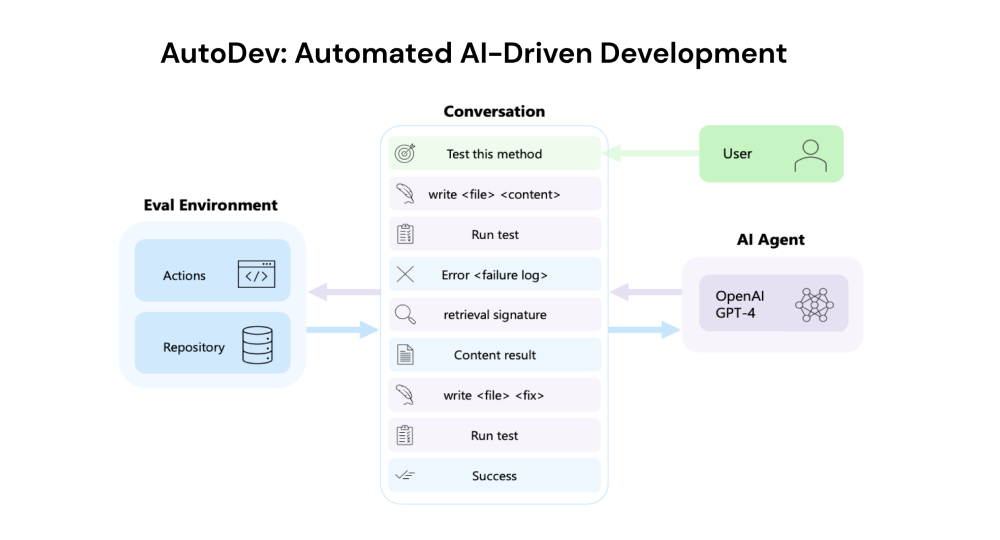
- arXiv research paper:https://arxiv.org/abs/2403.08299
Main features of AutoDev
- Goal definition and task allocation: Users can define complex software engineering goals, and AutoDev assigns these goals to autonomous AI agents to accomplish. This includes but is not limited to tasks such as coding, testing, building, and deployment.
- Code generation: AutoDev can generate code based on user requirements, which may include implementing new features, improving or optimizing existing code, and more.
- Test generation and execution: AutoDev can create test cases and execute these tests to verify the correctness of the code. It can analyze test results and, when necessary, adjust the code to fix errors.
- Code maintenance and debugging: AutoDev can review and maintain existing code, including identifying and fixing potential errors, optimizing code performance, and updating code to adapt to new requirements.
- Version control: AutoDev supports Git operations and can help manage code versions, including operations such as committing, pushing, and merging.
- File editing and management: AutoDev can perform file editing tasks, such as adding, modifying, or deleting file contents in a code repository.
- Retrieval and information extraction: AutoDev can retrieve information from a code repository, helping with tasks such as code reuse, pattern recognition, and knowledge extraction.
- Build and execution: AutoDev can compile, build, and execute a code repository, ensuring the runnability and performance of the code.
- Multi-agent collaboration: AutoDev's architecture supports multiple agents working together, with each agent having specific roles and responsibilities to jointly complete complex software engineering tasks.
- Conversation management: AutoDev interacts with users through the conversation manager, manages session history, and ensures effective communication between users and AI agents.
- Security and privacy maintenance: AutoDev executes tasks in a Docker environment, ensuring the security and privacy of operations and preventing potential security risks.
- Self-evaluation and iteration: AutoDev can self-evaluate the code and tests it generates, continuously improving and optimizing the effectiveness of task execution through an iterative process.
AutoDev's architectural components
AutoDev is mainly composed of four functional modules. This technical architecture design enables it to automate complex software engineering tasks while remaining efficient, secure, and controllable. This architecture allows AutoDev to complete tasks autonomously without human intervention, while also providing flexibility that allows users to customize AutoDev's behavior according to their needs.
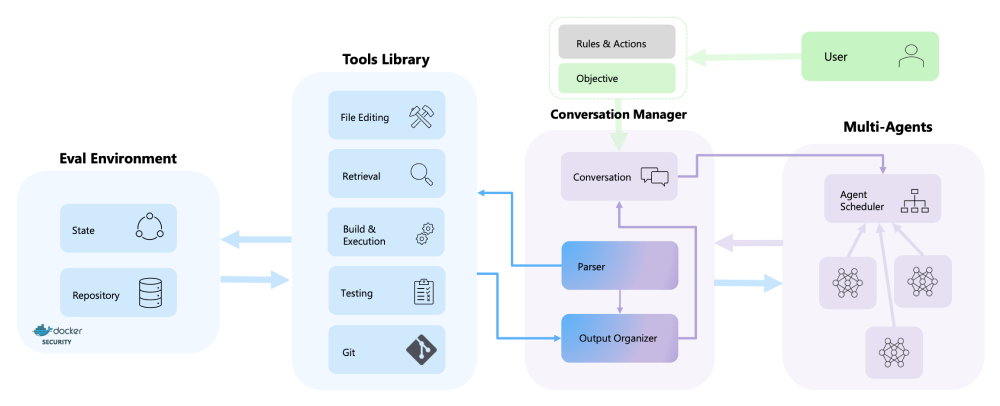
- Conversation Manager:
- Responsible for initializing and managing session history.
- Maintains the operation results from AI agents and the evaluation environment.
- Includes a parser, an output organizer, and a dialogue terminator, used to interpret agent responses, organize output information, and decide when to end the session.
- Tools Library:
- Provides a series of commands that enable AI agents to perform operations on the codebase.
- Includes commands in categories such as file editing, retrieval, building and execution, testing and verification, Git operations, and communication.
- Agents Scheduler:
- Responsible for coordinating AI agents to achieve user-defined goals.
- Uses loop-based, token-based, or priority-based algorithms to determine the order and manner in which agents participate in the conversation.
- Evaluation Environment:
- Runs in a Docker container, safely executing file editing, retrieval, building, execution, and testing commands.
- Provides a simplified interface to AI agents, abstracting the complexity of the underlying commands.
- AI Agents:
- Composed of large language models (such as OpenAI GPT-4) and small language models optimized for code generation.
- Receives goals and conversation history, and specifies actions according to rules and action configurations.
- Rules, Actions, and Goal Configuration:
- Users configure rules and operations through YAML files to start the process.
- Defines the commands (operations) that AI agents can execute and the specific commands that users can enable/disable.