
In today's rapidly evolving technological landscape, the Agentic Workflow, as an emerging automated process system, is reshaping the way we handle complex tasks. This article provides a comprehensive and easy-to-understand technical explanation for users without a technical background, helping everyone understand the essence, value, and application prospects of this innovative technology.
What Is an Agentic Workflow
An Agentic Workflow is a new type of automated process system in which multiple AI agents work collaboratively. By breaking down complex tasks into subtasks that are dynamically executed by AI agents with autonomous decision-making capabilities, the overall goal is ultimately achieved. Unlike traditional workflows that rely on fixed rules, Agentic Workflow emphasizesautonomy、adaptabilityandmulti-agent collaboration, and can respond to real-time changes in environments and requirements.
"Agentic Workflow = a group of little AI assistants writing their own scripts, casting their own actors, and editing their own footage, while humans act only as producers."
Core Features
- Task decomposition and planning: Break down complex tasks into executable subtasks, with each agent responsible for a specific part, forming a complete task chain.
- Multi-agent collaboration: Different agents take on specialized roles (such as data analysis or user interaction), achieving specialized division of labor and efficient collaboration.
- Tool use capability: Call external APIs, databases, or software (such as executing Python code or web search) to extend the boundaries of what agents can do.
- Dynamic adjustment and reflection: Optimize strategies in real time based on execution results, with self-learning and adaptive capabilities to respond to changing environments.
Technical Origins and Development History
Emergence of the concept (1980s–early 2000s)
- Originated from research in computer science onagent theoryanddistributed systems, with early attention to process automation and intelligent design. During this period, the concept ofSoftware Agentwas proposed, but under the technical conditions of the time it was not yet widely applied.
Technological catalysis (2010s–2023)
- Cloud computing and large language models (LLMs)provided agents with powerful computing power and a cognitive foundation.AI Agentbegan to rise, and a single agent was already able to complete simple tasks (such as early applications like ChatGPT). This stage laid the foundation for subsequent multi-agent collaboration.
Paradigm established (2024 to present)
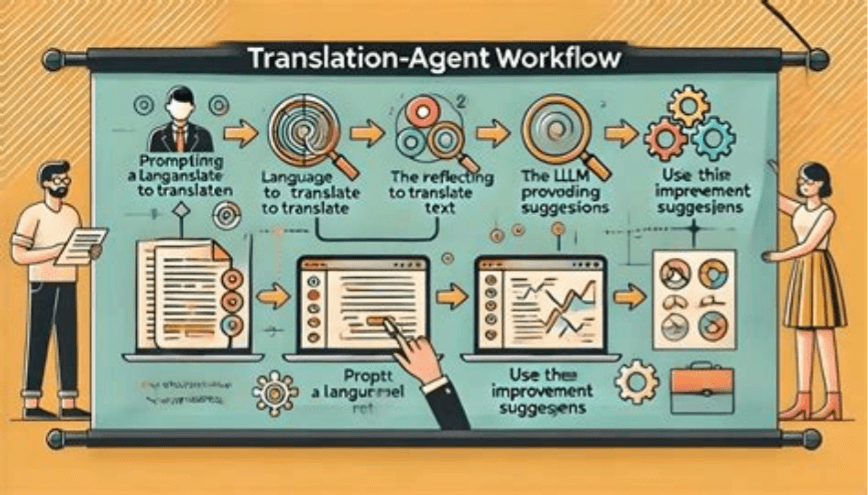
Andrew Ng formally proposed the concept of Agentic Workflow at the Sequoia Summit and defined four core design patterns:
- Reflection: Self-assess results and iteratively optimize
- Tool Use: Call external resources to solve problems
- Planning: Dynamically formulate execution paths
- Multi-agent Collaboration: Multiple agents work together
The emergence of open-source frameworks (such asLangChain, AutoGen) and platforms (such asCoze、ModelScope) has promoted the widespread application of this technology.
Typical Application Scenarios
Enterprise-level applications
- Intelligent customer service systems: Case: Klarna's AI customer service handles 2/3 of inquiries, with accuracy comparable to humans and costs reduced by 90%.
- Workflow: user question → routing agent → knowledge base retrieval → response generation → human review (optional).
- Marketing Automation: Agent systems can automatically generate social media content, adjust advertising strategies in real time, and optimize marketing performance based on user behavior data.
- Main functions: content creation and optimization; audience analysis and targeting; advertising placement management; performance tracking and optimization.
Research and Development
- Academic Research: Agent systems can automate research tasks such as literature reviews, data cleaning, and model training, greatly improving research efficiency.
- Research process: literature search and screening → data collection and cleaning → model selection and training → result analysis and reporting
- Code Development: Collaborative agent systems can complete the entire software development process, including code generation, testing, and debugging, helping developers improve coding quality.
- Development process: requirements analysis and planning → code generation and implementation → unit testing and integration → performance optimization and deployment
Personal Productivity
- Office Automation: Agent systems can automatically generate PPTs, handle emails, look up information, and perform other daily office tasks, improving personal work efficiency.
- Common functions: document drafting and formatting; scheduling and reminders; information retrieval and organization; meeting notes and summaries.
- Cross-platform Tool Integration: Connect calendars, email, cloud documents, and various other tools through platforms such as Coze to achieve seamless workflow integration.
- Integration examples: calendar and email synchronization; document and spreadsheet linkage; contacts and meeting systems; project management and task tracking.
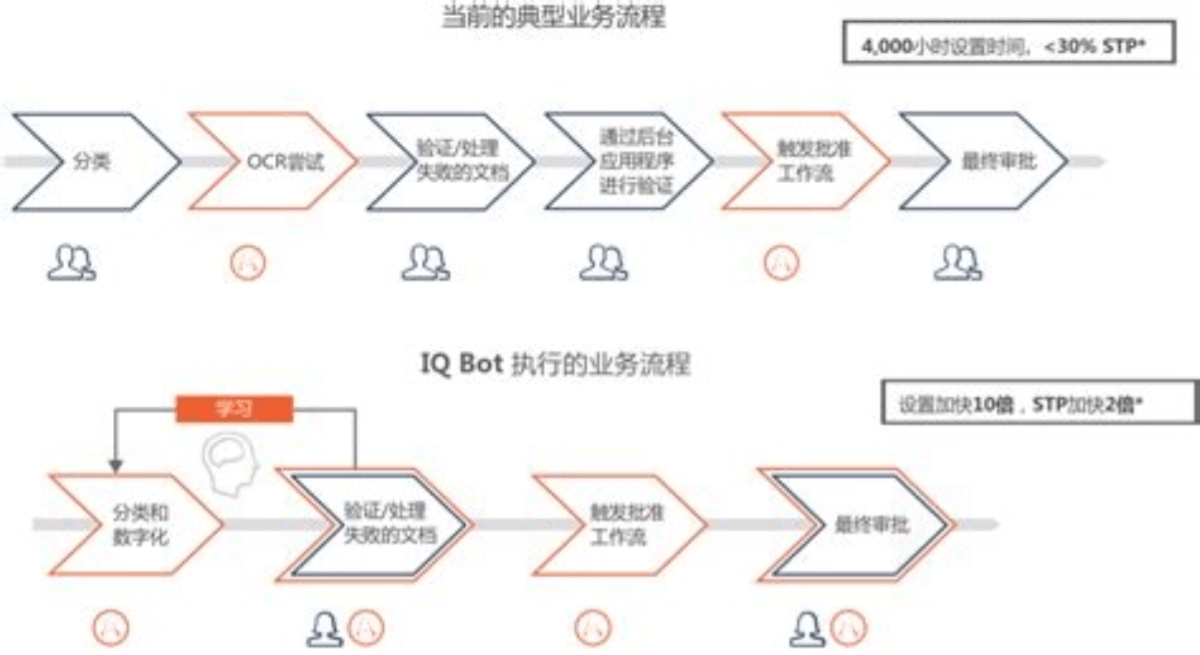
Comparison with Traditional Workflows
| Dimension | Traditional Workflow | Agentic Workflow |
|---|---|---|
| Architecture | Centralized control, fixed process | Distributed agents, dynamic orchestration |
| Degree of Autonomy | Low (requires preset rules) | High (autonomous decision-making + real-time adjustment) |
| Scalability | Limited (process must be redesigned) | High (quickly scale by adding agents) |
| Complexity Handling | Suitable for simple repetitive tasks | Good at complex multi-step tasks |
| Maintenance Cost | Low (clear rules) | Relatively high (agent behavior must be monitored) |
Technology Stack and Open-source Tools
Core Components
| Component | Function | Representative Tools/Technologies |
|---|---|---|
| Agent | Task execution unit | AutoGen, CrewAI |
| Large Language Model | Provides reasoning and generation capabilities | GPT-4, Llama, Wenxin Model |
| Tool Library | Extends external capabilities (API, code, database) | LangChain Tools |
| Workflow Orchestrator | Visual design of task flows | Coze, LangFlow |
Development Frameworks
LangChain: Suitable for Python developers, provides a rich API, and supports integration with multiple large language models and tools. Main features:
- Modular design
- Flexible LLM integration
- Powerful toolchain support
- Active community
AutoGen: Launched by Microsoft, supports multi-agent conversations and complex inter-agent communication. Main features:
- Multi-agent conversation
- Role definition mechanism
- Message passing protocol
- Enterprise-grade support
Low-code platforms: iFLYTEK Spark Platform and Coze are suitable for non-technical users, building workflows through visual interfaces. Main features:
- Drag-and-drop operation
- Preset template library
- No programming required
- Rapid deployment
Beginner's build guide (using LangChain as an example)
Environment configuration
# Install Python 3.10+
pip install langchain langchain-openai python-dotenv
# Configure OpenAI API key (requires registering an OpenAI account)
echo “OPENAI_API_KEY=sk-…” > .env
Configuration instructions:
- Ensure Python 3.10+ is installed
- Use pip to install the necessary LangChain library and OpenAI integration package
- Create a .env file to store the API key (for security, do not commit it to version control)
- Obtain an OpenAI account API key and replace the placeholder in the example
Build a simple workflow (weather query assistant)
from langchain.agents import AgentType, initialize_agent
from langchain.tools import Tool
from langchain_openai import OpenAI# 1. Define tool: weather API call
def get_weather(city):
return f"{city} weather: 25°C, sunny"weather_tool = Tool(
name=”WeatherQuery”,
func=get_weather,
description="Query city weather"
)# 2. Initialize agent
agent = initialize_agent(
tools=[weather_tool],
llm=OpenAI(temperature=0),
agent=AgentType.ZERO_SHOT_REACT_DESCRIPTION
)# 3. Execute task
agent.run("What's the weather in Beijing?")
Code explanation:
- Import the necessary LangChain modules and OpenAI integration
- Define the weather query tool function and wrap it as a LangChain Tool
- Initialize the agent, specifying the toolset and large language model
- Call the agent to execute the "What's the weather in Beijing?" task
Run and test
python weather_agent.py
# Output: Beijing weather: 25°C, sunny
Test process:
- Save the code to the weather_agent.py file
- Run the python weather_agent.py command in the terminal
- Observe whether the output matches expectations
- Try modifying the input question (e.g., "Shanghai weather") to verify the system response
Security and privacy challenges
Main risks
- Data leakage: Agents may accidentally expose sensitive information, such as personally identifiable data, trade secrets, etc.
- Compliance risk: Violating regulations such as GDPR (e.g., processing user data without authorization or without obtaining appropriate consent).
- Malicious manipulation: Attackers mislead agents into performing erroneous operations, which may cause system failures or data corruption.
Protective measures
| Technology | Function |
|---|---|
| Data encryption | Encryption of data in transit and at rest |
| Access control (RBAC) | Role-based permission management |
| Sandbox environment | Isolated code execution |
| Audit logs | Record all agent operations |
Implementation recommendations
- Implement end-to-end encryption for sensitive data
- Establish strict access control policies
- Use sandboxes to isolate critical operations in production environments
- Regularly review audit logs to detect anomalous behavior
- Implement the principle of data minimization, collecting only necessary data
Future Development Trends
- Technological Convergence: Combining with blockchain to ensure data trustworthiness, integrating the Internet of Things (IoT) to achieve control over the physical world, and combining with edge computing to enable localized processing.
- Enhanced Automation: Moving from "assisting humans" to "fully autonomous" task execution, enhancing decision-making capabilities, reducing manual intervention, and achieving cross-domain knowledge transfer and application.
- Popularization and Downmarket Expansion: Low-code platforms lower the barrier to use. Industry-specific solutions become widespread, and embedded agent devices become widespread.,
For organizations and individuals hoping to adopt Agentic Workflow, the recommendations are:
- Start with pilot projects in simple scenarios and gradually expand
- Attach importance to security and privacy protection measures
- Continuously monitor and optimize agent performance
- Pay attention to technological developments and stay updated
- Cultivate cross-domain talent and adapt to the new technological environment
Agentic Workflow represents a paradigm shift in automation technology: fromrule-driventoagent-driven. Through task decomposition, multi-agent collaboration, and dynamic adjustment, it efficiently handles complex scenarios (such as customer service, scientific research, and office automation). For ordinary users, open-source frameworks (LangChain/AutoGen) and low-code platforms (Coze/iFlytek Spark) have greatly lowered the barrier to use. Attention must be paid to data security and compliance risks, with protection through measures such as encryption, access control, and auditing. In the future, with the development of LLMs and the Internet of Things, Agentic Workflow will become the core infrastructure for human-machine collaboration.