What is LangChain
LangChain is a framework used for developing applications powered bylarge language models(LLMs). By simplifying the development, productionization, and deployment process of LLM applications, the framework helps developers quickly build intelligent agents and applications. LangChain's core features include a quick-start development experience, powerful productionization support, and flexible deployment options. The framework consists of multiple open-source libraries, such aslangchain-core、langchainandlanggraph, providing comprehensive support from basic abstractions to complex application orchestration. LangChain integrates LangSmith and LangGraph, which are used for application evaluation and production-grade orchestration, respectively, helping developers transition seamlessly from prototype to production.
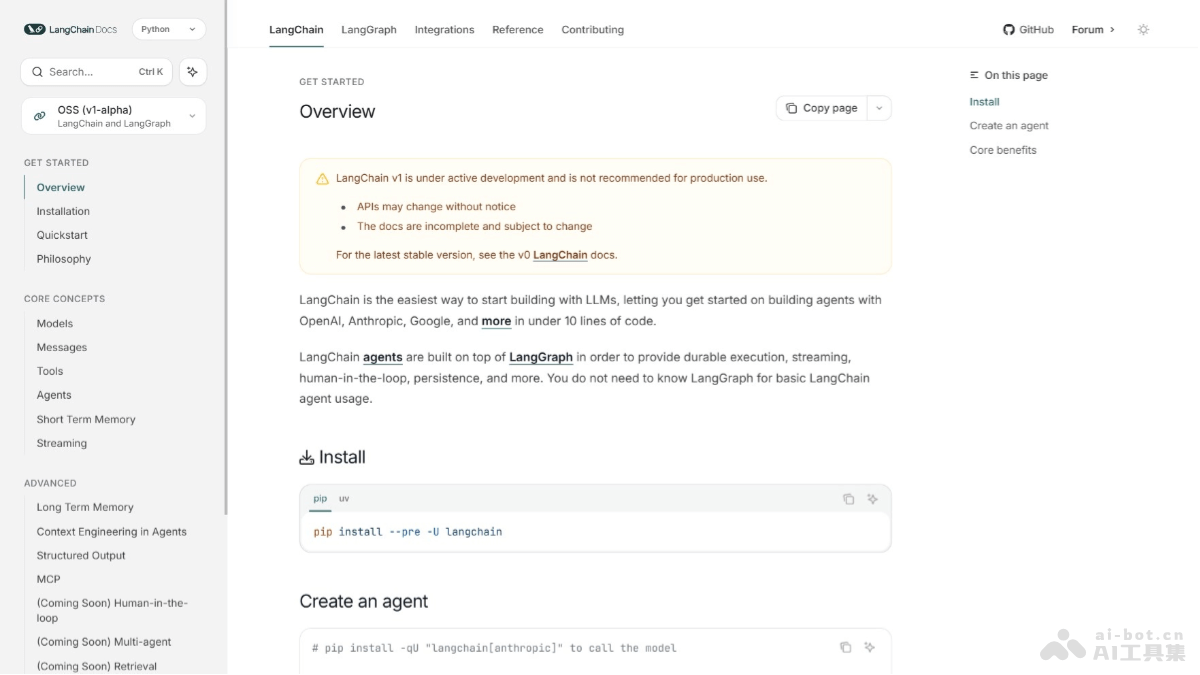
LangChain's main features
-
Development: LangChain provides a rich set of open-source components and third-party integrations to help developers quickly build applications based on large language models (LLM).
-
Productionization: Through LangSmith, LangChain supports evaluating, monitoring, and optimizing applications, ensuring performance and stability in production environments.
-
Deployment: Supports turning applications into production-grade APIs and intelligent agents, supporting high-concurrency processing and durable execution to meet enterprise-level deployment needs.
-
Integration: LangChain supports a variety of LLM models as well as rich third-party tool integrations, greatly expanding the functionality and scope of applications.
-
Community and Extensions: LangChain has an active community, whose members jointly maintain third-party integrations, and users can easily add custom tools and models to meet specific needs.
How to use LangChain
- Install LangChain: The LangChain ecosystem is split into different packages, and you can choose to install the required functional modules.
- Install the main
langchainpackage:
- Install the main
pip install langchain-
- Install specific integration packages:
- If you need to use OpenAI's models, install the
langchain-openaipackage:
- If you need to use OpenAI's models, install the
- Install specific integration packages:
pip install langchain-openai-
-
- If you need to use Anthropic's models, install the
langchain-anthropicpackage:
- If you need to use Anthropic's models, install the
-
pip install langchain-anthropic-
- Install other toolkits: If you need to use other tools, install the
langchain-communitypackage:
- Install other toolkits: If you need to use other tools, install the
pip install langchain-community- Configure environment variables: Make sure the API key has been configured in the environment variables. For example, if using OpenAI, set it like this:
export OPENAI_API_KEY=your_openai_api_key- Write code: The following is a simple LangChain application example, showing how to create a chatbot based on OpenAI.
from langchain.chat_models import ChatOpenAI
from langchain.prompts import ChatPromptTemplate
from langchain.chains import LLMChain

# 初始化聊天模型
model = ChatOpenAI(model_name="gpt-3.5-turbo")

# 定义聊天提示模板
prompt_template = ChatPromptTemplate.from_template(
    "You are a helpful assistant. Answer the user's question: {question}"
)

# 创建LLM链
chain = LLMChain(llm=model, prompt=prompt_template)

# 运行链
response = chain.invoke({"question": "What is the capital of France?"})
print(response)- Build more complex applications with LangChain: LangChain supports building more complex applications, such as intelligent agents and workflows. The following is an example of building an intelligent agent with LangChain.
from langchain.agents import create_agent
from langchain.tools import Tool

# 定义一个简单的工具函数
def get_weather(city: str) -> str:
    """Get weather for a given city."""
    return f"It's always sunny in {city}!"

# 创建智能代理
agent = create_agent(
    model="gpt-3.5-turbo",
    tools=[Tool(name="get_weather", func=get_weather, description="Get weather for a given city")],
    prompt="You are a helpful assistant that can get weather information."
)

# 运行智能代理
response = agent.invoke({"messages": [{"role": "user", "content": "What is the weather in Paris?"}]})
print(response)- Use LangSmith for application evaluation and optimization: LangSmith is a tool for evaluating and optimizing LangChain applications. Using LangSmith, you can track application performance, monitor operation, and perform optimization.
from langchain.smith import LangSmith

# 初始化LangSmith
langsmith = LangSmith()

# 评估应用
evaluation_result = langsmith.evaluate(chain, input={"question": "What is the capital of France?"})
print(evaluation_result)- Deploy LangChain applications: LangChain supports deploying applications as production-grade APIs or intelligent agents. Use LangGraph to turn applications into production-grade services.
from langchain.graph import LangGraph

# 初始化LangGraph
graph = LangGraph()

# 将应用添加到LangGraph
graph.add_chain(chain)

# 部署为API
api = graph.deploy_as_api()
print(api.url)- Use LangChain's community resources: LangChain has an active community. Visit LangChain's GitHub repository, documentation, and community forums to get more resources and help.
LangChain application scenarios
-
Natural Language Processing (NLP): Used in tasks such as text generation, text classification, and text summarization to help developers build efficient language processing applications.
-
AI Assistants: Create intelligent chatbots and virtual assistants to provide users with personalized services and interactive experiences.
-
Enterprise Automation: Support enterprise workflow automation, simplify complex tasks through intelligent agents, and improve work efficiency.
-
EdTech: Used to develop personalized learning tools and intelligent tutoring systems to improve education quality and learning outcomes.
-
Healthcare: Provide medical consultation services and data analysis, assist medical decision-making, and improve patient care.