
What is LangFlow
LangFlow is a low-code, visual AI application buildingtool for quickly building and experimenting with LangChain pipelines. Through a drag-and-drop interface, users can easily create complex AI workflows without writing a large amount of code. LangFlow supports multi-agent conversation management and RAG (Retrieval-Augmented Generation) applications, and is suitable for scenarios such as building intelligent chatbots, document analysis systems, and content generation tools. Users can publish workflows as APIs or export them as Python applications for easy integration into other systems.
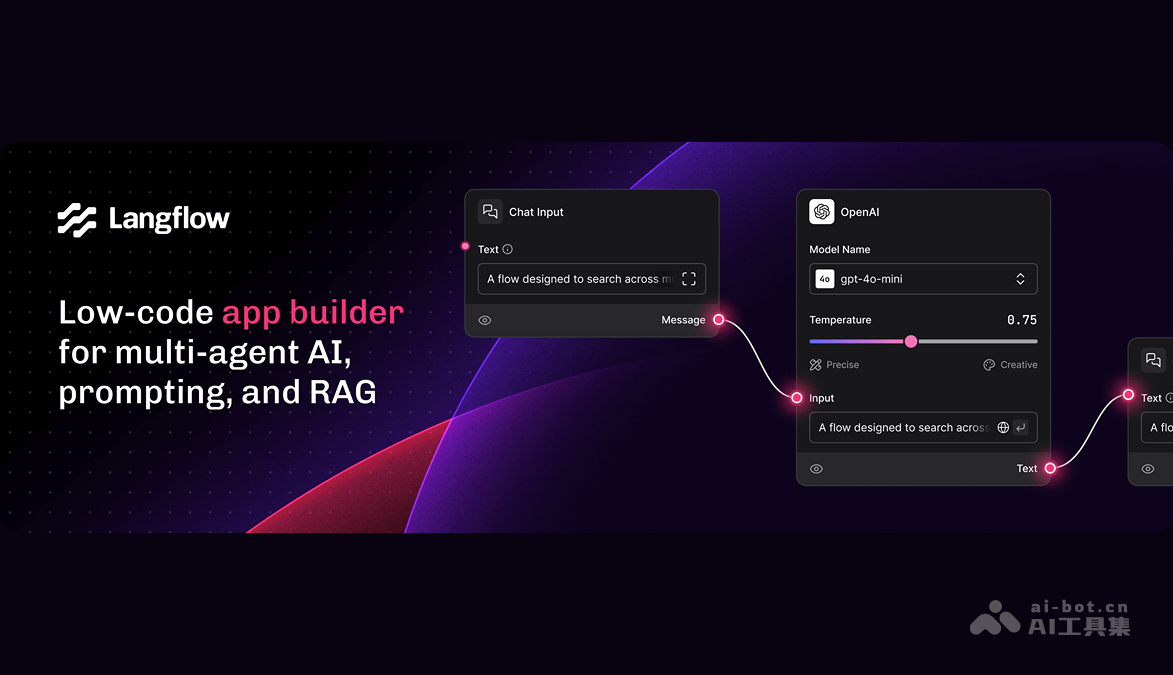
Main features of LangFlow
- Visual workflow building: Through drag-and-drop components, users can easily create complex AI workflows.
- Multi-agent support: Supports multi-agent orchestration, conversation management, and information retrieval.
- Python customization: Users can customize components using Python code.
- Prebuilt components: Provides hundreds of prebuilt components and templates for quickly starting projects.
- Instant testing environment: The built-in Playground feature allows users to test and iterate workflows in real time.
- Cloud deployment and local running: Supports free deployment on the DataStax Langflow cloud platform, and also supports local running.
- API publishing and export: Users can publish workflows as APIs or export them as Python applications.
- Ecosystem integration: Supports integration with tools such as LangSmith, LangFuse, or LangWatch, providing enterprise-grade security and scalability.
Technical principles of LangFlow
- Execution engine based on Directed Acyclic Graph (DAG): When a workflow runs, LangFlow builds a Directed Acyclic Graph (DAG) based on components and connection lines. The nodes (components) of the DAG are sorted and executed in sequence according to dependencies, and the output of each node is passed to the next node that depends on it. This ensures efficient execution of the workflow and correctness of the results.
- Component-based design and flexibility: LangFlow's component-based design allows users to choose or customize components according to their needs. It supports integration with multiple models, APIs, and databases, and developers can easily extend and reuse components. LangFlow provides hundreds of prebuilt components to meet the needs of different scenarios.
- RAG (Retrieval-Augmented Generation) support: LangFlow provides support for RAG, structuring and storing long documents into a vector database through an intelligent text chunking module, and quickly locating relevant information through vector retrieval during queries.
- Python-driven and open-source features: LangFlow is developed based on Python and is fully open source. Users can fully customize workflows or extend functionality through Python.
LangFlow project address
- Github repository:https://github.com/langflow-ai/langflow
Application scenarios of LangFlow
- Intelligent document question-answering system: LangFlow can use RAG (Retrieval-Augmented Generation) technology to chunk long documents and store them in a vector database, enabling efficient semantic retrieval and question-answering capabilities. Users can quickly build document question-answering systems, improving knowledge retrieval efficiency and question-answering accuracy.
- Automated content generation: LangFlow supports inputting daily records or data into workflows and generating standardized documents through preset templates, such as weekly reports, reports, etc.
- Multi-agent dialogue system: LangFlow supports multi-agent orchestration and dialogue management, and can build complex chatbots or customer service systems to achieve natural language interaction and information retrieval.