
What is MiMo Code
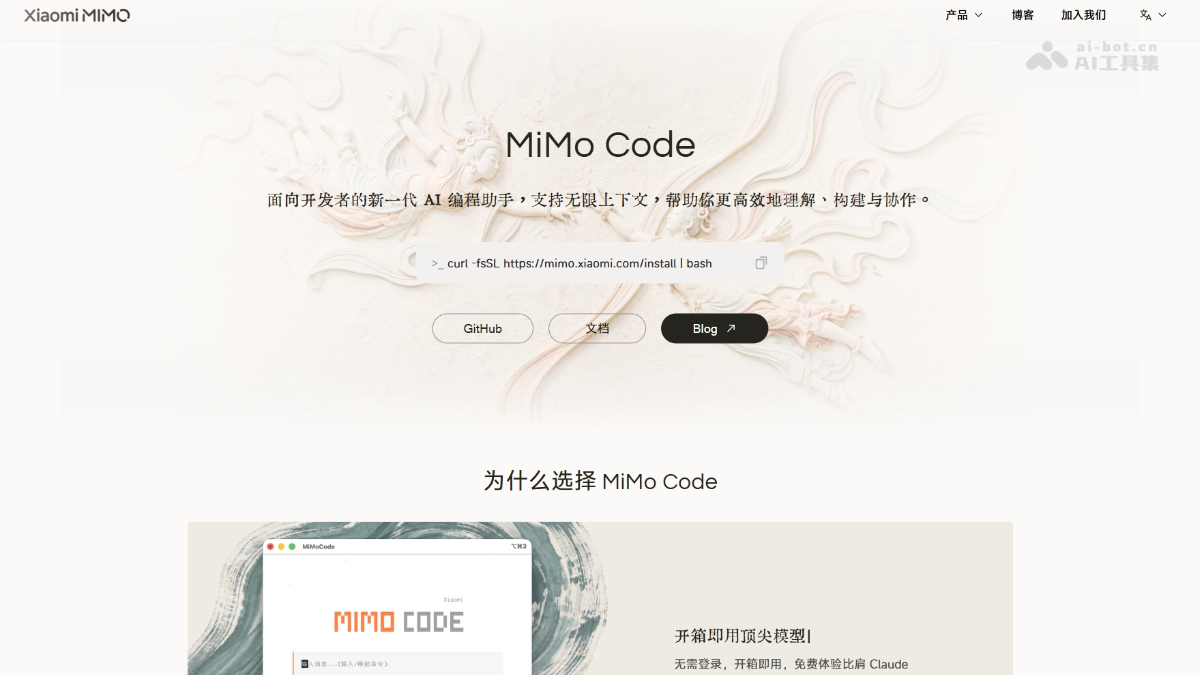
MiMo Code is the new-generation AI programming assistant, based on OpenCode is open-sourced under the MIT license, with a built-in limited-time free MiMo-V2.5 model. Its original persistent memory system automatically saves state through an independent subagent to solve the "forgetfulness" problem in long conversations; Compose mode supports completing the entire design, planning, coding, and testing workflow with one click; and the Dream command achieves 7-day periodic memory consolidation, making the AI understand you better the more you use it. It supports voice input and third-party model integration, outperforms Claude Codein real programming tests such as SWE-Bench, and is fully localized in Chinese, making it a cost-effective new AI programming choice for domestic developers.
Main features of MiMo Code
-
Persistent memory system: Built-in triple mechanisms of project memory, session checkpoints, and task progress, with an independent subagent automatically saving state, solving the problem of "forgetting the more you use it" in long conversations and supporting hundreds of rounds of dialogue without losing key information.
-
Compose mode: Switch with the Tab key, enter a simple idea and it will automatically complete the entire design, planning, coding, testing, and review workflow, delivering industrial-grade finished code.
-
Dream memory consolidation: Built-in
/dreamcommand, which automatically triggers an independent Agent every 7 days to organize historical sessions, merge and deduplicate, verify paths, and compress memories, making the AI understand you better the more you use it. -
Voice input control: Based on MiMo-V2.5-ASR speech recognition, it supports verbally inputting prompts, modifying instructions, sending execution commands, and other operations, all without touching the keyboard.
-
Multi-model compatibility: Built-in limited-time free MiMo-V2.5 channel, while also supporting integration with mainstream models such as DeepSeek, Kimi, GLM, and third-party Token Plans.
-
Full Chinese localization: All settings are localized in Chinese, with a permanent status dashboard on the right side of the TUI page to observe work progress at any time, friendly to domestic developers.
-
Open source and free: Based on OpenCode and open-sourced under the MIT license, individuals can freely modify and distribute it, and enterprises can integrate it into their own toolchains without licensing constraints.
-
Intelligent code editing: Supports automatic mapping of codebase structure, secure change analysis, diff review, and runtime checks, capturing potential issues before merging.
How to use MiMo Code
-
Install the tool: Mac and Linux users run
curl -fsSL https://mimo.xiaomi.com/install | bashfor one-click installation; Windows users install globally vianpm install -g @mimo-ai/cliglobal installation -
Launch the application: After installation is complete, enter
mimodirectly in the terminal to launch it; using it in iTerm or the VS Code terminal is recommended for the best experience -
View configuration: Enter
/to view all configuration items; all settings are fully localized in Chinese, and the permanent status dashboard on the right lets you observe work progress in real time -
Use Compose mode: Press Tab key to switch to Compose mode, enter a simple idea, and the AI will automatically complete the entire design, planning, coding, testing, and review workflow
-
Trigger memory consolidation: Use
/dreamcommand, the system automatically organizes historical sessions every 7 days, merges and deduplicates them, and updates global memory, allowing the AI to continuously learn your project habits -
Voice control: directly input prompts via voice or issue operation commands such as "send" and "execute", with no keyboard needed throughout, powered by MiMo-V2.5-ASR for speech recognition support
-
Switch models: the built-in MiMo-V2.5 limited-time free channel can be used without registration; you can also configure API Keys for DeepSeek, Kimi, GLM, or third-party Token Plans
-
Code review and editing: let the AI automatically analyze the codebase structure, perform safe edits, generate diffs, and run checks to catch potential issues before merging
MiMo Code project address
- Project official website:https://mimo.xiaomi.com/mimocode
- GitHub repository:https://github.com/XiaomiMiMo/MiMo-Code
MiMo Code's core advantages
-
Original persistent memory system: through the triple mechanisms of project memory, session checkpoints, and task progress, an independent subagent automatically saves state without relying on the model to "consciously" take notes, completely solving the pain point of long sessions "forgetting more the longer they are used."
-
Model-Agent collaborative optimization: a dedicated Harness system built specifically for the MiMo series models, deeply adapted to model characteristics and the Agent framework, with measured performance superior to Claude Code under the same model.
-
Compose full-process mode: switch with one press of the Tab key, automatically completing the full process of design, planning, coding, testing, and review, with sufficient planning upfront to reduce later rework and deliver industrial-grade finished code.
-
Dream self-evolving memory: built-in
/dreamcommand, which automatically triggers an independent Agent every 7 days to organize, merge, and deduplicate historical memories, continuously accumulating project understanding and truly achieving "understanding you better the more it is used." -
Extreme cost-effectiveness: built-in MiMo-V2.5 limited-time free channel; API pricing as low as 0.7 yuan per million tokens, with Token Plan starting at 1,188 yuan per year, far lower than overseas competitors such as Cursor and Claude Code.
-
Full-process voice control: based on MiMo-V2.5-ASR speech recognition, it supports full-process voice control from inputting prompts to sending and executing, enabling feature development without touching the keyboard.
-
Open source with zero barriers: open sourced under the MIT license based on OpenCode, individuals can freely modify and distribute it, and enterprises can integrate it into their own toolchains at zero cost, with no licensing constraints.
-
Comprehensive Chinese localization: all configuration items are fully localized in Chinese, with stable direct connections on domestic networks and a persistent status dashboard on the right for real-time progress monitoring, making it extremely friendly to domestic developers.
-
Ultra-long context support: the MiMo-V2.5 series supports a 1M context window, easily handling understanding of large codebases and complex cross-file development tasks.
-
Leading authoritative real-world testing: in the real programming tests of SWE-Bench and Terminal Bench, its results under the same model comparison are comprehensively better than Claude Code, with stronger industrial-grade code delivery capability.
Comparison of MiMo Code with similar competitors
| Comparison dimension | MiMo Code | Cursor | Claude Code |
|---|---|---|---|
| Developing company | Xiaomi Large Model Team | Anysphere | Anthropic |
| Product form | Terminal TUI + desktop application | Standalone IDE based on VS Code | Terminal application + IDE extension |
| Open source license | MIT open source | Closed-source | Closed-source |
| Underlying models | MiMo-V2.5 (built-in) + supports third parties such as DeepSeek / Kimi / GLM | Claude / GPT-4 / Gemini, etc. (API Key required) | Claude series only (Sonnet 4.6 / Opus 4, etc.) |
| Core features | Compose full-workflow mode, persistent memory system, Dream memory consolidation, voice input | Tab real-time completion, Composer multi-file editing, Chat conversation, Cursor Rules | Agent Teams multi-agent collaboration, Plan mode, code review, test execution |
| Memory mechanism | Original persistent memory: an independent subagent automatically saves checkpoints + 7-day-cycle Dream organization | Relies on session history + user-configured Cursor Rules | Relies on the model's own context + user-triggered memory notes |
| Voice support | Built-in MiMo-V2.5-ASR, full-workflow voice input and control | Not supported | Not supported |
| Context window | 1M (MiMo-V2.5 series) | ~200K (depends on the model) | 1M(Claude 3.7 Sonnet) |
| Access in China | Stable direct connection, servers located in China | Proxy required, stability about 78% | Proxy required |
| Interface language | Fully localized in Chinese | Mainly English | Mainly English |
| Pricing | Built-in free for a limited time; API from 0.7 yuan/M tokens; Token Plan from 1,188 yuan/year | Pro $20/month; Business $40/month; usage-based billing separately | $17-200/month (tiered usage-based billing) |
| SWE-Bench Pro | 62%(MiMo-V2.5-Pro) | Official data not disclosed | 55%(Claude Sonnet 4.6) |
| Terminal Bench 2 | 73%(MiMo-V2.5-Pro) | Official data not disclosed | 69%(Claude Sonnet 4.6) |
MiMo Code application scenarios
-
Daily coding for individual developers: Use Compose mode to quickly implement feature requirements, with the entire process from design to testing completed automatically, suitable for independent developers to deliver projects efficiently.
-
Maintenance and refactoring of large codebases: With a 1M ultra-long context and persistent memory system, it easily understands complex cross-file dependencies and safely performs large-scale code refactoring.
-
Rapid setup of full-stack projects: Enter a simple idea, and MiMo Code automatically plans the frontend and backend architecture, generates code, and provides complete tests, suitable for MVP prototyping and project kickoff.
-
Code review and quality assurance: Automatically checks diffs, runs tests, and catches potential issues, acting as an "AI reviewer" before code merge to reduce the risk of online bugs.
-
Voice-controlled development scenarios: Based on built-in ASR speech recognition, it supports full voice input and control, suitable for developers who need to free their hands and pursue extreme efficiency, or users with keyboard operation difficulties.
-
Open-source community and vertical-domain tool development: The MIT open-source license allows free modification and distribution, and the community can build specialized programming assistants for specific languages (such as Rust, Go) or specific domains (such as embedded, blockchain) based on MiMo Code.

