

What is book-to-skill
book-to-skill is an open-source Claude Code skill tool that can convert technical books or document collections in PDF, EPUB, DOCX and other formats into a structured AI skill library. Through in-depth analysis, it extracts the core frameworks, terminology and patterns from the book, generating a main SKILL.md file and separate files split by chapter, equipped with a glossary and quick reference table. To use it, simply enter /技能名 关键词, and Claude will load the corresponding chapters on demand, avoiding the need to stuff an entire book into the context at once and consume a large number of tokens, while answering accurately based on the original content, effectively solving problems such as "forgetting after reading", inefficient PDF search, and AI hallucination.
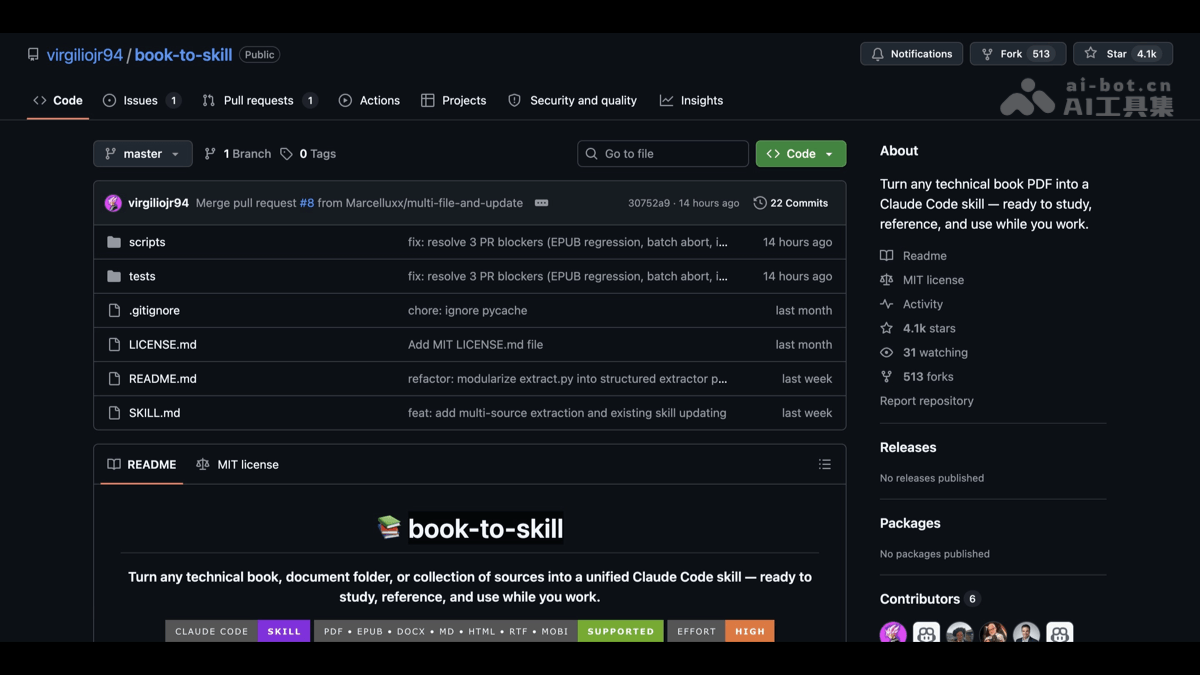
Main features of book-to-skill
-
Multi-format document conversion: Supports common formats such as PDF, EPUB, DOCX, TXT, Markdown, HTML, RTF, MOBI/AZW, converting a single book or an entire document folder into a Claude Code skill
-
Intelligent extraction strategy: Automatically determines the book type (technical with code/tables vs. text-intensive), and selects the corresponding tool (Docling preserves Markdown tables and code blocks; pdftotext quickly extracts plain text)
-
Structured skill generation: Generates
SKILL.md(core mental models + chapter index), separate files split by chapter, a glossary (glossary.md), a pattern table (patterns.md) and a quick reference table (cheatsheet.md) -
On-demand loading mechanism: Chapter files are not all stuffed into the conversation context at once; the corresponding chapter is loaded only when the user asks about a related topic, greatly saving token consumption
-
Deep knowledge extraction: Performs a one-time in-depth analysis of the book, extracting the author's named frameworks, actionable principles, step-by-step techniques, anti-patterns and tone/style, rather than simple summaries or fragment retrieval
-
Multi-source merging and incremental updates: Supports batch merging of multiple files, an entire folder, or glob-matched files into a unified skill, and can also append new material to an existing skill
-
Precise query invocation: After installation, via
/技能名 关键词or/技能名 ch05directly locate the corresponding chapter and answer accurately based on the original content, avoiding AI hallucination -
Controllable token cost: Provides a consumption estimate before the full conversion, supports first choosing the "analyze only" mode to preview the structure, and then deciding whether to generate the complete skill
How to use book-to-skill
-
One-click installation: In a Claude Code session, enter
Install book-to-skill: https://raw.githubusercontent.com/virgiliojr94/book-to-skill/master/SKILL.md, or manually rungit clone https://github.com/virgiliojr94/book-to-skill.git ~/.claude/skills/book-to-skill -
Convert a single book: Enter in Claude Code
/book-to-skill ~/path/to/your-book.pdf, supports multiple formats such as PDF, EPUB, DOCX -
Convert multiple files: Enter
/book-to-skill ~/papers/paper1.pdf ~/notes/export.txt unified-research, merging multiple materials into one unified skill -
Convert an entire folder: Enter
/book-to-skill ~/workspace/project-docs/ project-knowledge, batch process all documents in the folder in supported formats -
Glob batch matching: Enter
/book-to-skill "~/books/*.epub" my-library, batch convert books according to wildcard rules -
Incrementally update a skill: Enter
/book-to-skill ~/articles/new-paper.pdf ~/.claude/skills/project-knowledge, append new material to an existing skill -
Invoke knowledge on demand: After conversion is complete, via
/技能名 关键词(e.g./designing-data-intensive-apps replication) Accurately locate and explain a specific topic -
Deep dive into a specified chapter: via
/技能名 ch05directly load and dive deep into Chapter 5 content, with only that chapter entering the context -
View chapter index: via
/技能名 "what chapters do you have?"query all chapters and frameworks included in this skill -
Select extraction mode: when processing PDFs, follow the prompt to choose "Technical book" (code/table intensive, use Docling) or "Text-intensive" (use pdftotext), to balance accuracy and speed
Core advantages of book-to-skill
-
High-fidelity framework extraction: strictly preserve the author's original naming and precise wording (e.g., extract "The 5 Whys" rather than generalizing to "ask why a few more times"), ensuring the accuracy of the knowledge system.
-
On-demand loading saves tokens: chapter files are stored independently, and the corresponding chapter is loaded only when a related topic is asked, avoiding stuffing the entire book into the context at once and consuming a large amount of context.
-
Zero-hallucination precise answers: answers are based entirely on the actual text content provided by the user, without relying on training data, eliminating hallucination issues for obscure books or specific chapters.
-
Deep structuring rather than fragment retrieval: at "compile time", deeply analyze and extract named frameworks, anti-patterns, and actionable principles, rather than simply vector-retrieving text fragments at query time.
-
Seamless integration into workflows: after installation, call it directly via
/技能名 关键词, turning book knowledge into a real-time reference tool during coding or writing. -
Intelligent format adaptation: automatically identifies technical books (code/table intensive) and text books, and automatically selects the optimal extraction toolchain such as Docling or pdftotext.
Comparison of book-to-skill with similar competing products
| Comparison dimension | book-to-skill | Google NotebookLM | ChatPDF |
|---|---|---|---|
| Core positioning | Compiles books into Claude Code structured Skills, integrating into coding/writing workflows | AI knowledge exploration platform, research assistant and thinking partner | PDF AI chat tool, quickly extracts information |
| Technical approach | Deep analysis at compile time, extracting named frameworks, anti-patterns, and actionable principles | RAG vector retrieval + Gemini synthesis | Semantic indexing + fragment retrieval at query time |
| Knowledge organization | SKILL.md + chapter files + glossary + pattern table + quick reference table | Two-level notebook-source management, supporting 50–300 sources | Single-document or session-level collections, with no structured splitting |
| Context strategy | On-demand loading, with only relevant chapters entering the conversation | Inject retrieved relevant fragments at query time | Inject matched text passages at query time |
| Framework fidelity | High: preserves the author's original naming and precise wording | Medium: synthesized from retrieved fragments, may generalize the wording | Low: relies on retrieved fragments, with no structured extraction |
| Cross-book retrieval | Weak (suitable for deep dives into a single book or related document groups) | Strong (natively supports cross-analysis of 50+ documents) | Weak (single-document or small-file conversations) |
| Derived content | None (focuses on callable knowledge frameworks) | Strong (podcasts, slides, quizzes, mind maps, etc.) | Weak (mainly summaries and Q&A) |
| Integration method | Native Claude Code Skill, invoked via terminal commands | Web + mobile app, can also be packaged as a Claude Skill | Web application, partially supports API |
| Offline/local | Fully local, no internet connection required (except for the Claude API) | Internet connection required, relies on Google services | Internet connection required, cloud processing |
Application scenarios of book-to-skill
-
In-depth study of technical books: Transform thick technical books such as "Designing Data-Intensive Applications" into callable skills, allowing you to look up specific frameworks, algorithms, or anti-patterns at any time via
/技能名 关键词, without having to dig through the PDF. -
Multi-source material integration and management: Batch-merge papers, notes, and exported documents scattered across different folders into a single unified skill, enabling cross-document associative knowledge retrieval.
-
Real-time reference in coding workflows: When writing code in Claude Code, directly call design patterns or best practices from books, making knowledge available instantly along with the workflow, without switching to a browser or note-taking software.
-
Building an internal team knowledge base: Encode a company's internal technical specifications, best practice documents, or training materials as a Skill, so new members can quickly call upon and learn from them through conversation.
-
Handling niche and internal materials: For niche technical reference books, internal documents, or the latest publications that do not exist in Claude's training data, build a zero-hallucination knowledge base based on the original text.
-
Quick review and pre-exam lookup: Use the generated
cheatsheet.mdandglossary.md, through/技能名to quickly locate key terms, decision tables, and chapter highlights, replacing traditional notes.


