
What is ML for Beginners
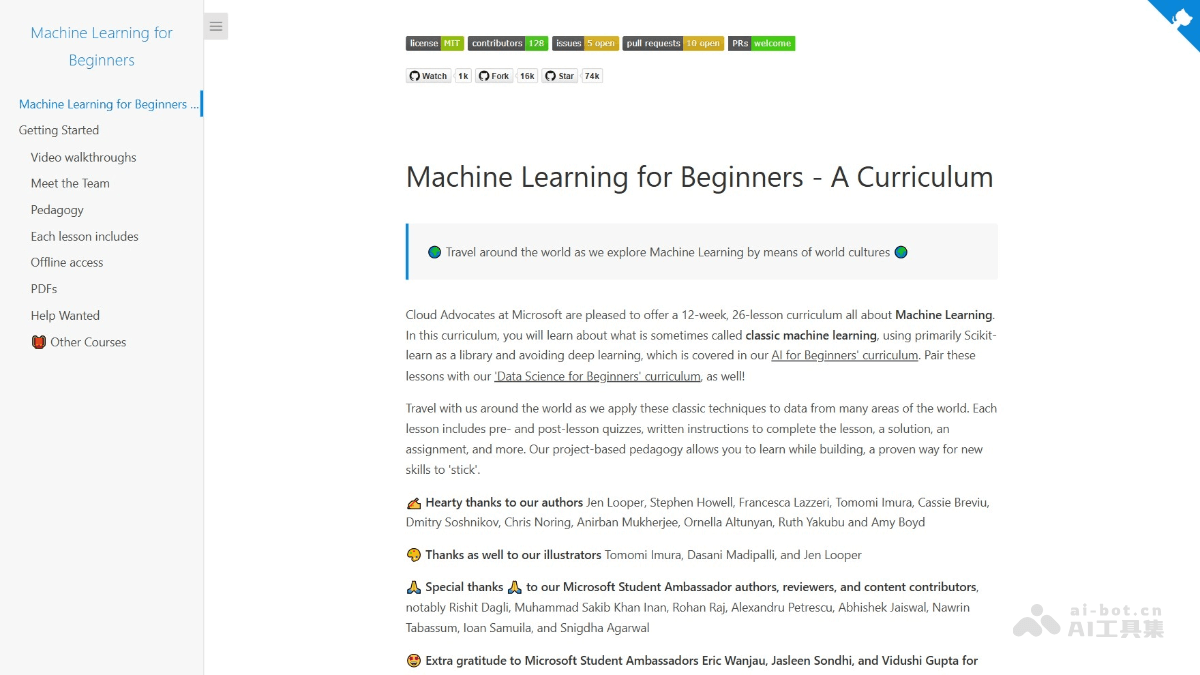
ML for Beginners (Machine Learning for Beginners) is a 12-week machine learning course launched by Microsoft for beginners. ML for Beginners includes 26 lessons covering classic machine learning techniques, mainly using theScikit-learnlibrary. The course combines global cultural data and adopts a project-driven teaching method, with each lesson including a pre-lesson quiz, written instructions, solutions, assignments, etc. The course content progresses from basic concepts to topics such as regression, classification, clustering, and natural language processing. ML for Beginners provides video tutorials, project guides, and quiz applications to help learners master knowledge through practice.
Main features of ML for Beginners
- A systematic learning path: Provides a complete 12-week, 26-lesson learning plan, covering machine learning fundamentals to advanced topics, suitable for beginners to progress step by step.
- Practice-driven: Each lesson includes practical projects and code examples, helping students consolidate knowledge through hands-on practice.
- Interactive learning: Includes pre-quizzes, post-quizzes, and knowledge checks, enhancing learning outcomes through interactive methods.
- Multimedia support: Provides video tutorials, illustrations, and diagrams to assist in understanding complex concepts and improve the learning experience.
- Community support: Features discussion boards and progress assessment tools to promote student communication and self-reflection.
- Flexible learning: Supports running documents and code locally, and provides Python and R language versions to meet different learning needs.
- Extended learning: Links to Microsoft Learn modules and explores real-world applications, providing students with more in-depth learning resources.
ML for Beginners courses
- Introduction to machine learning: Understand the basic concepts, definitions, and application scenarios of machine learning.
- The history of machine learning: Learn about the development history of machine learning and understand its historical background and important milestones.
- Fairness in machine learning: Discuss the philosophical issues of fairness that need to be considered when building and applying machine learning models.
- Machine learning techniques: Understand the techniques and methods machine learning researchers use to build models.
- Introduction to regression analysis: Learn the basics of using Python and Scikit-learn for regression models.
- North American pumpkin prices: Learn data visualization and cleaning to prepare for machine learning.
- North American pumpkin prices: Build linear and polynomial regression models.
- North American pumpkin prices: Build a logistic regression model.
- Web app: Learn how to build a web app to use a trained model.
- Introduction to classification: Learn the basics of data cleaning, visualization, and classification.
- Asian and Indian cuisine: Learn the basics of classifiers.
- Asian and Indian cuisine: Learn more uses of classifiers.
- Asian and Indian cuisine: Use models to build a recommendation system web app.
- Introduction to clustering: Learn the basics of data cleaning, visualization, and clustering.
- Exploring Nigerian Music Taste: Exploring the K-Means clustering method.
- Introduction to Natural Language Processing: Learn the basics of natural language processing by building a simple chatbot.
- Common NLP Tasks: Dive deep into the common tasks required when processing language structure.
- Translation and Sentiment Analysis: Learn translation and sentiment analysis, using the works of Jane Austen as an example.
- European Romantic Hotels: Use hotel reviews for sentiment analysis.
- European Romantic Hotels: Dive deep into sentiment analysis, continuing to use hotel review data.
- Introduction to Time Series Forecasting: Learn the basics of time series forecasting.
- Global Electricity Usage: Use ARIMA for time series forecasting.
- Global Electricity Usage: Use a Support Vector Regressor (SVR) for time series forecasting.
- Introduction to Reinforcement Learning: Learn reinforcement learning using Q-Learning.
- Help Peter Avoid the Wolf: Practice reinforcement learning through a reinforcement learning Gym environment.
- Afterword: Explore the real-world applications of machine learning and learn about model debugging tools.
Application Scenarios of ML for Beginners
- User Interest Clustering: Analyze user interests with the help of clustering algorithms to assist enterprises with precision marketing and product recommendations.
- Sentiment Analysis: Use natural language processing techniques to analyze the sentiment tendencies of text data such as hotel reviews, providing references for businesses to optimize their services.
- Electricity Demand Forecasting: Use time series forecasting models to estimate electricity demand, helping the power sector plan resource allocation reasonably.
- Agent Decision-Making: Use reinforcement learning to train agents so that they can make autonomous decisions in complex environments, such as robot navigation and game AI.
- Medical Diagnosis Assistance: Applied in the medical field to assist doctors in disease diagnosis, improving the accuracy and efficiency of diagnosis.


