

What is Scikit-Learn
Scikit-Learn is a Python machine learning library, widely used in data mining and data analysis. Scikit-Learn provides simple and efficient tools, supports a variety of machine learning algorithms, including classification, regression, clustering, and dimensionality reduction. Scikit-Learn is designed to be concise and easy to use, and integrates seamlessly with scientific computing libraries such as NumPy and SciPy. Scikit-Learn is known for its practicality, high performance, and rich algorithm implementations, suitable for users at all levels from beginners to experts. Scikit-Learn provides detailed documentation and examples to help users get started quickly and solve practical problems.
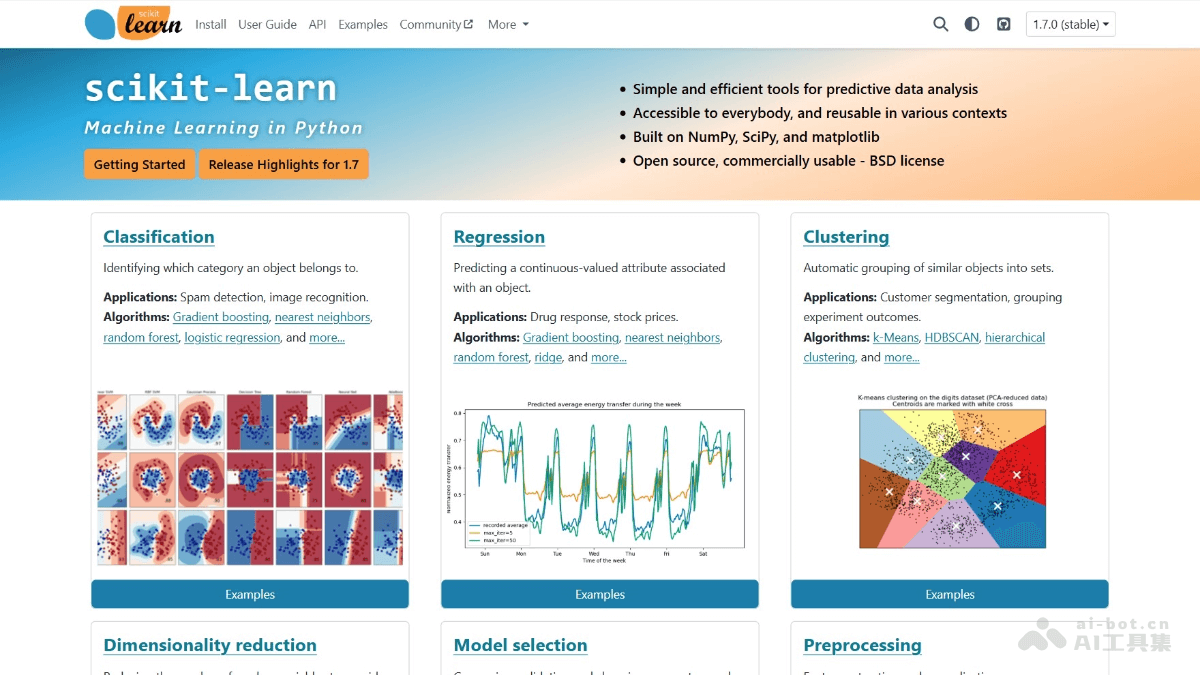
Main features of Scikit-Learn
- Machine learning algorithms: Provides a variety of classification, regression, clustering, and dimensionality reduction algorithms to meet the needs of different machine learning tasks.
- Data preprocessing: Includes tools such as feature scaling, missing value handling, feature encoding, and feature selection to help prepare data for model training.
- Model selection and evaluation: Provides cross-validation, hyperparameter tuning, and performance evaluation tools to help select and optimize models.
- Pipeline: Through pipeline tools, data preprocessing, model training, and evaluation are combined into a complete workflow, simplifying code and improving efficiency.
- Ensemble learning: Provides ensemble learning algorithms such as Bagging, Boosting, and random forests to improve model performance and stability.
- Multi-output and multi-label: Supports multi-output classification and regression tasks, as well as multi-label classification tasks, allowing models to predict multiple target values or categories at the same time.
How to use Scikit-Learn
- Install scikit-learn:
-
- Install using pip:
pip install -U scikit-learn-
- Install using conda:
conda install -c conda-forge scikit-learn- Import necessary modules: In Python, import scikit-learn and related modules (such as NumPy and Pandas) to process data.
import numpy as np
import pandas as pd
from sklearn import datasets
from sklearn.model_selection import train_test_split
from sklearn.preprocessing import StandardScaler
from sklearn.linear_model import LogisticRegression
from sklearn.metrics import accuracy_score, classification_report- Load datasets: scikit-learn provides many built-in datasets, such as the Iris dataset (Iris), the handwritten digits dataset (Digits), etc.
-
- Use built-in datasets:
# 加载鸢尾花数据集
iris = datasets.load_iris()
X = iris.data
y = iris.target-
- Load custom datasets:
# 使用 Pandas 加载 CSV 文件
data = pd.read_csv('your_dataset.csv')
X = data.drop('target_column', axis=1)
y = data['target_column']- Data preprocessing: Before training a model, data usually needs to be preprocessed, such as splitting the training set and test set, standardization, etc.
X_train, X_test, y_train, y_test = train_test_split(X, y, test_size=0.2, random_state=42)- Standardize data:
scaler = StandardScaler()
X_train = scaler.fit_transform(X_train)
X_test = scaler.transform(X_test)- Train the model: Choose an appropriate model and train it. Take logistic regression as an example.
model = LogisticRegression()
model.fit(X_train, y_train)- Model evaluation: Use the test set to evaluate the performance of the model.
y_pred = model.predict(X_test)
accuracy = accuracy_score(y_test, y_pred)
print(f'Accuracy: {accuracy:.2f}')
print(classification_report(y_test, y_pred))- Use the model for prediction: Use the trained model to make predictions on new data.
new_data = np.array([[5.1, 3.5, 1.4, 0.2]])  # 示例新数据
new_data = scaler.transform(new_data)  # 标准化
prediction = model.predict(new_data)
print(f'Prediction: {prediction}')- Save and load models:
- Save model:
import joblib
joblib.dump(model, 'model.pkl')-
- Load model:
model = joblib.load('model.pkl')Application scenarios of Scikit-Learn
- Data mining: Extract valuable information from large amounts of data, for example, discovering natural groupings in data through clustering algorithms.
- Data analysis: Helps conduct exploratory data analysis, for example, using dimensionality reduction algorithms (such as PCA) to visualize high-dimensional data.
- Classification tasks: Suitable for various classification problems, such as spam detection, image classification, disease diagnosis, etc.
- Regression tasks: Used for predicting continuous values, such as house price prediction, stock price prediction, sales volume prediction, etc.
- Cluster analysis: Grouping data based on unsupervised learning algorithms (such as K-means) to discover patterns and structures in the data.

