What is Kaggle
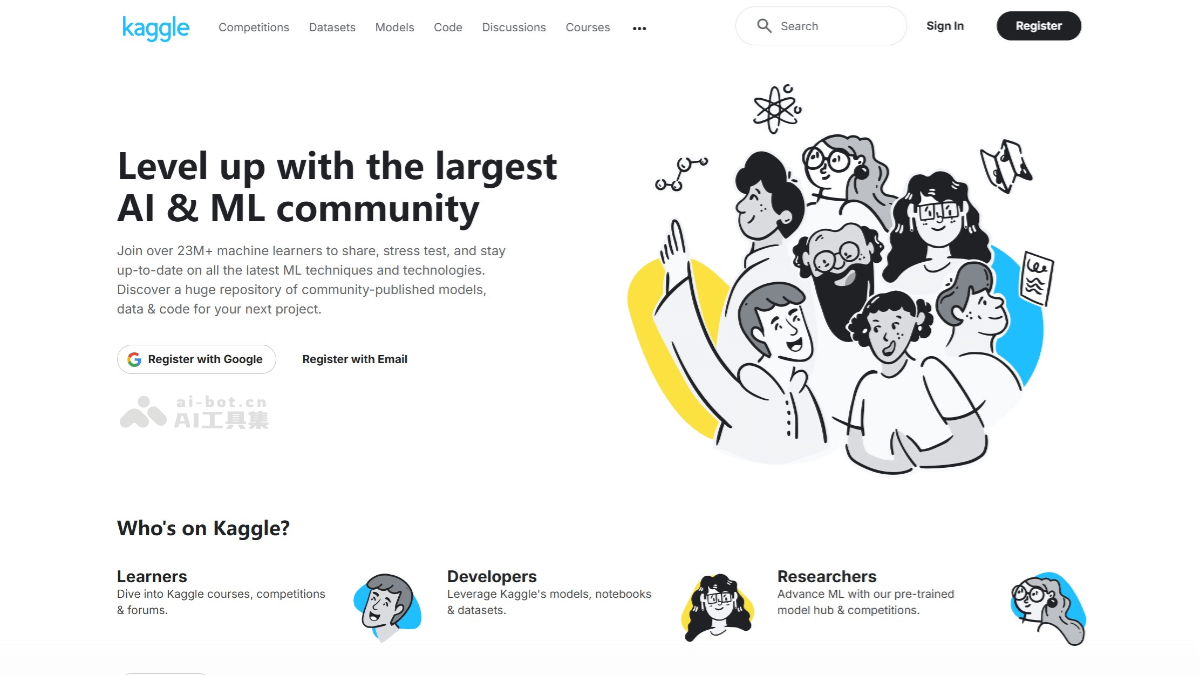
Kaggle is a globally renowned online data science and machine learning community platform, famous for hosting data science competitions that attract data scientists and machine learning enthusiasts from around the world to participate. Kaggle provides a rich resource of datasets, which users can download and use for free for research and learning. Kaggle's online code editor (Kernels) feature supports users in running code in the cloud without the need to configure a local environment, greatly facilitating data science practice. Users can exchange experiences and share knowledge with other data scientists through the forums.
Kaggle's Main Features
- Diverse Competition Types: Kaggle offers multiple types of competitions, including entry-level "Getting Started" competitions, intermediate "Playground" competitions, and advanced "Featured" competitions. The competitions cover different topics and difficulty levels, suitable for data scientists of different skill levels.
- Real-World Project Practice: Competitions are usually initiated by companies or research institutions, providing real datasets and problems, and participants need to solve the problems through data analysis and modeling. This helps participants improve their skills and accumulate practical project experience.
- Prizes and Rewards: Many competitions offer prize money, and winners can receive substantial rewards, which incentivizes data scientists around the world to actively participate.
- Rich Public Datasets: Kaggle has thousands of public datasets covering various fields such as finance, healthcare, social media, etc. Users can download and use these datasets for free for research and learning.
- Dataset Management: Users can upload their own datasets and share them with other users. At the same time, Kaggle provides dataset version control functionality, making it convenient for users to manage dataset updates and maintenance.
- Cloud Runtime Environment: Kaggle provides a powerful online code editor that supports Jupyter Notebook. Users can run code in the cloud without the need to configure a complex local development environment.
- Free GPU Resources: Users can use GPU resources for free to train deep learning models, which greatly lowers the barrier to machine learning practice.
- Code Sharing and Learning: Users can view and run other users' code, and can also share their own code with others. This promotes the sharing and dissemination of knowledge, helping users learn and progress quickly.
- Forums and Discussion Areas: Kaggle has dedicated forums and discussion areas where users can view and participate in related topics under the "Discussions" tab, start new topics to ask questions, or share experiences. This provides users with a platform for communication and learning.
- Team Collaboration: Users can connect with other participants through the forums and even form teams to participate in competitions together. This promotes teamwork and knowledge exchange.
- Tutorials and Courses: Kaggle offers a series of free tutorials and courses covering the fundamentals and advanced skills of data science and machine learning. These tutorials are written by industry experts and are suitable for beginners and advanced learners.
- Competition Analysis: After many competitions end, Kaggle publishes competition analyses and winners' solutions, from which users can learn advanced techniques and methods.
- Competition Publishing: Companies can publish competitions on Kaggle to solve complex data science problems through crowdsourcing. This not only helps companies find solutions but also provides them with opportunities to discover and recruit top data scientists.
Kaggle's official website address
- Official website address:kaggle.com
Kaggle's application scenarios
- Learning and practice: Kaggle is an important tool for data science education. Many universities and online learning platforms use it as a practical platform. By participating in competitions and projects, students can apply theoretical knowledge to real problems and improve their data analysis and machine learning skills.
- Course design: Teachers can use Kaggle's datasets and competition projects to design courses, allowing students to learn and solve problems in a real environment, enhancing the interest and practicality of learning.
- Scientific research projects: Researchers can use Kaggle's datasets and competition platform for scientific research projects. For example, biomedical researchers can use medical datasets on Kaggle to study disease prediction models.
- Algorithm development and validation: Kaggle's competitions provide researchers with opportunities to validate new algorithms and models. By competing with other researchers, the strengths and weaknesses of algorithms can be identified, driving algorithm improvement and development.
- Skill improvement: Individuals can improve their data analysis, machine learning, and programming skills by participating in Kaggle's competitions and projects. Kaggle's online code editor and rich datasets provide a platform for individuals to practice.