

What is Deeplearning4j
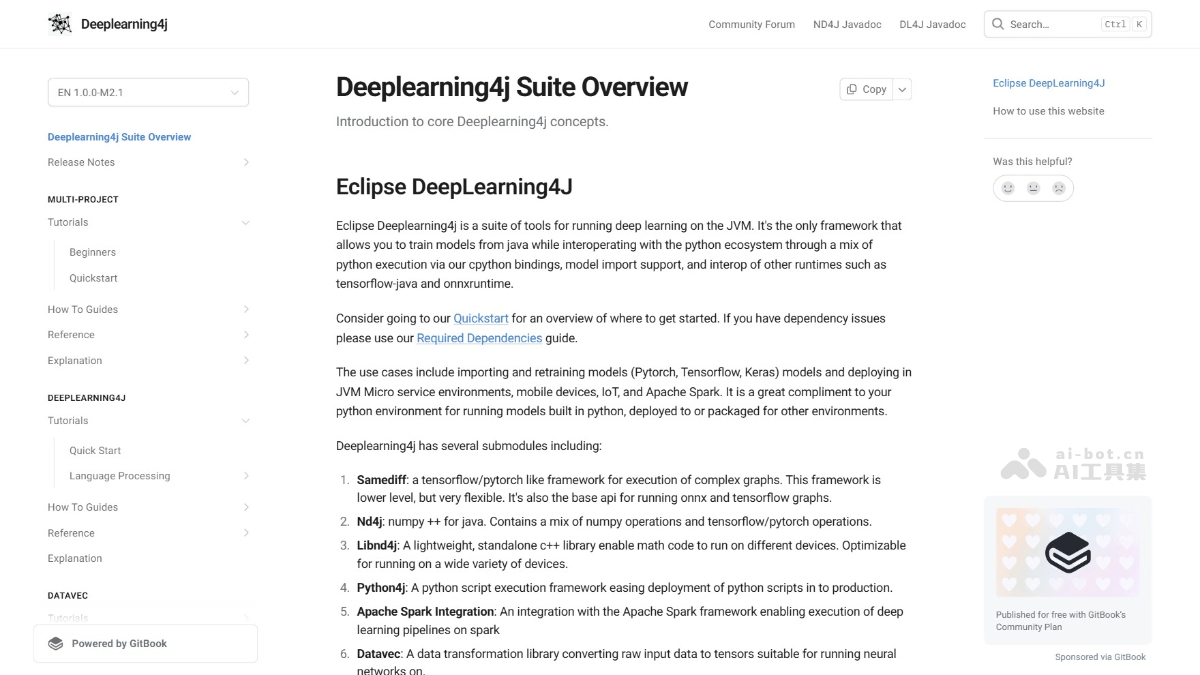
Eclipse Deeplearning4j (DL4J) is an open-source deepmachine learningframework based on the Java Virtual Machine (JVM), designed specifically for Java and Scala developers. Eclipse Deeplearning4j supports training and deploying deep learning models in the Java environment, while also being compatible with the Python ecosystem, and can import and retrain models such as TensorFlow、PyTorch . Eclipse Deeplearning4j includes multiple submodules, such as Samediff (a low-level API similar to TensorFlow/PyTorch), Nd4j (a powerful tensor operation library), Datavec (a data preprocessing tool), and Apache Spark integration, making it suitable for microservices, mobile devices, IoT, and big data environments. Deeplearning4j is open-sourced under the Apache 2.0 license and is managed by the Eclipse Foundation. Deeplearning4j can be used to train models, and the models can perform image classification, object detection, image segmentation, natural language processing, and time series prediction.
Main features of Deeplearning4j
-
Cross-language interoperability: Supports seamless integration of Java, Scala, and Python, and can execute Python scripts through CPython bindings.
-
Model training and deployment: Provides a complete deep learning model training and deployment solution, supporting multi-layer networks and computation graphs.
-
Model import and retraining: Can import and retrain pretrained models from TensorFlow, PyTorch, and Keras.
-
Flexible API: Includes the Samediff module, providing a low-level API similar to TensorFlow and PyTorch, and supporting automatic differentiation.
-
Efficient data processing: Through the Datavec module, supports converting raw data into tensor formats suitable for neural networks.
-
Distributed computing support: Integrates with Apache Spark to support deep learning tasks in large-scale distributed environments.
-
Cross-platform deployment: Supports deploying models in various environments such as JVM microservices, mobile devices, and IoT devices.
-
Low-level optimization: Provides low-level C++ support through Libnd4j, optimizes mathematical operations, and supports a variety of hardware devices.
How to use Deeplearning4j
- Environment preparation:
- Install Java: Deeplearning4j is a JVM-based framework and requires Java to be installed. JDK 11 or later is recommended.
- Set up the development environment: It is recommended to use an IDE that supports Java, such as IntelliJ IDEA or Eclipse, which can help users develop more efficiently.
- Add dependencies: Add the Deeplearning4j dependencies to the project through build tools such as Maven or Gradle.
- Create a project:
- Create a Java project: Create a new Java project in the IDE.
- Import dependencies: Ensure that the Deeplearning4j dependencies are correctly imported into the project.
- Configure and train the model:
- Load data: Use the data loading tools provided by Deeplearning4j (for example,
DataSetIterator) to load the dataset. - Data preprocessing: Use the Datavec module to preprocess the data. Common preprocessing operations include normalization, standardization, etc., which can improve the model's training performance.
- Configure the neural network: Configure the structure of the neural network through the API provided by Deeplearning4j, allowing you to define parameters such as the number of network layers, the number of neurons in each layer, activation functions, and optimizers.
- Train the model: Call the training methods provided by Deeplearning4j (for example,
fitmethod) to train the model. During the training process, monitor the training progress and the model's performance metrics through listeners (for example,ScoreIterationListener).
- Load data: Use the data loading tools provided by Deeplearning4j (for example,
- Evaluate and save the model:
- Evaluate the model: Use the test dataset to evaluate the model's performance. Common evaluation metrics include accuracy, recall, and others.
- Save the model: After training is complete, save the model to a file.
Application scenarios of Deeplearning4j
-
Enterprise application development: Deeplearning4j is designed specifically for the JVM ecosystem, supports Java and Scala, and is suitable for developing deep learning applications in enterprise environments.
-
Model import and retraining: Supports importing models from frameworks such as TensorFlow and PyTorch, and retraining or fine-tuning them in the JVM environment.
-
Microservices and cloud computing: Supports deploying models into JVM microservices, making it suitable for providing high-performance, scalable intelligent services in cloud computing environments.
-
Mobile devices and the Internet of Things: Supports deploying models to mobile devices and Internet of Things devices, enabling edge computing and real-time intelligent decision-making.
-
Big data processing and analysis: Through integration with Apache Spark, it supports deep learning tasks in large-scale distributed environments and is suitable for processing massive amounts of data.

