

What is TensorFlow
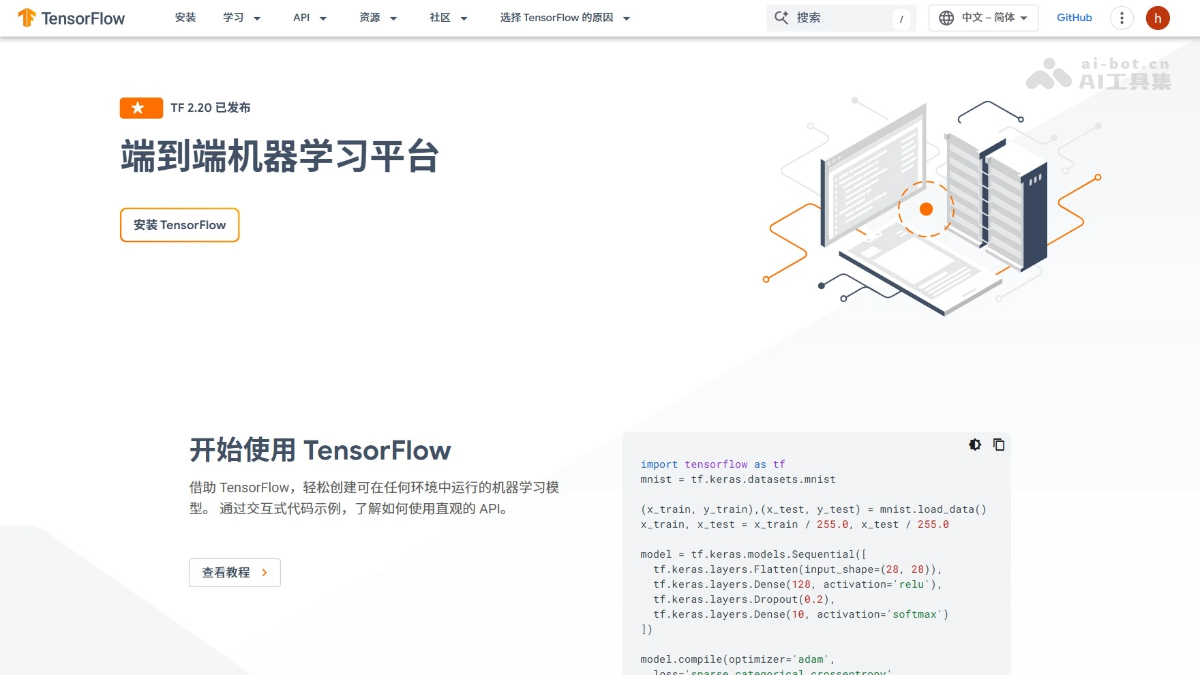
TensorFlow is an open-source machine learning framework launched by Google and is widely used in the field of deep learning. The framework supports multiple programming languages, such as Python and C++, and can efficiently handle large-scale data and build complex models. TensorFlow provides a rich set of APIs and tools, making it convenient for developers to build models from scratch or use pretrained models for transfer learning. TensorFlow supports a variety of application scenarios, including computer vision, natural language processing, and speech recognition. With its flexible architecture and strong community support, TensorFlow has become one of the important tools for artificial intelligence development among developers worldwide.
Main features of TensorFlow
- Flexible computational framework: Through tensor operations and automatic differentiation, TensorFlow provides efficient and flexible computational capabilities, simplifying the process of building and training complex models.
- Multi-platform support: TensorFlow supports multiple operating systems and hardware devices (such as CPU, GPU, and TPU), and provides TensorFlow Lite for model deployment on mobile and embedded systems, offering broad applicability.
- Rich model-building tools: TensorFlow has a built-in Keras API, provides high-level interfaces for quickly building models, and offers a large number of pretrained models to support transfer learning, reducing development difficulty.
- Powerful visualization tools: TensorFlow is equipped with TensorBoard, which can intuitively display various metrics during training and help developers better debug and optimize models.
- Distributed training: TensorFlow supports distributed training across multiple GPUs and multiple machines, greatly improving model training efficiency and suitable for training needs involving large-scale data and complex models.
- Model optimization and deployment: It provides model optimization tools (such as quantization and pruning) and convenient deployment methods to efficiently deploy optimized models to different platforms, improving model practicality and runtime efficiency.
How to use TensorFlow
- Installation and environment configuration:
- Install Python: Ensure that Python is installed on the computer (version 3.8 or above is recommended).
- Install TensorFlow: Install TensorFlow through pip, Python's package management tool. If GPU acceleration is needed, install the GPU-supported version.
- Verify installation: After installation is complete, run simple commands to verify whether TensorFlow was installed successfully and check whether a GPU can be detected (if available).
- Define the model structure: According to the task requirements (such as image recognition, natural language processing, etc.), choose an appropriate model architecture (such as the number of neural network layers, the number of neurons per layer, etc.).
- Configure the training process: Set the loss function (used to measure the gap between model predictions and true values) and the optimizer (used to update model parameters to minimize the loss function).
- Prepare data: Collect and preprocess data, for example, normalizing images and encoding text.
- Train the model: Train the model with training data and adjust model parameters through multiple iterations (Epoch) until model performance reaches expectations.
- Evaluate model performance: Evaluate the model's performance using a validation set or test set, such as accuracy, recall, and other metrics.
- Optimize the model: Adjust the model structure or training parameters based on the evaluation results to improve model performance.
- Model Saving: Save the trained model as a file for convenient subsequent use.
- Model Deployment: Deploy the model to servers, mobile devices, or the cloud for practical applications. TensorFlow provides a variety of tools (such as TensorFlow Serving and TensorFlow Lite) to support model deployment.
TensorFlow's official website address
- Official Website Address:https://www.tensorflow.org/
- GitHub Repository:https://github.com/tensorflow/tensorflow
TensorFlow Application Scenarios
- Computer Vision: TensorFlow is widely used in tasks such as image recognition, object detection, and image segmentation. Through models such as convolutional neural networks (CNN), it efficiently processes and analyzes image data.
- Natural Language Processing: It supports natural language processing tasks such as text classification, sentiment analysis, machine translation, and text generation, using architectures such as recurrent neural networks (RNN) and Transformer to process sequence data.
- Speech Recognition: It is used in speech recognition systems to convert speech into text by processing audio signals, supporting various speech processing tasks such as voice command recognition and speech transcription.
- Reinforcement Learning: It is used to train agents to make optimal decisions in complex environments, and is applied in fields such as robot control and game AI.
- Recommendation Systems: It is used to build recommendation systems, predicting user preferences by analyzing user behavior data to achieve personalized recommendations, such as e-commerce recommendations and content recommendations.

