
What is Qwen3.6-27B
Qwen3.6-27B is a 27-billion-parameter dense multimodal large model open-sourced by Alibaba's Tongyi Qianwen team, and is the only dense-architecture version in the Qwen3.6 series. The model focuses on agentic coding and multimodal reasoning, comprehensively surpassing the previous-generation 397-billion-parameter MoE flagship on coding benchmarks such as SWE-bench and Terminal-Bench Qwen3.5-397B-A17B, supports mixed input of images, video, and text, and can be deployed without MoE routing, greatly lowering the barrier to use for developers.
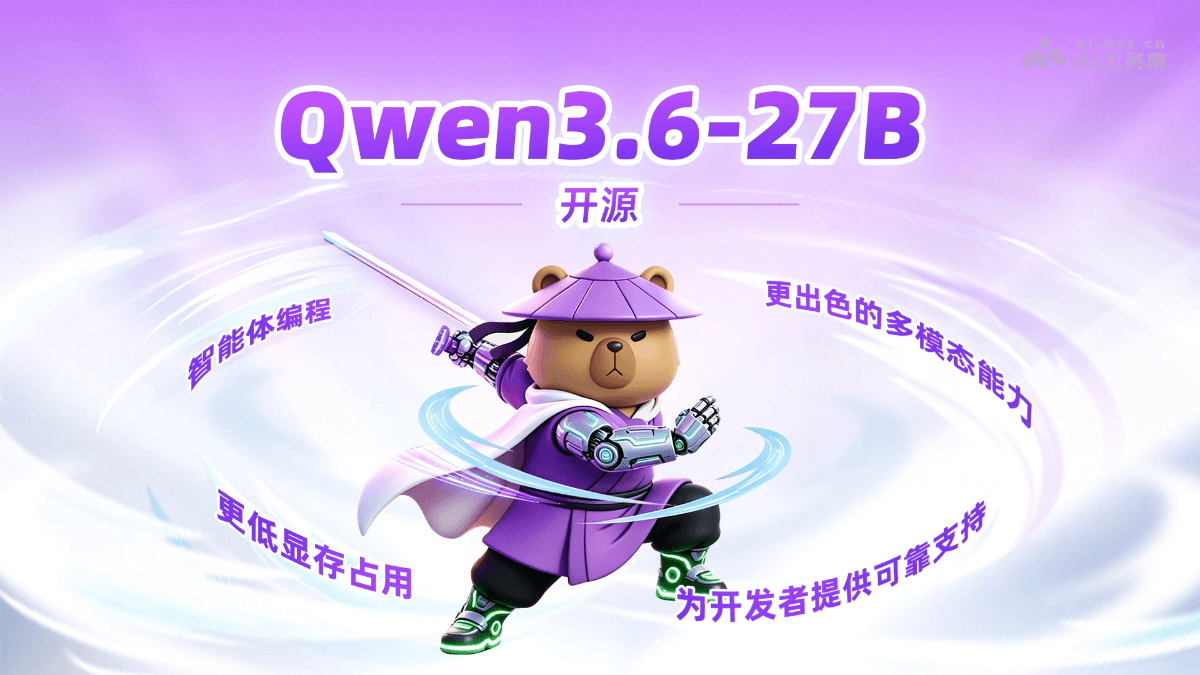
Main Features of Qwen3.6-27B
- Agentic Coding: Supports repository-level code reasoning, front-end workflows, and complex coding tasks, with integration into Claude Code、Claude Code and other mainstream coding assistants.
- Multimodal Understanding: Natively supports mixed input of images, video, and text, covering visual reasoning, in-depth document understanding, and interactive visual question answering.
- Dual-Mode Reasoning: Supports flexible switching between Thinking mode and Non-thinking mode to adapt to different task requirements.
- Chain-of-Thought Retention: Provides the
preserve_thinkingfeature, which can retain the complete reasoning content of previous turns in messages, facilitating iteration on agentic tasks. - Ultra-Long Context: Natively supports 262,144 tokens, expandable to 1,010,000 tokens, meeting long-document processing needs.
Technical Principles of Qwen3.6-27B
-
Dense Architecture: Adopts a fully activated dense architecture with 27 billion parameters. Unlike MoE routing mechanisms, it requires no sparse activation during inference, making deployment more direct and simple.
-
Multimodal Fusion: As a causal language model, it integrates a Vision Encoder to achieve native unified understanding of images, video, and text.
-
Ultra-Long Context Reasoning: Supports a 200K context window in agentic coding evaluations, meeting repository-level code understanding needs.
-
Hybrid Attention Layout: Adopts a hidden-layer design combining Gated DeltaNet and Gated Attention, integrating the advantages of linear attention and standard attention.
How to Use Qwen3.6-27B
- Online Experience: Visit Qwen Studio to interact directly without local deployment.
- Local Deployment
-
Download model weights from Hugging Face (
Qwen/Qwen3.6-27B) or ModelScope. -
Use mainstream frameworks such as vLLM, SGLang, and KTransformers to load and run it.
-
Switch to a domestic download source by setting an environment variable (such as
VLLM_USE_MODELSCOPE=true).
-
- API Calls:Alibaba Cloud Model Studioplatform will soon launch the Qwen3.6-27B API service, supporting the
preserve_thinkingparameter. - Coding Assistant Integration: Connect the model to OpenClaw, Claude Code, or Qwen Code to enable context-aware coding assistance.
Key Information and Usage Requirements for Qwen3.6-27B
-
Release Date: April 22, 2026
-
Model Specifications: 27 billion parameters, dense architecture (Dense)
-
Open-Source License:Apache 2.0
-
Context Length: API configuration supports 131072 tokens, and evaluation scenarios support a 200K context window
-
Hardware Requirements: Deployable locally on a single or dual high-end GPU
-
Multimodal support: Mixed input of images, video, and text
-
API service: Coming soon to Alibaba Cloud Model Studio, with access supported in the Beijing, Singapore, and US regions
-
Coding assistant compatibility: Supports OpenClaw (Node.js 22+), Claude Code, and Qwen Code (Node.js 20+)
Core advantages of Qwen3.6-27B
-
Punching above its weight: The 27-billion-parameter dense model comprehensively surpasses the previous-generation flagship, a 397-billion-parameter MoE 15 times its size, on coding benchmarks.
-
Deployment-friendly: The dense architecture requires no MoE routing, offering higher inference efficiency and significantly lowering the barrier to local deployment.
-
Flagship-level coding capability: SWE-bench Verified 77.2, Terminal-Bench 2.0 59.3, and SkillsBench 48.2, all substantially ahead of the previous generation and models of the same scale.
-
Aligned multimodal capability: Vision-language processing capability is consistent with Qwen3.6-35B-A3B, supporting both thinking and non-thinking modes.
Project addresses for Qwen3.6-27B
- Project official website:https://qwen.ai/blog?id=qwen3.6-27b
- HuggingFace model repository:https://huggingface.co/Qwen/Qwen3.6-27B
Comparison of Qwen3.6-27B with similar competing products
| Dimension | Qwen3.6-27B | Qwen3.5-397B-A17B | Gemma4-31B |
|---|---|---|---|
| Architecture | Dense (27B) | MoE(397B/17B) | Dense (31B) |
| SWE-bench Verified | 77.2 | 76.2 | 52.0 |
| Terminal-Bench 2.0 | 59.3 | 52.5 | 42.9 |
| SkillsBench | 48.2 | 30.0 | 23.6 |
| Multimodal | Native support | Native support | Native support |
| Deployment difficulty | Low | High | Medium |
| Open-source license | Apache 2.0 | Apache 2.0 | Apache 2.0 |
Application scenarios for Qwen3.6-27B
-
AI-assisted programming: Provides developers with repository-level code understanding, bug fixing, and front-end development support to improve coding efficiency.
-
Agent development: Serves as the core brain of an Agent, executing complex multi-step tasks and tool calls to build automated workflows.
-
Intelligent document processing: Based on ultra-long context capability, performs in-depth document analysis, long report summarization, and cross-page information extraction.
-
Visual question answering system: Handles mixed text-and-image content, enabling chart understanding, video analysis, and interactive visual dialogue.
-
Enterprise local deployment: In data-privacy-sensitive scenarios, enables secure and controllable private AI services through open-source weights.