
What is Qwen3.5
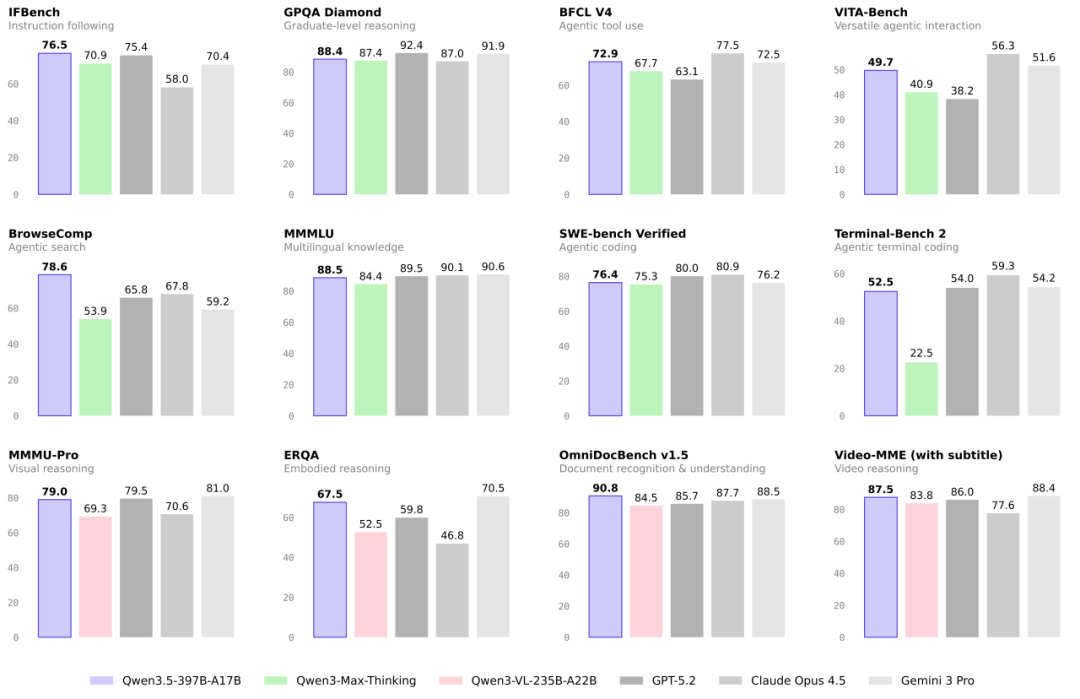
Qwen3.5 is a new-generation native multimodal large model officially released and open-sourced by the Alibaba Tongyi Qianwen team. The first open-source version, Qwen3.5-397B-A17B, adopts an innovative hybrid architecture that combines linear attention (Gated Delta Networks) with sparse Mixture of Experts (MoE). It has a total of 397 billion parameters but activates only 17 billion parameters per inference, achieving "winning big with small"—its performance surpasses the trillion-parameter Qwen3-Max, deployment VRAM is reduced by 60%, and inference throughput is increased by up to 19 times. As a native vision-language model, through early text-vision fusion, M-RoPE, and 3D position encoding technologies, it uniformly handles text, image, and video tasks, and language support has expanded from 119 to 201 languages. In multiple authoritative benchmarks, Qwen3.5 scores 87.8 on MMLU-Pro, surpassing GPT-5.2; 88.4 on GPQA, higher than Claude 4.5; and its IFBench instruction-following score of 76.5 sets a new historical record. API pricing is only 0.8 yuan per million tokens, 1/18 that of Gemini 3 Pro. Developers can obtain model weights and APIs through the ModelScope community, HuggingFace, or Alibaba Cloud Bailian.
Alibaba Qianwen launches smaller Qwen3.5 models: 0.8B / 2B / 4B / 9B. The entire series is based on the unified Qwen3.5 foundation, open-sourced under Apache 2.0 for commercial use, supports LoRA/full fine-tuning, and can launch task adaptation on consumer-grade GPUs, enabling low-cost deployment in vertical scenarios. 0.8B/2B are suitable for mobile devices and IoT edge deployment; 4B is positioned as a lightweight Agent foundation; 9B performance rivals gpt-oss-120B.
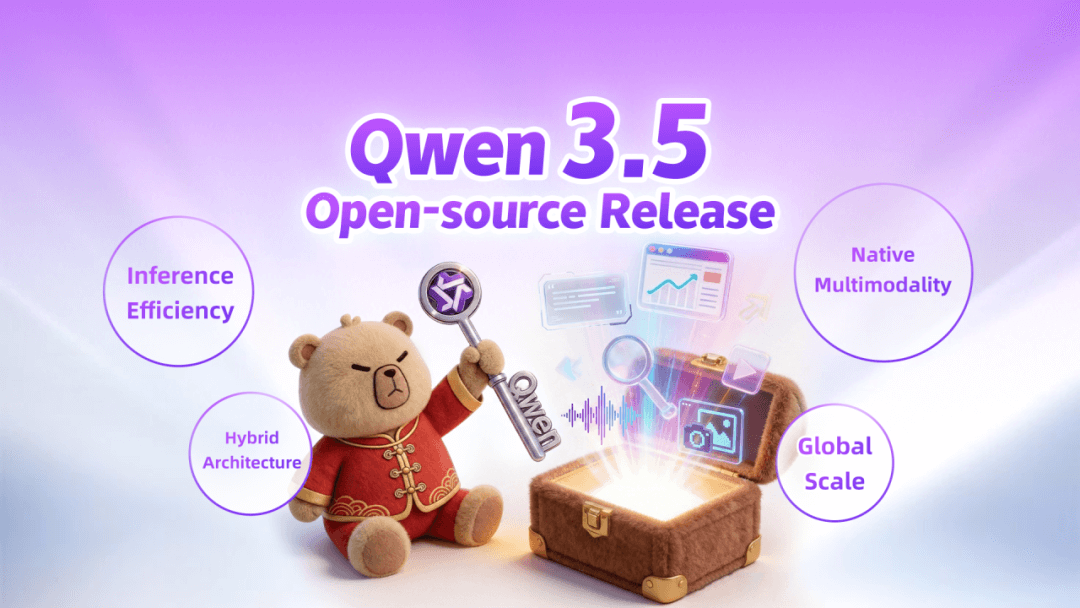
Qwen3.5's Main Features
-
Native Multimodal Understanding: uniformly processes text, images, and video, enabling cross-modal reasoning through early vision-language fusion.
-
Agent Capabilities: supports tool calling, task planning, and execution, with excellent performance in Agent benchmarks such as BFCL-V4.
-
Efficient Inference Architecture: adopts a Gated DeltaNet+MoE hybrid design, achieving top-tier performance with only 17B activated out of 397B parameters.
-
Long Context Processing: supports up to 1M context length, and decoding throughput in 256K scenarios is 19 times that of the previous generation.
-
Multilingual Support: covers 201 languages and dialects, with the vocabulary expanded to 250,000 and encoding efficiency improved by 10-60%.
-
Code Generation: possesses strong programming capabilities, supporting multilingual code writing, debugging, and complex project development.
-
Visual Recognition: fine-grained image understanding, object detection, OCR document parsing, and spatial relationship reasoning.
-
Search Enhancement: integrates search Agent capabilities such as BrowseComp to achieve online information retrieval and integration.
Qwen3.5's Technical Principles
-
Hybrid Attention Architecture: integrates Gated DeltaNet linear attention with Gated Attention sparse attention to achieve adaptive allocation of computational resources.
-
MoE Sparse Activation: total parameters of 397B with only 17B activated (about 4.3%), reducing inference cost through 1 shared expert + 512 routed experts (10 activated each time).
-
Gating Mechanism Optimization: adopts head-specific sigmoid gating to replace traditional softmax attention; this work won the 2025 NeurIPS Best Paper Award.
-
Native Multimodal Fusion: uses M-RoPE and 3D position encoding to natively embed spatiotemporal information into the LLM, achieving early vision-language fusion.
-
Heterogeneous Training Framework: Decoupled parallel strategy for vision and language components, sparse activation enables cross-module computation overlap, training throughput approaches pure-text baseline.
-
FP8 Mixed Precision: Native FP8 pipeline uses low precision for activations, MoE routing, and GEMM, while sensitive layers remain in BF16, reducing VRAM by over 50%.
-
Asynchronous Reinforcement Learning: Builds a scalable asynchronous RL framework supporting full-size models, enabling training-inference separation and dynamic load balancing, with 3-5x end-to-end acceleration.
Qwen3.5 Project Address
- Hugging Face Model Repository:https://huggingface.co/collections/Qwen/qwen35
- GitHub Repository:https://github.com/QwenLM/Qwen3.5
How to Use Qwen3.5
-
Web Experience: Visit Qwen Chat or download the Qwen APP/PC client to directly input text or upload images/videos for multimodal interaction.
-
API Access: Obtain an API key through the Alibaba Cloud Model Studio platform to access model services at a low price of 0.8 yuan per million tokens.
-
Local Deployment: Download the open-source weights Qwen3.5-397B-A17B from HuggingFace or ModelScope, and deploy and run them locally or in a private cloud environment.
-
Agent Development: Leverage the model's native Agent capabilities, combined with tool-calling interfaces, to develop applications such as automated task execution and data analysis.
-
Multilingual Applications: Directly input any of the 201 supported languages for conversation, with no need for an additional translation module.
-
Long Document Processing: Upload very long text, PDFs, or videos, and the model automatically handles complex reasoning tasks with up to 1M context.
Qwen3.5 Model Pricing
-
Input Price: Only 0.8 yuan per million tokens, one of the lowest prices among the world's top models
-
Price Comparison: Only 1/18 of Gemini 3 Pro and 1/15 of GPT-5.2, with a significant cost-performance advantage
-
Open Source and Free: The Qwen3.5-397B-A17B model weights are fully open source, and developers can download them for free for local deployment
Qwen3.5 Application Scenarios
-
Intelligent Customer Service: Supports multi-turn conversations and complex question answering in 201 languages, suitable for customer service systems of global enterprises.
-
Content Creation: Assists with copywriting, video script generation, multilingual translation, and localized content adaptation.
-
Code Development: Provides code generation, debugging, and refactoring services, supporting the development and maintenance of complex software projects.
-
Visual Analysis: Enables image recognition, document OCR, video content understanding, and fine-grained visual question answering.
-
Agent Automation: Builds automated workflows to execute Agent tasks such as data analysis, information retrieval, and task scheduling.
-
Educational Assistance: Supports multilingual teaching, homework grading, personalized learning path planning, and knowledge question answering.