
What is Ponytail
Ponytail is an open-source AI Agent code reduction plugin that, by injecting into Claude Code、Codex、Cursor and 10+ mainstream AI coding tools the minimalist mindset of a "senior lazy developer," forces the Agent to judge necessity through a six-step ladder before writing code, reducing code volume by 80-94%, cutting invocation costs by 47-77%, and improving runtime speed by 3-6x.
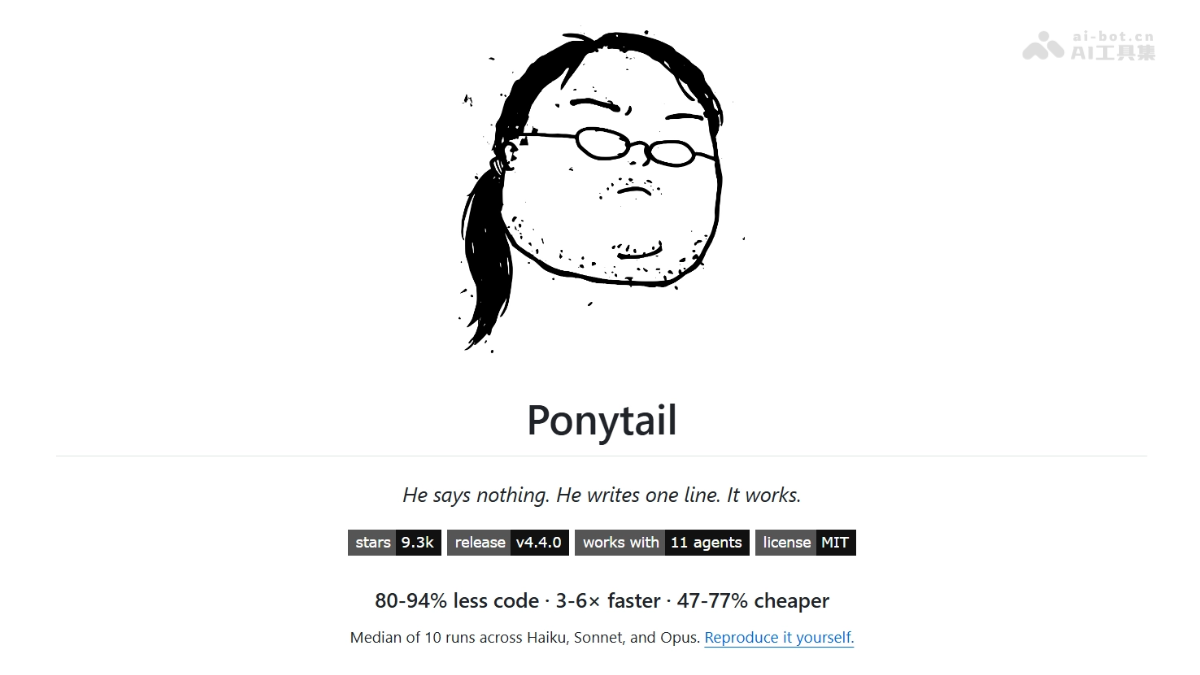
Ponytail's main features
-
Six-step decision ladder: Before writing code, forces the selection of a solution in the order of "YAGNI → standard library → native platform → existing dependencies → one-liner → minimal implementation."
-
Four-level intensity modes: Provides
lite/full/ultra/offfour levels of reduction intensity, adjustable as needed. -
Code review commands:
/ponytail-reviewreviews the current diff for deletable content,/ponytail-auditaudits the entire repository,/ponytail-debtcollects technical debt for deferred optimization. -
Cross-platform plugin: Supports Claude Code, Codex, OpenCode, Gemini CLI, Cursor, Windsurf, Copilot, Pi Agent and other tools with install-and-use readiness.

Follow WeChat and reply "open source" to joinAI Open Source Project Exchange Group
How to use Ponytail
- Claude Code: Execute
/plugin marketplace add DietrichGebert/ponytail→/plugin install ponytail@ponytail, automatically activated for each session after installation. - Codex: Execute
codex plugin marketplace add DietrichGebert/ponytail, in/pluginsinstall and trust lifecycle hooks. - Gemini CLI: Execute
gemini extensions install https://github.com/DietrichGebert/ponytail, the rule set is loaded as always-on context. - Cursor / Windsurf / Copilot: Copy the corresponding rule file from the repository to
.cursor/rules/、.windsurf/rules/、.github/copilot-instructions.mdto take effect. - OpenCode: In
opencode.jsonadd{ "plugin": ["./.opencode/plugins/ponytail.mjs"] }and load AGENTS.md.
Ponytail's core advantages
-
Sharp reduction in code volume: Median reduction of 80-94%, for example replacing an entire flatpickr wrapper with native
<input type="date">. -
Both cost and speed advantages: Token consumption reduced by 47-77%, response speed improved by 3-6x, verified on Haiku/Sonnet/Opus.
-
Zero-config plug-and-play: No configuration file needed, effective with one command or by copying a file, supporting 10+ mainstream Agent platforms.
-
Safety bottom line preserved: Trust boundary validation, data loss handling, security and accessibility are never compromised.
-
Auditable and traceable:
ponytail:comments mark every reduced path and upgrade option, facilitating team retrospectives.
Ponytail's project address
- GitHub repository:https://github.com/DietrichGebert/ponytail
Comparison of Ponytail with similar competitors
| Dimension | Ponytail | Caveman |
|---|---|---|
| Positioning | AI code reduction rule set plugin | Code optimization and reduction plugin (control group) |
| Core goal | Reduce code volume and over-engineering, enforce a six-step decision ladder | Streamline code output, reduce redundancy |
| Decision mechanism | Six-step ladder: YAGNI → standard library → native platform → existing dependencies → one-liner → minimal implementation | Specific decision process not disclosed |
| Installation method | Plugin marketplace installation / copy rule file | Plugin installation |
| Intensity adjustment | Four levels: lite / full / ultra / off | No explicit grading |
| Review commands | /ponytail-review Review diff,/ponytail-audit audit the entire repository,/ponytail-debt collect technical debt |
No native review commands |
| Effectiveness data | Reduces code volume by 80-94%, lowers costs by 47-77%, speeds up by 3-6x | As a control group, effectiveness is weaker than Ponytail |
| Cross-platform | Supports 10+ tools including Claude Code, Codex, Cursor, Windsurf, Copilot, Gemini CLI, etc. | Limited support scope |
Ponytail's application scenarios
-
Rapid prototyping: When an Agent generates an MVP, it automatically removes redundant dependencies and replaces third-party libraries with native capabilities, shortening startup time.
-
Legacy code slimming: Integrates with existing projects to audit the entire repository, identifying and cleaning up overly encapsulated "scaffolding" and duplicate wheels.
-
Teaching and code review: Injected as a team coding standard, it unifies a "minimalism-first" engineering culture and prevents junior developers from over-engineering.
-
Low-cost AI programming: In token-billing scenarios, it significantly reduces API overhead and speeds up iteration, making it suitable for high-frequency invocation environments.