
What is Nano Banana 2.1
Nano Banana 2.1 (gemini-nano-banana-2.1) is a new-generationimage generationand conversational editing model from Google DeepMind, part of the Gemini 3 series, built on Gemini 3.6 Flash. Nano Banana 2.1 supports 1K/2K/4K output and fusion of up to 14 reference images; its core improvements focus on design completeness, mask-based local editing, multi-character consistency, and natural-looking images, with infographic factuality greatly enhanced. Nano Banana 2.1 is integrated into Gemini App、AI Studio, API and other platforms, targeting professional visual production scenarios.
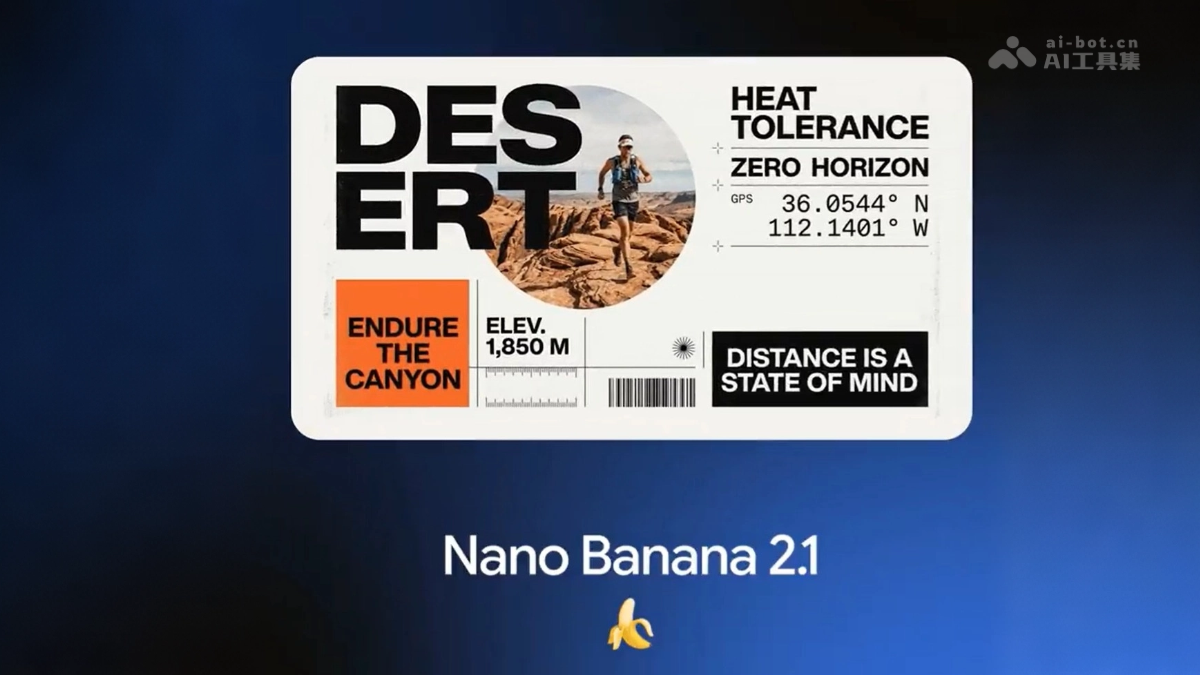
Main Features of Nano Banana 2.1
-
Text-to-Image (T2I): Generate high-quality images from text prompts, with support for 1K, 2K, and 4K resolution output.
-
Conversational Image Editing: Modify images through natural language instructions, iterating repeatedly until satisfied.
-
Mask/Scribble Local Editing: Select or paint a specified region for precise modification while keeping the rest of the image unchanged.
-
Multi-Image Fusion: Accept up to 14 reference images, supporting multiple characters and products retaining their respective features in the same image.
-
Infographics and Text Rendering: Generate posters, charts, and complex layout designs with clear text, supporting multilingual localized text.
-
Knowledge-Enhanced Generation: Leverage Gemini's world knowledge and combine it with Google Search for grounding, generating factually accurate educational illustrations and real objects.
-
Wide/Ultra-Wide Formats: Optimized tiling artifacts for aspect ratios such as 1:4, 4:1, 1:8, and 8:1.
Technical Principles of Nano Banana 2.1
- Native Multimodal Architecture: Nano Banana 2.1 is based on Gemini 3.6 Flash and belongs to the Gemini 3 series of native multimodal reasoning models, capable of understanding text and image inputs within the same model and jointly generating image and text outputs.
- 1M Long Context and Multi-Image Reasoning: The model has a context window of up to 1M tokens, able to simultaneously process large numbers of reference images, documents, and instructions, and on this basis perform consistent reasoning and composition for multiple characters and products.
- Thinking Reasoning Mode: Nano Banana 2.1 offers two modes, Thinking and No Thinking; when Thinking is enabled, the model first explicitly reasons and plans the design requirements, layout structure, and editing constraints before executing generation, thus scoring significantly higher on infographic design, factuality, and overall preference.
- Mask-Constrained Local Editing Mechanism: In Mask/Ink-Based Editing, the model must simultaneously understand the region range specified by the mask and the constraints of the preserved region, achieving "only change what should be changed" through spatial localization and attention control, with an evaluation score of 1049.
- Knowledge Grounding and Factuality Assurance: The model can invoke Gemini's real-time world knowledge, combined with Google Web Search and Image Search for retrieval grounding, organizing the retrieved real information into visual structures, making its infographic factuality score (0.521) far exceed Nano Banana 2.
How to Use Nano Banana 2.1
- Choose an Entry Point: Can be used through the Gemini App,Google AI Studio、Gemini API、Google Flow or products such as Stitch; developers can call the model ID in the API
gemini-nano-banana-2.1。 - (Developers) Get the API key: Go to Google AI Studio to apply for an API Key.
- Enter a prompt: Describe the image you want to generate or modify in natural language, such as "generate a Swiss-style vintage poster".
- (Optional) Upload reference images: You can upload up to 14 reference images for consistent fusion of multiple characters and products or for image editing.
- (Editing scenarios) Specify the modification area: You can circle a mask or scribble to mark the area that needs to be modified, while requiring other parts to remain unchanged.
- Enable Thinking (optional): For high-precision tasks such as infographics and complex layouts, enabling Thinking mode provides better reasoning and factuality.
- Multi-round iteration: Continue giving modification instructions through conversation, adjusting repeatedly until satisfied.
- Export the result: Choose 1K/2K/4K resolution to output the image, and comply with Gemini's terms of use and content safety policies.
Core advantages of Nano Banana 2.1
-
Professional-grade design sense: Infographic Design Elo reaches 1048, capable of consistently producing finished graphic designs with complete layout, typography, and hierarchy.
-
Precise local editing: Mask/Ink-Based Editing scores 1049, allowing precise modification of circled areas while keeping the subject's position, size, and the rest of the image unchanged, approaching Photoshop-like deterministic control.
-
Outstanding multi-subject consistency: Multi-character consistency reaches 1106, supports fusion of up to 14 reference images, so that characters and products do not change faces in continuous generation and combined scenes.
-
Far ahead in factuality: Infographic Factuality reaches 0.521, combined with Gemini world knowledge and Google search grounding, suitable for educational illustrations and real-object generation.
-
More natural and realistic visuals: At 1K/2K/4K resolution, materials, lighting, and spatial details are closer to real photography, noticeably reducing the "AI feel" of traditional generated images.
Comparison of Nano Banana 2.1 with similar competitors
| Comparison dimension | Nano Banana 2.1(Google DeepMind) | ChatGPT Images 2.5(OpenAI) |
|---|---|---|
| Underlying architecture | A native multimodal model based on Gemini 3.6 Flash, with a 1M token long context and 4K token image output | The GPT Image 2.5 family's dual-model architecture: Flare (fast version) and Sunburst (precision version) share the same underlying architecture, with a prompt window of up to 20,000 characters |
| Core positioning | High-efficiency generation + conversational editing + knowledge grounding, oriented toward professional design production | Shifting from "generation" to "precise editing," making editability a default capability, approaching designers' "layer editing" mental model |
| Generation capability | Text-to-image, 1K/2K/4K output, knowledge-enhanced infographics, localized multilingual text rendering | 1K/2K/4K native resolution tiers, maximum side 3840px, supports aspect ratios from 1:3 to 3:1, native transparent background (PNG/WebP) |
| Editing capability highlights | Mask/doodle local editing Elo 1049, multi-character consistency 1106 | "Only change the parts you specify, keep the rest as-is"; previously confirmed edits are unlikely to degrade during multi-turn editing, with industry-best subject fidelity |
| Multi-image processing | Up to 14 reference images, multi-character and multi-product consistency | Up to 16 reference images, supports mask-limited editing scope |
| Knowledge grounding | Leverages Gemini world knowledge + Google Search, infographic factuality 0.521 | No real-time search grounding, but 2.5 infographic accuracy and layout improve measurably |
Application scenarios of Nano Banana 2.1
-
Advertising and marketing material design: Quickly generate posters, social media graphics, e-commerce visuals, and UI mockups. The model can autonomously handle layout, fonts, color blocks, and information hierarchy, directly producing near-finished visual drafts.
-
E-commerce product visuals: Reposition product images into different scenes or combine multiple products while keeping product appearance consistent, producing product display images and advertising images in batches at low cost.
-
Character and persona content creation: Using multi-character consistency capabilities, combine multiple model reference images into fashion editorials, or have the same character appear continuously across sequential images. Suitable for character stories, virtual idols, and narrative visual content.
-
Education and infographics: Leverages Gemini world knowledge combined with search grounding to generate factually accurate educational illustrations, knowledge posters, and complex charts such as Earth's structure and cloud classification.