
What is Gemini 3.6 Flash
Gemini 3.6 Flash is Google DeepMind's latest flagship workhorse model, positioned for large-scale AI Agent scenarios. Compared to Gemini 3.5 Flash, output tokens are reduced by 17%, the price drops to $7.5 per million tokens, the coding benchmark DeepSWE improves from 37% to 49%, and MLE-Bench rises from 49.7% to 63.9%. At the same time, coding, knowledge work, and computer operation capabilities are comprehensively improved, with the built-in Computer Use tool, and it is now open to developers, enterprises, and general users.
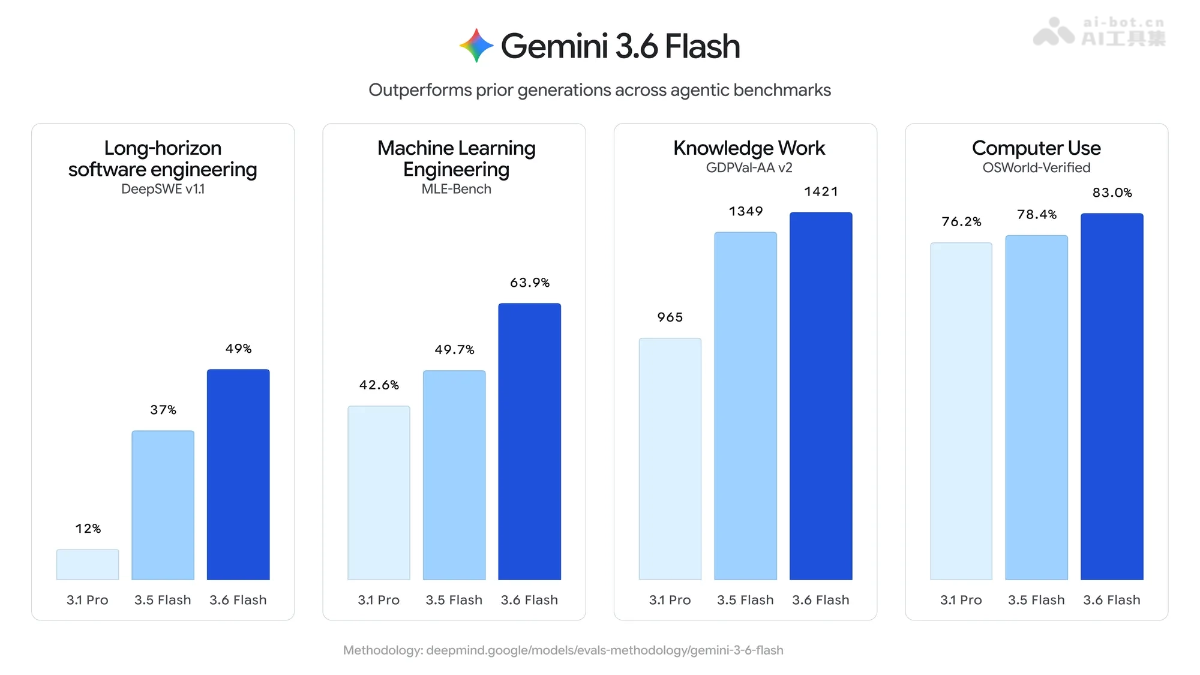
Main Features of Gemini 3.6 Flash
-
Workhorse model: Positioned as a workhorse, specifically optimized for large-scale AI Agent scenarios, with 17% fewer output tokens than 3.5 Flash and a thinner bill.
-
Upgraded coding capabilities: DeepSWE improves from 37% to 49%, MLE-Bench rises from 49.7% to 63.9%, and generated code is closer to production environments.
-
Built-in computer operation: OSWorld-Verified rises from 78.4% to 83%, and "Computer Use" becomes an out-of-the-box tool for the API and enterprise edition.
-
Enhanced knowledge work: GDPval-AA v2 rises from 1349 to 1421, with outstanding performance in multimodal tasks such as document parsing, chart analysis, and report drafting.
-
Security upgrade: Frontier Safety protections are strengthened, with a focus on guarding against CBRN and cyberattack abuse, and stronger jailbreak resistance.
Technical Principles of Gemini 3.6 Flash
- Token efficiency optimization: By improving reasoning strategies, the model reduces unnecessary intermediate output when executing multi-step tasks. In DeepSWE scenarios, output tokens can be saved by 65%, completing more effective work at the same cost.
- Streamlined Agent architecture: Optimizes the tool-calling chain, reduces the number of reasoning steps and execution loop length, makes code generation better meet production environment requirements, and reduces redundant changes.
- Strengthened safety alignment: Deploys an upgraded version of Frontier Safety protections, conducts targeted alignment for two types of abuse scenarios, CBRN and cyberattacks, and enhances jailbreak resistance while reducing false refusals of normal requests.
How to Use Gemini 3.6 Flash
-
Gemini App: Open the Gemini app, and select "3.6 Flash" from the model dropdown menu to use it.
-
Google AI Studio: Log in to studio, and switch to 3.6 Flash in the model selector for development and testing.
-
API calls: Specify the model name through the Gemini API as
gemini-3.6-flash, with input priced at $1.5 per million tokens and output at $7.5 per million tokens. -
Enterprise edition: Workspace and Cloud enterprise users can enable it directly in the console, and the Computer Use tool is ready to use out of the box.
Core Advantages of Gemini 3.6 Flash
-
More economical: Output tokens are reduced by 17%, and in DeepSWE scenarios by as much as 65%, lowering the cost per task.
-
Faster: Fewer reasoning steps and tool calls improve response speed.
-
Stronger: Comprehensively surpasses the previous generation on Agent benchmarks such as coding, machine learning engineering, computer operation, and knowledge work.
-
Cheaper: Output price drops from $9 to $7.5 per million tokens, further improving cost-effectiveness.
-
Safer: Upgraded Frontier Safety protections enhance jailbreak resistance and reduce false refusals.
Competitor comparison of Gemini 3.6 Flash
| Dimension | Gemini 3.6 Flash | GPT-5.6 Luna |
|---|---|---|
| Input price | $1.5 per million tokens | $1.0 per million tokens |
| Output price | $7.5 per million tokens | $6.0 per million tokens |
| SWE-Bench Pro | 58.7% | 62.7% |
| DeepSWE v1.1 | 49% | 67% |
| Terminal-Bench 2.1 | 78.0% | 84.7% |
| MLE-Bench | 63.9% | 47.6% |
| OSWorld-Verified | 83.0% | 72.6% |
| GDPval-AA v2 | 1421 | 1584 |
Application scenarios of Gemini 3.6 Flash
-
Software development: Developers can leverage its enhanced coding capabilities to complete long-horizon software engineering tasks, automated code review, and test script generation.
-
Machine learning research: Researchers can use it to assist with model training, experiment design, and data analysis in MLE-Bench-style tasks.
-
Intelligent document processing: Enterprise users can perform multimodal parsing, chart extraction, and automatic report drafting on massive contracts, financial reports, and research reports.
-
Computer automation: Through the built-in Computer Use tool, it can automatically operate browsers, fill out forms, and perform system-level repetitive tasks.
-
Enterprise knowledge work: It can be embedded into toolchains such as Figma and JetBrains to assist with design iteration, code completion, and e-commerce data feature extraction.